Odd and even numbers worksheet for Year 2: Odd or even?
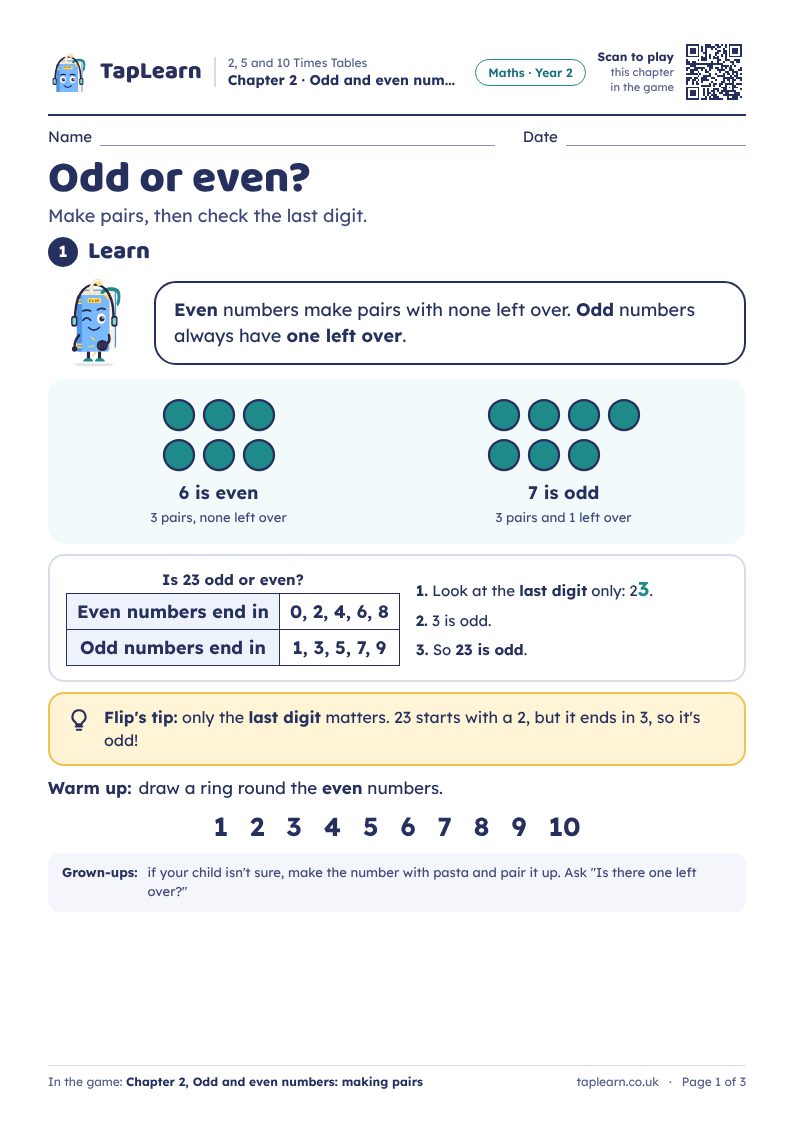
Odd or Even? is a printable odd and even numbers worksheet for Year 2 (ages 6 to 7) that teaches children that even numbers pair up with none left over and that only the last digit tells you, so 23 is odd. It covers the Year 2 maths statement to recall and use multiplication and division facts for the 2, 5 and 10 times tables, including recognising odd and even numbers.
This worksheet is for members
Membership opens every chapter of every game and every worksheet, for all your children.
See the plansAlready a member? Log in to print it.
Start with the free one: Counting in twos (chapter 1).
Print it on A4, in colour or black and white. Do it after the chapter, or before it to see what your child already knows.
What's on the worksheet
Your child tells odd and even numbers apart by making pairs and checking the last digit, for numbers up to 100. Includes a pair-them-up activity and an answers sheet.
- Page 1 · Learn
- 6 as 3 pairs and 7 with one left over, which last digits are odd and even, a worked example deciding 23 is odd, Flip's tip that only the last digit matters, and a warm-up.
- Page 2 · Try it together
- Pair them up: grab a handful of pasta, guess odd or even, make pairs in two lines, count them and see if one is left over, then check the last digit.
- Page 3 · Practise
- Join counters into pairs, colour even numbers to 20, sort numbers like 30 and 41 into odd and even, ring odd or even, fill gaps, and a challenge about 23.
- Answers sheet
- Every answer, mix-ups like looking at the tens digit, and door-number and odd-one-out ideas.
3 A4 pages and an answers sheet · about 20 minutes
In the classroom
- Run pair them up in small groups with cubes, recording each grab in the table.
- Use Practise C as a sorting task, then ask children what they notice about the last digits.
Questions from the worksheet
- Write each number in the right box, even or odd: 12, 7, 30, 25, 18, 41, 9, 56, 33, 64.
- Fill the gap: even number after 16; odd number between 20 and 22; even number between 47 and 49.
- Leo says 23 is even, because 2 is even. Is he right? How do you know?
The answers are on the answers sheet, for grown-ups.
National curriculum in England
This worksheet practises this statement from the Year 2 maths programme of study:
- Recall and use multiplication and division facts for the 2, 5 and 10 multiplication tables, including recognising odd and even numbers
Source: National curriculum in England: mathematics programmes of study (DfE)
Using it at home
- If your child isn't sure, make the number with pasta, pair it up and ask "Is there one left over?"
- After each grab in pair them up, ask your child to look at the last digit. Does it match what the pairs showed?
- On a walk, say if each house number is odd or even. One side of a street is often odd and the other even.
Watch out for
- Looking at the first digit, thinking 23 is even.
- Cover the tens digit with a finger and look at what's left.
- Mixing up odd and even.
- Even numbers pair up exactly; odd numbers have an odd one out.
- Being unsure about numbers ending in 0.
- Numbers ending in 0, like 30 and 90, are even.
Questions and answers
How do you know if a number is odd or even?
Look at the last digit. Even numbers end in 0, 2, 4, 6 or 8, and odd numbers end in 1, 3, 5, 7 or 9.
What makes a number even?
An even number can be made into pairs with none left over. An odd number always has one left over.
Is 0 odd or even?
Numbers ending in 0, like 30 and 90, are even.
 TapLearn