The Moon Landing: Blast Off with Apollo 11 and Columbus
Learn about the Moon landing in 1969 and the Apollo 11 crew, then sail with Columbus in 1492 and build a timeline of explorers.
- Ages 5–7
- About 40 min
- Easy start
- People Who Changed the World
Learn about the Moon landing in 1969 and the Apollo 11 crew, then sail with Columbus in 1492 and build a timeline of explorers.
Years 1–2 history · 1
Years 1–2 history · 1
Years 1–2 history · 1
Years 1–2 history · 2
Years 1–2 history · 2 Years 1–2 history · 1
What the chapters cover in the national curriculum in England:
Moon Landing Explorers is an interactive history game that teaches children aged 5–7 about the Moon landing in 1969, the Apollo 11 astronauts and how space travel compares with Christopher Columbus's voyage in 1492. It follows the KS1 History curriculum and is pitched at Year 1.
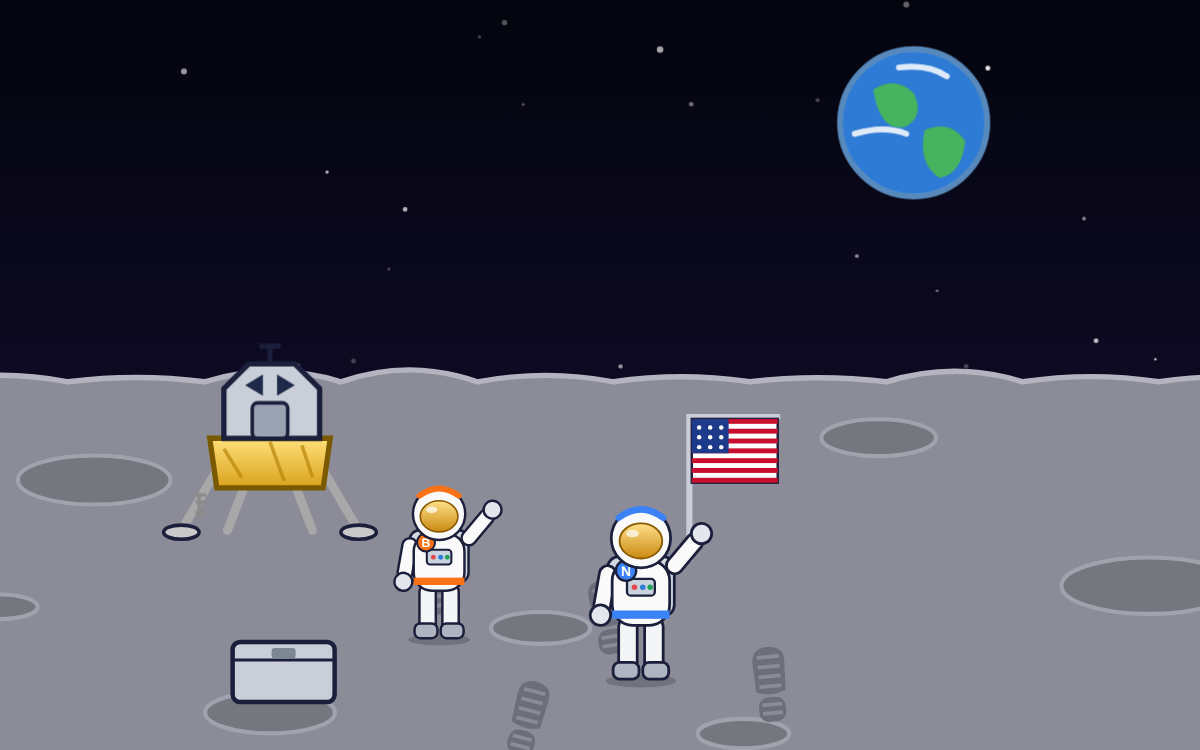
Players count down and launch the Saturn V rocket, fly for four days, steer the Eagle lander to a safe, flat spot and help Neil Armstrong and Buzz Aldrin make footprints on the Moon while Michael Collins circles above in Columbia. Then they load Columbus's wooden ship, blow wind into its sails and find the way with a compass and the stars.
A friendly robot guide reads every line aloud. Children place both journeys on a timeline using before, after, long ago and now, and spot what was the same and what was different about life in 1492 and 1969.
People first landed on the Moon on 20 July 1969, during NASA's Apollo 11 mission. The Eagle lander touched down on a flat, dusty plain called the Sea of Tranquility, and Neil Armstrong stepped out a few hours later.
The Apollo 11 astronauts were Neil Armstrong, Buzz Aldrin and Michael Collins. Armstrong was the commander and the first person to walk on the Moon, Aldrin joined him about 20 minutes later, and Collins flew the Columbia spacecraft around the Moon.
Columbus sailed across the Atlantic Ocean in 1492 in wooden ships pushed by the wind, finding his way with a compass and the stars. Armstrong flew to the Moon in 1969 on a rocket with computers and radios, and people watched his Moon walk live on TV.
This game is made for children aged 5 to 7, especially Year 1, where the Moon landing and explorers are usually taught in KS1 History. Every line is read aloud, so children do not need to read on their own to play.
The game has five chapters, an optional past-and-present warm-up and a 10-question Explorer Challenge, and takes about 40 minutes to play in full. Children can pick any chapter from the time map and stop between chapters.

 TapLearn
Getting it ready…
Great work on chapter 1! To open the next chapters, ask a grown-up to take a look.
To play this game, ask a grown-up to take a look. There are lots of free games you can play right now too!
Create a free family account and your child can play every chapter of every game for 7 days, with no card needed. Their progress is kept. After that, the free plan is free for ever, and membership is £6.99 a month if you'd like to keep every chapter.
That's all the learning time for today. Great work! Flip will be ready to play again tomorrow.