Simple Circuits: Light a Bulb with Lumi the Firefly
Learn how simple circuits work and when a bulb will light. Join cells, wires, bulbs, buzzers and switches into a complete loop, then fix broken circuits.
What the chapters cover in the national curriculum in England:
Year 4 science: Identify common appliances that run on electricity
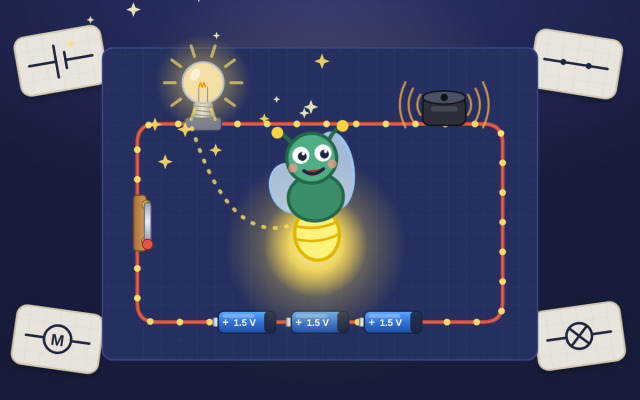
Year 4 science: Construct a simple series electrical circuit, identifying and naming its basic parts, including cells, wires, bulbs, switches and buzzers
Year 4 science: Identify whether or not a lamp will light in a simple series circuit, based on whether or not the lamp is part of a complete loop with a battery
Year 4 science: Recognise that a switch opens and closes a circuit and associate this with whether or not a lamp lights in a simple series circuit
About this adventure
Simple Circuits is an interactive science game that teaches children aged 7–10 how to build a simple series circuit and work out whether a bulb will light. It follows the Year 4 electricity topic in the English national curriculum, and Lumi the firefly reads every step aloud.
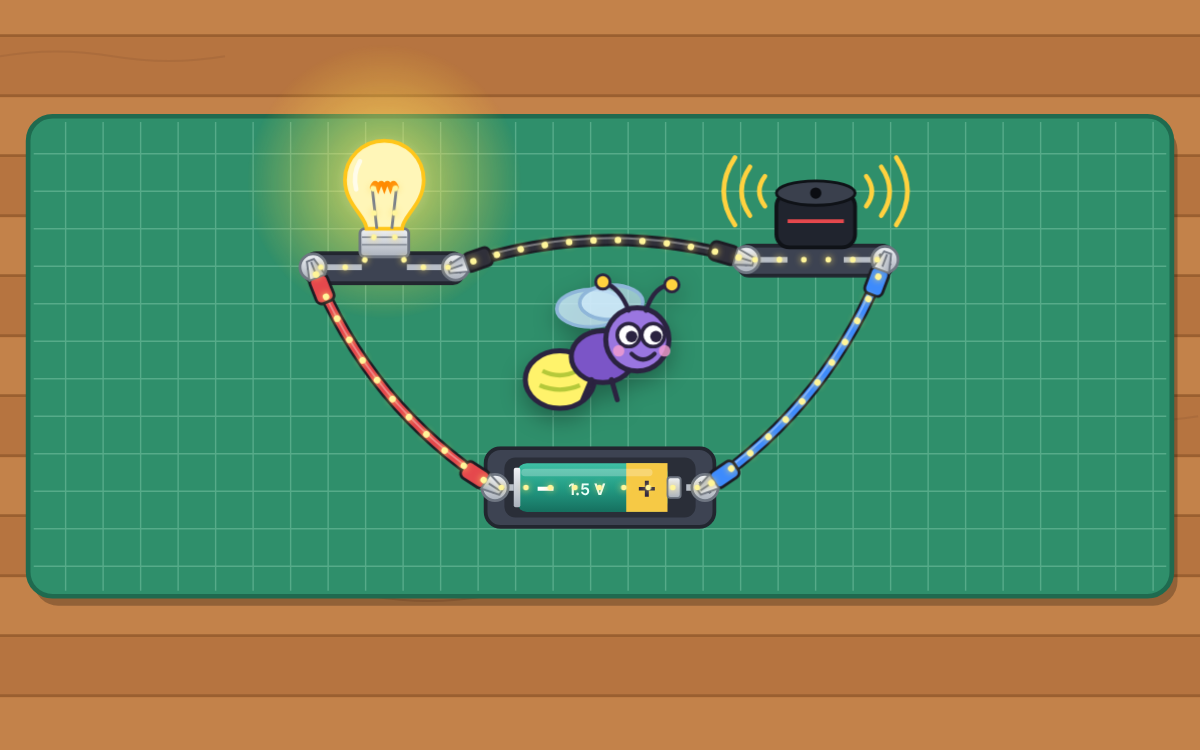
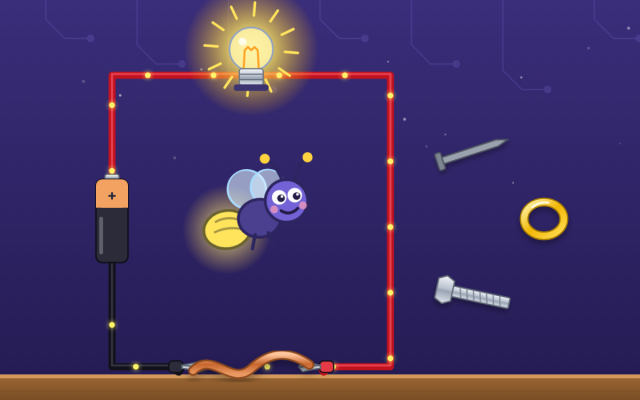
Players spot the appliances in a house that need electricity, then sort them into mains and battery. They look inside a torch, meet each part of a circuit, and wire up a cell, a bulb and a buzzer on a workbench. The bulb only lights when the wiring makes one complete loop, so children see for themselves why one wire is never enough.
Next they predict and test tricky circuits, find the gap in broken ones, and use a switch to open and close the loop before building a working doorbell.
Questions and answers
What is a simple circuit, in simple words?
A simple circuit is a complete loop that electricity can flow round. It needs a cell or battery to push the electricity, wires to carry it, and a part such as a bulb or buzzer that works when the electricity flows through it.
Why won't a bulb light with just one wire?
A bulb needs a complete loop to light, so one wire is not enough. Electricity must flow out of one end of the cell, through the bulb and back into the other end, which takes two wires.
How does a switch turn a light on and off?
A switch turns a light on and off by closing or opening a gap in the circuit. When it is closed, its metal parts touch and the loop is complete, so the bulb lights; when it is open, there is a gap and the bulb goes out.
What age is the Simple Circuits game for?
Simple Circuits is designed for children aged 7 to 10 and matches Year 4 science in England. Spoken narration with matching captions helps younger or less confident readers follow each step.
What is included in the game and how long does it take?
The game has five chapters, an optional warm-up on light and sound, and a 10-question Circuit Champion Challenge. Playing everything takes about 40 minutes, and children can start any chapter from the workshop map.
Can we count your visit? We'd like to use one cookie, only on this site, to see how families find and use TapLearn, so we can make it better. No adverts, and nothing is shared. How we measure
Create a free family account and your child can play every chapter of every game for 7 days, with no card needed. Their progress is kept. After that, the free plan is free for ever, and membership is £6.99 (about $9.35) a month if you'd like to keep every chapter.

 TapLearn