What you'll learn
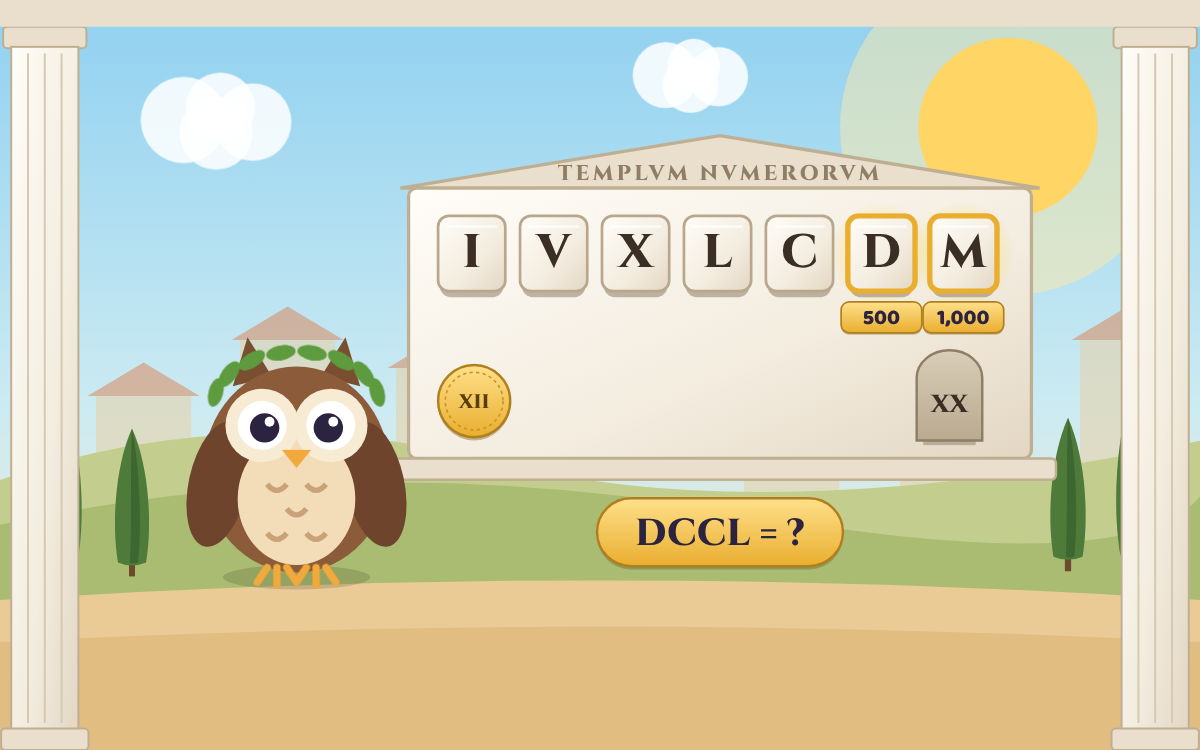
- What I, V, X, L, C, D and M are each worth
- Why D is 500 and M is 1,000
- How take-away pairs like IV, XC and CM work
- How to read any Roman numeral to 1,000 using chunks
- Why a missing chunk means a zero, as in CDIV = 404
- How to recognise years such as MCMLXVI and MMXXVI
Chapter by chapter
- Roman numeral letters: I, V, X, L, C, D (500) and M (1,000) Free to try
Year 5 maths · 1
- Take-away pairs: reading IV, IX, XL, XC, CD and CM
Year 5 maths · 1
- Reading Roman numerals to 1,000 by splitting them into chunks
Year 5 maths · 1
- Recognising years written in Roman numerals
Year 5 maths · 1
- Arena challenge: Roman numerals to 1,000 and Roman years (10 questions)
See every Maths chapter in the chapter library
What the chapters cover in the national curriculum in England:
- Year 5 maths: Read Roman numerals to 1,000 (M) and recognise years written in Roman numerals
About this adventure
Roman Numeral Quest is an interactive maths game that teaches children aged 8–11 to read Roman numerals up to 1,000 (M) and recognise years written in Roman numerals, matching the Year 5 national curriculum in England.
Guided by Octavia the owl, players tap stones to learn what I, V, X, L, C, D and M are worth, swap letters to see why VI adds but IV takes away, and open jars holding the six take-away pairs: IV, IX, XL, XC, CD and CM. They then cut long numerals into colour-coded hundreds, tens and ones chunks and type the totals on a keypad.
In the town square, they read real-looking Roman years on a foundation stone, film credits and a church bell, finding the thousands first. A short warm-up recaps numerals to 100, and a 10-question arena challenge checks everything at the end.
Questions and answers
How do you read Roman numerals, in simple words?
Add the letters when they go from biggest to smallest, so DCL is 500 + 100 + 50 = 650. When a smaller letter comes just before a bigger one, take it away instead, so XC is 100 − 10 = 90.
What are D and M in Roman numerals?
D is 500 and M is 1,000. M comes from mille, the Latin word for a thousand, which is a handy way to remember it. Children usually meet D and M in Year 5, after learning I to C in Year 4.
How do you work out a year written in Roman numerals?
Find the thousands chunk first, then read the rest in hundreds, tens and ones. For example, MCMLXVI is M (1,000) + CM (900) + LX (60) + VI (6), which makes 1966.
What age is this Roman numerals game for?
It is written for children aged 8 to 11 and follows the Year 5 maths objective to read Roman numerals to 1,000 and recognise Roman years. Older Year 4 pupils who already know I to C can enjoy it too.
What does the Roman numerals game include and how long does it take?
It has an optional warm-up, four narrated chapters with hands-on activities and typed answers, and a 10-question final challenge. Playing everything takes about 35 minutes, and children can start from any chapter on the map.




 TapLearn