What you'll learn
- Why rainforests grow near the equator, in the tropical climate zone
- What a biome is and why rainforests are hot and wet
- The four layers: emergent, canopy, understory and forest floor
- How drip tips, buttress roots, lianas and epiphytes help plants survive
- Which animals live in each layer, and how camouflage helps them hide
- How transpiration helps rainforests make rain, and how we can protect them
Chapter by chapter
- Where rainforests grow: the equator, tropics and climate zones Free to try
Years 3–6 geography · 1
- Rainforest climate: a hot, wet tropical biome
Years 3–6 geography · 1
- Rainforest layers: emergent, canopy, understory and forest floor
Years 3–6 geography · 1
- Rainforest plants: drip tips, buttress roots, lianas and epiphytes
Years 3–6 geography · 1
- Rainforest animals and the layers they live in
Years 3–6 geography · 1
- Why rainforests matter: rain, homes, food and protection
Years 3–6 geography · 1
- Rainforest Ranger Challenge (10 questions)
See every Earth & Geography chapter in the chapter library
What the chapters cover in the national curriculum in England:
- Years 3–6 geography: Describe and understand key aspects of physical geography, including: climate zones, biomes and vegetation belts, rivers, mountains, volcanoes and earthquakes, and the water cycle
About this adventure
Rainforest Explorers is an interactive game that teaches children aged 7–11 about the rainforest biome: where tropical rainforests grow, how their four layers work, how plants and animals survive in them and why rainforests matter.
Guided by Tico the toucan, players draw the equator and the tropics on a world map, compare rainfall in London and the Amazon, and build the emergent layer, canopy, understory and forest floor. They test plant adaptations such as drip tips (pointed leaves that shed heavy rain) and buttress roots (giant props for tall trees), then run the water cycle to see transpiration, when leaves release water vapour that becomes clouds and rain.
Every line is read aloud with captions, each chapter ends with a quick check, and a 10-question challenge tests everything. It follows the KS2 geography curriculum on climate zones, biomes and the water cycle.
Questions and answers
What are the four layers of the rainforest?
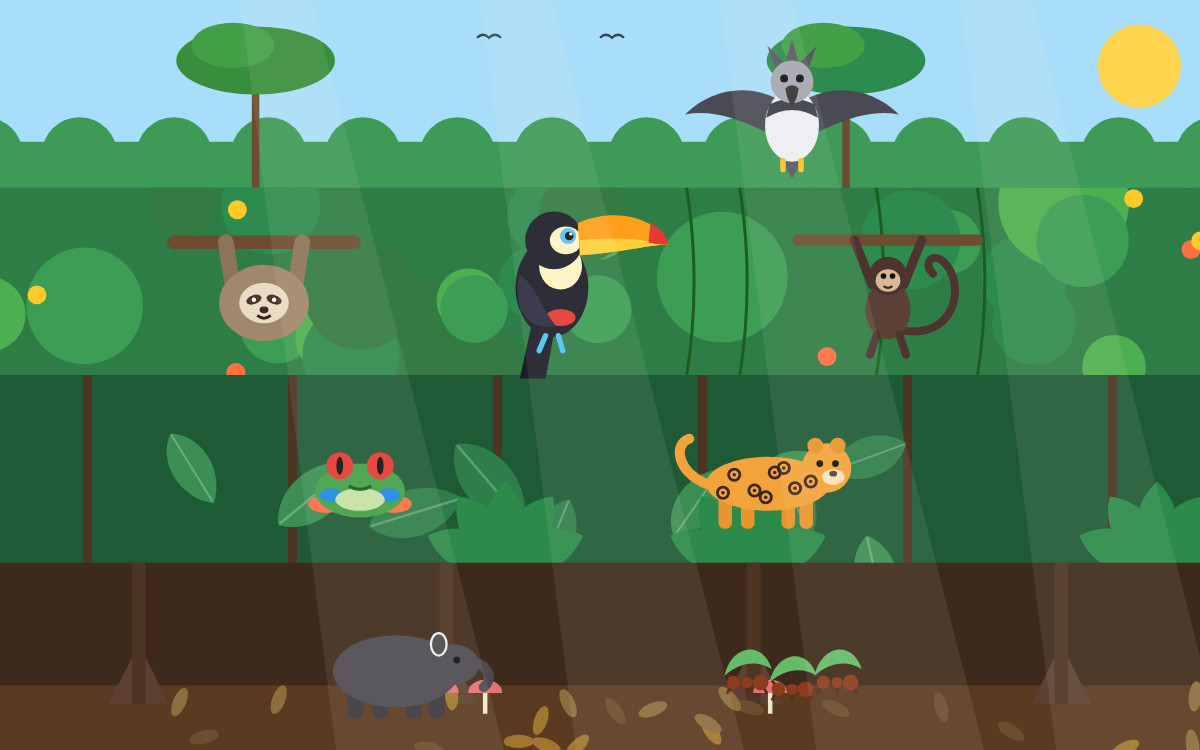
The four layers of the rainforest, from top to bottom, are the emergent layer, the canopy, the understory and the forest floor. The tallest trees poke up into the sunny emergent layer, while less than 2% of sunlight reaches the dark forest floor.
Why do rainforests grow near the equator?
Rainforests grow near the equator because the sun shines strongly there all year, keeping it hot, and warm rising air brings heavy rain. Tropical rainforests usually stay around 27°C and get more than 2,000 mm of rain a year.
Does the Amazon rainforest make most of the world's oxygen?
No, that is a popular myth. Rainforest plants make lots of oxygen, but the forest's animals, fungi and rotting leaves use almost all of it. Rainforests matter because they store carbon, help make rain and are home to more than half of all kinds of plants and animals.
What age is this rainforest game for?
This rainforest game is for children aged 7 to 11 and is pitched at Year 4, where rainforests are usually taught in KS2 geography. Every instruction is read aloud with captions, so younger or less confident readers can follow along.
What does the rainforest game include and how long does it take?
The game has six hands-on chapters and a final 10-question challenge, and takes about 45 minutes to play through. Each chapter opens with an animated introduction, ends with quick check questions, and can be played in any order from the expedition map.



 TapLearn