What you'll learn
- Why the first flight is beyond living memory
- Who Wilbur and Orville Wright were and how they worked
- What happened on 17 December 1903 near Kitty Hawk
- That the first flight lasted 12 seconds, with Orville as pilot
- How people travelled before aeroplanes, by horse, train and ship
- Why the first flight changed travel and led to space travel
Chapter by chapter
- Beyond living memory: how people travelled before the first aeroplane flight Free to try
Years 1–2 history · 1
- Significant people: the lives of Wilbur and Orville Wright
Years 1–2 history · 2
- The first aeroplane flight: 17 December 1903 at Kitty Hawk
Years 1–2 history · 1 Years 1–2 history · 2
- Why the first flight matters: comparing travel then and now, from the Wright brothers to Neil Armstrong
Years 1–2 history · 1 Years 1–2 history · 2
- Big Flight Quiz (8 questions)
What the chapters cover in the national curriculum in England:
- Years 1–2 history: Events beyond living memory that are significant nationally or globally
- Years 1–2 history: The lives of significant individuals in the past who have contributed to national and international achievements, some should be used to compare aspects of life in different periods
About this adventure
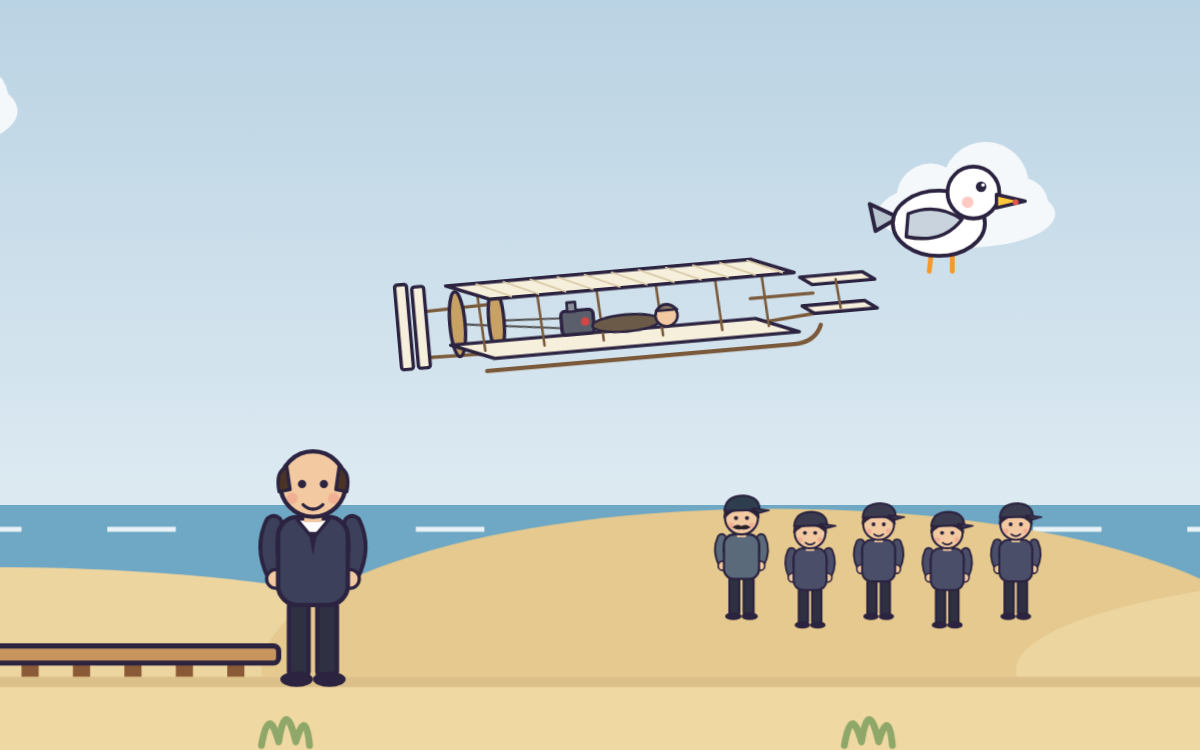
Wright Brothers First Flight is an interactive history game that teaches children aged 5–7 who Wilbur and Orville Wright were, what happened on the first aeroplane flight in 1903, and why it changed the world. It follows the KS1 History curriculum and suits Year 1.
Pip the seagull reads every step aloud. Children build a timeline that shows the flight is beyond living memory, before anyone alive today was born. They twist a toy helicopter's rubber band, fix a bicycle, and help Orville start the engine and fly. On screen, they count the 12 seconds the first flight lasted.
Children also compare the wood-and-cloth Wright Flyer with a jumbo jet, and race a ship against a plane across the Atlantic. Short questions in each chapter offer hints, and a final quiz checks what they remember.
Questions and answers
Who were the Wright brothers?
The Wright brothers, Wilbur and Orville, were two American brothers who built and flew the first powered aeroplane. They started out building and fixing bicycles in Dayton, Ohio, and tested many gliders before they flew.
When and where was the first aeroplane flight?
The first aeroplane flight happened on 17 December 1903 on windy sand dunes near Kitty Hawk, North Carolina, in the USA. The brothers chose it for its strong, steady wind and soft sand for landings.
How long did the Wright brothers' first flight last?
The first flight lasted about 12 seconds and covered roughly 37 metres (120 feet), about the length of three buses. Orville was the pilot. Wilbur flew the longest flight that day, about 59 seconds.
What age is this Wright brothers game for?
The game is made for children aged 5 to 7 and matches KS1 History in England, where the first aeroplane flight is usually taught in Year 1. Every line is read aloud, so early readers can play along.
What does the game include and how long does it take?
The game has four chapters and an 8-question final quiz, and takes about 35 minutes to play through. Children can choose any chapter from the Flight Map and come back to finish it later.
More to explore
See all
Animal Life Cycles: Grow a Frog, Butterfly, Robin and Rabbit
Learn how animal life cycles work by helping a frog, butterfly, robin and rabbit grow, from egg or birth to a…
Skeletons and Muscles: Build a Body with Skelly
Learn how skeletons and muscles work together: build a skeleton, test how bones protect you, and make an arm…
The Heart and Circulatory System: Ride with Rosie
Learn how the heart and circulatory system work, then guide Rosie the red blood cell round the body, build yo…
Adding and Subtracting: Hop Along with Hopper the Frog
Learn adding and subtracting with number bonds, number lines and columns, then tap, hop and exchange counters…
Letter Sounds and Blending: Read Words with Bip the Robot
Learn letter sounds and blending: match letters to sounds, hear first sounds and push sounds together to read…
Multiplication and Division: Share, Group and Grow a Garden
Learn multiplication and division with equal groups, sharing, grouping and arrays, then help Dotty the ladybi…
Instruments of the Orchestra: Build It, Then Conduct It
Learn how the instruments of the orchestra make their sounds, then build all four families step by step and c…
 TapLearn