Spelling voice worksheet for Years 3–4: Say every letter
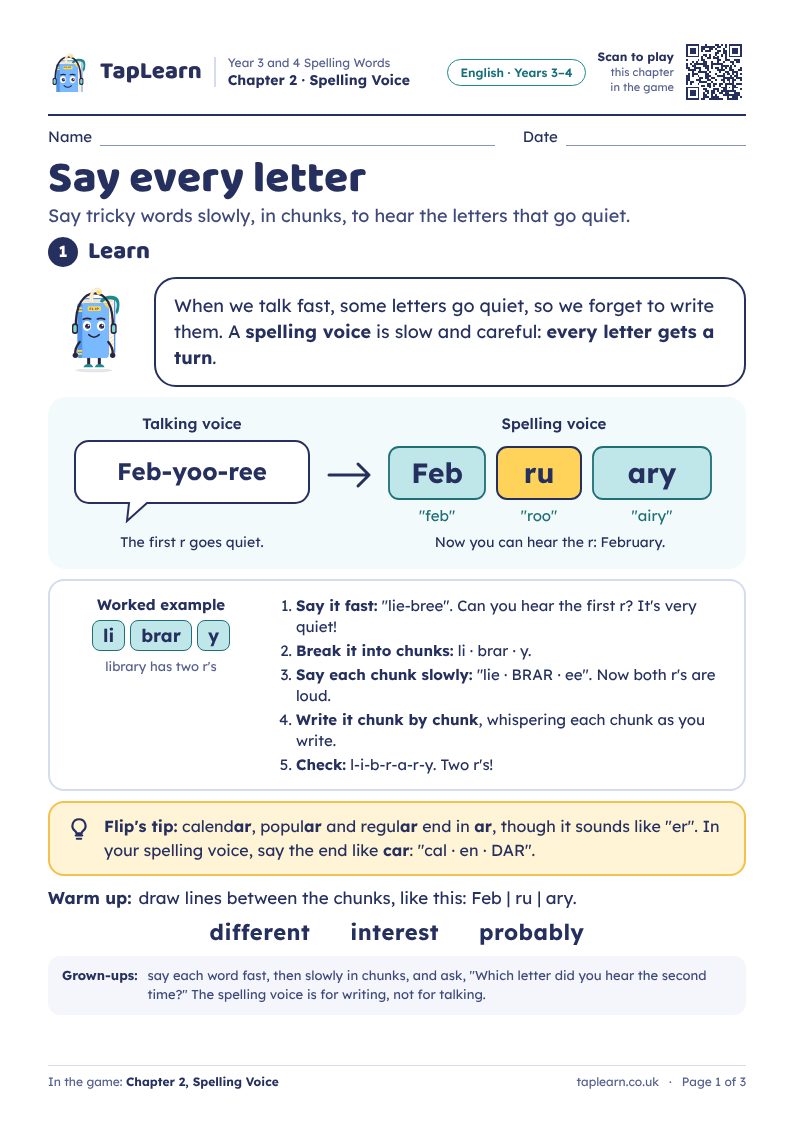
Say Every Letter is a printable spelling voice worksheet for Years 3 and 4 (ages 7 to 9) that teaches children to break long words into chunks and say each one slowly, so quiet letters like the first r in February come back. It covers the Years 3–4 English statement to spell words that are often misspelt, from English appendix 1.
This worksheet is for members
Membership opens every chapter of every game and every worksheet, for all your children.
See the plansAlready a member? Log in to print it.
Start with the free one: Words inside words (chapter 1).
Print it on A4, in colour or black and white. Do it after the chapter, or before it to see what your child already knows.
What's on the worksheet
Your child says tricky words slowly in chunks to hear quiet letters, like the r in February and library, and the ar ending in calendar. Includes a robot spelling voice activity and an answers sheet.
- Page 1 · Learn
- February in a talking voice and a spelling voice, a worked example chunking library, Flip's tip that calendar, popular and regular end in ar, and a chunk-splitting warm-up.
- Page 2 · Try it together
- Robot spelling voice: the grown-up says February, history, ordinary or calendar fast, the child says it back in a slow robot voice with a clap for each chunk, then writes it.
- Page 3 · Practise
- Ring the right spelling, write ar or er endings, put back fallen-out letters, chunk long words and write them from memory, write a sentence, and a challenge about libary and Febuary.
- Answers sheet
- Every answer, mix-ups like calender and populer, and robot-names ideas.
3 A4 pages and an answers sheet · about 25 minutes
Using it at home
- Say each word fast, then slowly in chunks, and ask "Which letter did you hear the second time?"
- In robot spelling voice, if your child says "his-tree", say "his · tor · y" together and ask which letter came back.
- Say family names or the days of the week in a robot spelling voice: "Wed · nes · day".
Watch out for
- Leaving out quiet letters, like Febuary, libary or diffrent.
- Say the word together in robot voice and ask "Which letter came back?"
- Writing er instead of ar, like calender or populer.
- Say the ending like car. Calendar and popular end in ar, while remember and answer end in er.
- Changing how they talk.
- The spelling voice is only for spelling, not for everyday speech.
Questions from the worksheet
- Say each word in your spelling voice. Draw a ring round the right spelling: Febuary or February, library or libary, diffrent or different.
- ar or er? Write the ending: calend__, popul__, rememb__, regul__, answ__, particul__.
- Split each long word into chunks. Then cover it and write it from memory: particular, experiment, material.
- Sam writes: "I went to the libary in Febuary." Write the two words correctly. What went wrong, and how could a spelling voice help?
The answers are on the answers sheet, for grown-ups.
National curriculum in England
This worksheet practises these statements from the Years 3–4 english programme of study:
- Read further exception words, noting the unusual correspondences between spelling and sound, and where these occur in the word
- Spell words that are often misspelt (English appendix 1)
In the classroom
- Use robot spelling voice as a whole-class warm-up, clapping chunks of the week's spelling words.
- Sort ar and er endings from Practise B on mini-whiteboards.
Questions and answers
What is a spelling voice?
A spelling voice is a slow, careful way of saying a word in chunks so every letter gets a turn, like "Feb · ru · ary". It is only for spelling, not for talking.
Why do children spell February as Febuary?
When we talk fast, the first r in February goes quiet. Saying it in chunks brings the r back.
Does calendar end in ar or er?
Calendar ends in ar, like popular and regular, even though the end sounds like "er". Saying it like car helps.
More worksheets from Year 3 and 4 Spelling Words: A Space Mission with Nova
- Chapter 1: Statutory spelling words worksheet: Words inside words Free
- Chapter 3: Silent letters worksheet: Shh! Silent letters Members
- Chapter 4: Soft c worksheet: When c says s Members
- Chapter 5: Double letters worksheet: Spot the twins Members
- Chapter 6: Ough, augh and eigh words worksheet: Tricky letter strings Members
- Chapter 7: Root words worksheet: Build from the root Members
- Chapter 8: Alphabetical order worksheet: Dictionary order Members
- Chapter 9: Look, say, cover, write, check worksheet: My spelling toolkit Members
 TapLearn