Look, say, cover, write, check worksheet for Years 3–4: My spelling toolkit
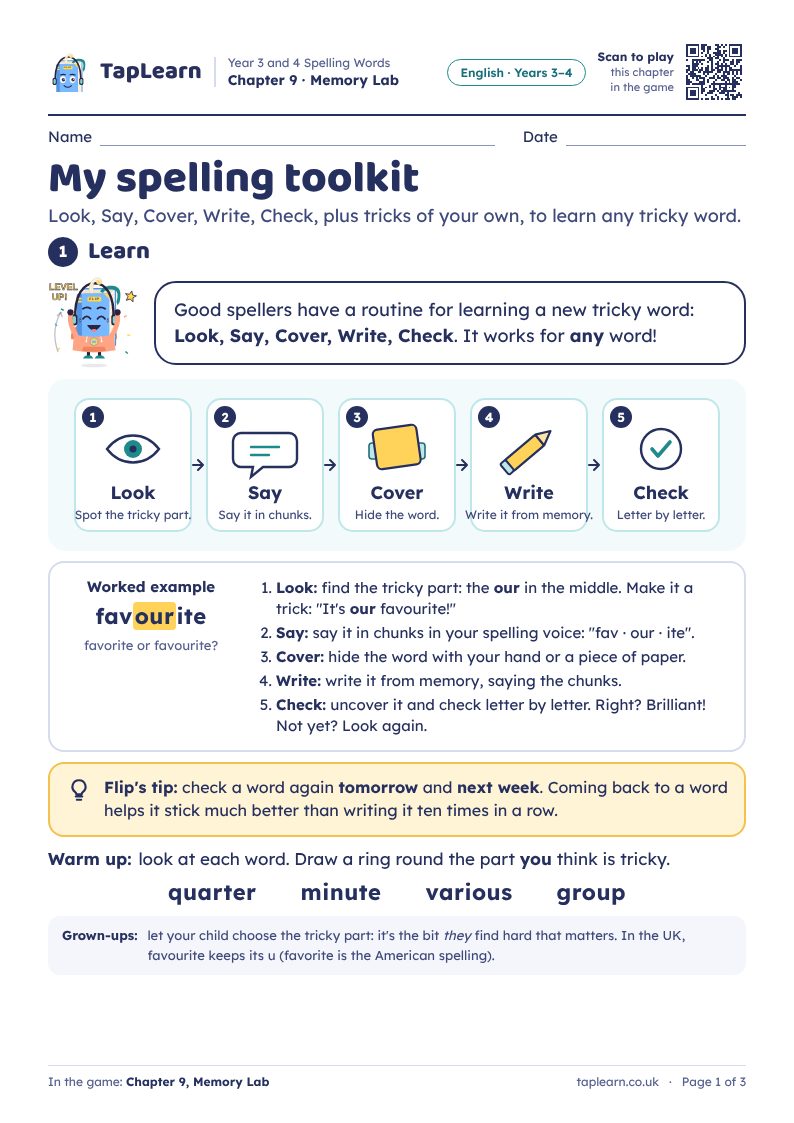
My Spelling Toolkit is a printable look, say, cover, write, check worksheet for Years 3 and 4 (ages 7 to 9) that teaches children a routine for any tricky word and to come back to words tomorrow and next week. It covers the Years 3–4 English statement to spell words that are often misspelt, from English appendix 1.
This worksheet is for members
Membership opens every chapter of every game and every worksheet, for all your children.
See the plansAlready a member? Log in to print it.
Start with the free one: Words inside words (chapter 1).
Print it on A4, in colour or black and white. Do it after the chapter, or before it to see what your child already knows.
What's on the worksheet
Your child learns tricky Year 3 and 4 words with Look, Say, Cover, Write, Check and memory tricks of their own, plus a round-up of every trick. Includes a fold, write, check routine and an answers sheet.
- Page 1 · Learn
- The five steps of Look, Say, Cover, Write, Check, a worked example learning favourite with "it's our favourite", Flip's tip on checking again tomorrow, and a ring-the-tricky-part warm-up.
- Page 2 · Try it together
- Fold, write, check: look at quarter, minute, various, group and straight, say them in a spelling voice, fold the sheet to cover each one, write it, then unfold and check.
- Page 3 · Practise
- Match words to their memory tricks, ring the right spelling, make up your own tricks for important, question and remember, fill gaps from every chapter, and a challenge.
- Answers sheet
- Every answer, mix-ups like copying instead of remembering, and word-of-the-day and teach-the-trick ideas.
3 A4 pages and an answers sheet · about 25 minutes
Using it at home
- Let your child choose the tricky part of each word: it's the bit they find hard that matters.
- In fold, write, check, a word that needed Try 2 isn't a failure. Circle it and check it again tomorrow.
- Pick one tricky word each morning and see if your child can spell it aloud at bedtime.
Watch out for
- Swapping vowels or i and e, like seperate or beleive.
- Go back to the hidden-word tricks: a rat, a ram, a lie.
- Copying instead of remembering.
- The Cover step matters: the word must be hidden while your child writes.
- Using American spellings, like favorite or center.
- In UK schools, write favourite and centre.
Questions from the worksheet
- Draw a line to match each word to its memory trick: separate, believe, business, women.
- Draw a ring round the right spelling: favorite or favourite, quarter or quater, various or varius.
- Make up your own memory trick for each word. Silly is good! important, question, remember.
- Mia wrote quarter ten times in a row and got it right. A week later she wrote quater. What could help her remember it next time?
The answers are on the answers sheet, for grown-ups.
National curriculum in England
This worksheet practises these statements from the Years 3–4 english programme of study:
- Read further exception words, noting the unusual correspondences between spelling and sound, and where these occur in the word
- Spell words that are often misspelt (English appendix 1)
In the classroom
- Use fold, write, check as a weekly spelling routine, revisiting words that needed a second try.
- Have pairs teach each other their own memory trick for a word from Practise C.
Questions and answers
What is look, say, cover, write, check?
It is a routine for learning a spelling: look at the tricky part, say it in chunks, cover it, write it from memory, then check letter by letter.
Is writing a word ten times a good way to learn it?
Coming back to a word tomorrow and next week helps it stick much better than writing it ten times in a row.
Is it favourite or favorite?
In the UK it is favourite, with a u. Favorite is the American spelling.
More worksheets from Year 3 and 4 Spelling Words: A Space Mission with Nova
- Chapter 1: Statutory spelling words worksheet: Words inside words Free
- Chapter 2: Spelling voice worksheet: Say every letter Members
- Chapter 3: Silent letters worksheet: Shh! Silent letters Members
- Chapter 4: Soft c worksheet: When c says s Members
- Chapter 5: Double letters worksheet: Spot the twins Members
- Chapter 6: Ough, augh and eigh words worksheet: Tricky letter strings Members
- Chapter 7: Root words worksheet: Build from the root Members
- Chapter 8: Alphabetical order worksheet: Dictionary order Members
 TapLearn