Silent letters worksheet for Years 3–4: Shh! Silent letters
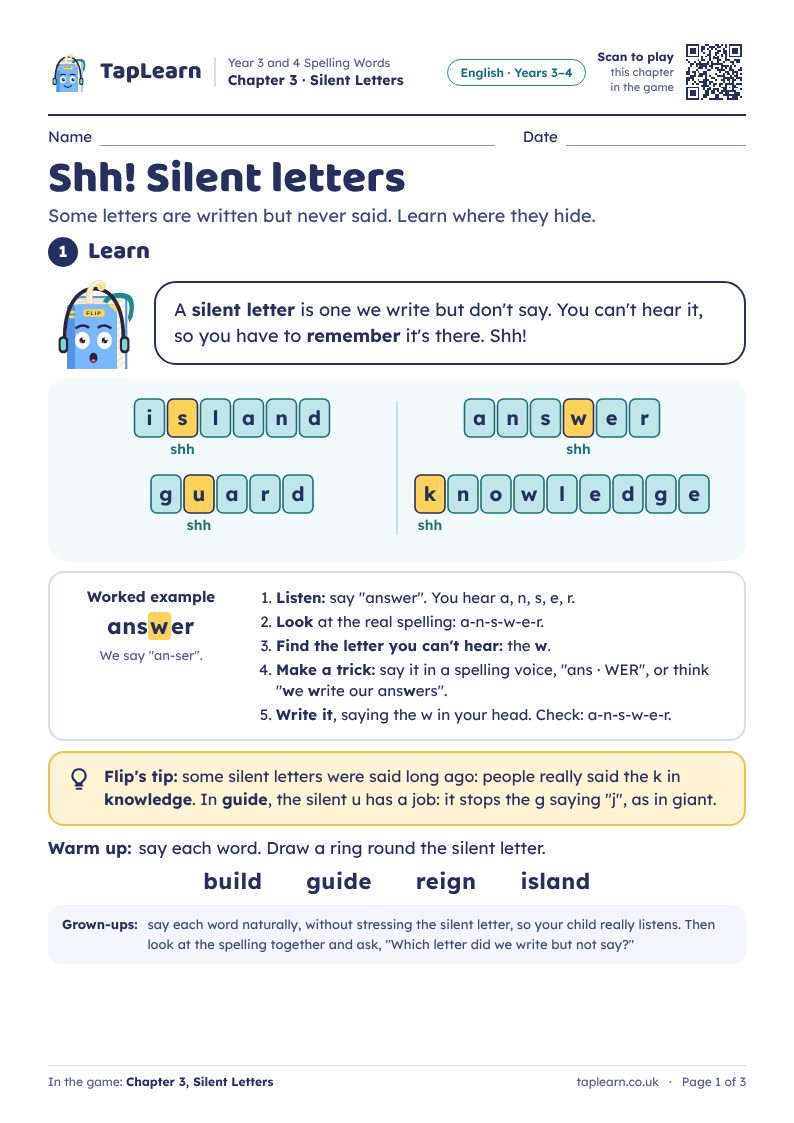
Shh! Silent Letters is a printable silent letters worksheet for Years 3 and 4 (ages 7 to 9) that teaches children to spot letters we write but don't say, like the s in island and the w in answer, and remember where they hide. It covers the Years 3–4 English statements to read further exception words, noting unusual correspondences between spelling and sound, and to spell words that are often misspelt.
This worksheet is for members
Membership opens every chapter of every game and every worksheet, for all your children.
See the plansAlready a member? Log in to print it.
Start with the free one: Words inside words (chapter 1).
Print it on A4, in colour or black and white. Do it after the chapter, or before it to see what your child already knows.
What's on the worksheet
Your child finds and remembers the silent letters in island, answer, guard, knowledge, build and reign. Includes a silent letter detectives game and an answers sheet.
- Page 1 · Learn
- Island, answer, guard and knowledge with their silent letters marked, a worked example for answer, Flip's tip on why guide needs its u, and a ring-the-silent-letter warm-up.
- Page 2 · Try it together
- Silent letter detectives: the grown-up says island, answer, guard, knowledge and build, the child writes each as it sounds, then compares with the real spelling and rings the silent letter.
- Page 3 · Practise
- Put back missing silent letters, explain why guide needs its u, correct misspelt words in sentences, write a sentence, spell four words from memory, and a dictionary challenge.
- Answers sheet
- Every answer, mix-ups like gaurd or ansewr, and silly-voices and silent-letter-spotting ideas.
3 A4 pages and an answers sheet · about 25 minutes
Using it at home
- Say each word naturally, without stressing the silent letter, so your child really listens, then look at the spelling together.
- In silent letter detectives, praise a good "sounds like" spelling: iland shows exactly which letter is silent.
- While reading together, stop at silent letters in words like knee, write and lamb and point them out.
Watch out for
- Leaving out silent letters, like iland, anser or nowledge.
- Praise the "sounds like" try, then show the real word and ring the silent letter together.
- Putting the silent letter in the wrong place, like ansewr or gaurd.
- Say it in a spelling voice: "ans · wer", "g · u · ard".
Questions from the worksheet
- Each word has lost its silent letter. Write it in the gap: i_land, ans_er, g_ard, _nowledge, b_ild, rei_n.
- Cover the u in guide with your finger, so it reads gide. How might you say it now? Why does guide need its u?
- Each sentence has one word spelt wrong. Find it and write it correctly: We sailed to a small iland.
- Leo wants to check how to spell knowledge. He looks under n in the dictionary, but he can't find it. Why not? Where should he look?
The answers are on the answers sheet, for grown-ups.
National curriculum in England
This worksheet practises these statements from the Years 3–4 english programme of study:
- Read further exception words, noting the unusual correspondences between spelling and sound, and where these occur in the word
- Spell words that are often misspelt (English appendix 1)
In the classroom
- Play silent letter detectives as a class dictation, then reveal the real spellings.
- Use the guide question in Practise B for a short discussion on why some silent letters have a job.
Questions and answers
What is a silent letter?
A silent letter is one we write but don't say, like the k in knowledge or the s in island. Children need to remember it's there.
Why does guide have a silent u?
The u stops the g saying "j", as in giant. Without it, guide would read as gide.
Why do words have silent letters?
Some silent letters were said long ago: people really did say the k in knowledge.
More worksheets from Year 3 and 4 Spelling Words: A Space Mission with Nova
- Chapter 1: Statutory spelling words worksheet: Words inside words Free
- Chapter 2: Spelling voice worksheet: Say every letter Members
- Chapter 4: Soft c worksheet: When c says s Members
- Chapter 5: Double letters worksheet: Spot the twins Members
- Chapter 6: Ough, augh and eigh words worksheet: Tricky letter strings Members
- Chapter 7: Root words worksheet: Build from the root Members
- Chapter 8: Alphabetical order worksheet: Dictionary order Members
- Chapter 9: Look, say, cover, write, check worksheet: My spelling toolkit Members
 TapLearn