Alphabetical order worksheet for Years 3–4: Dictionary order
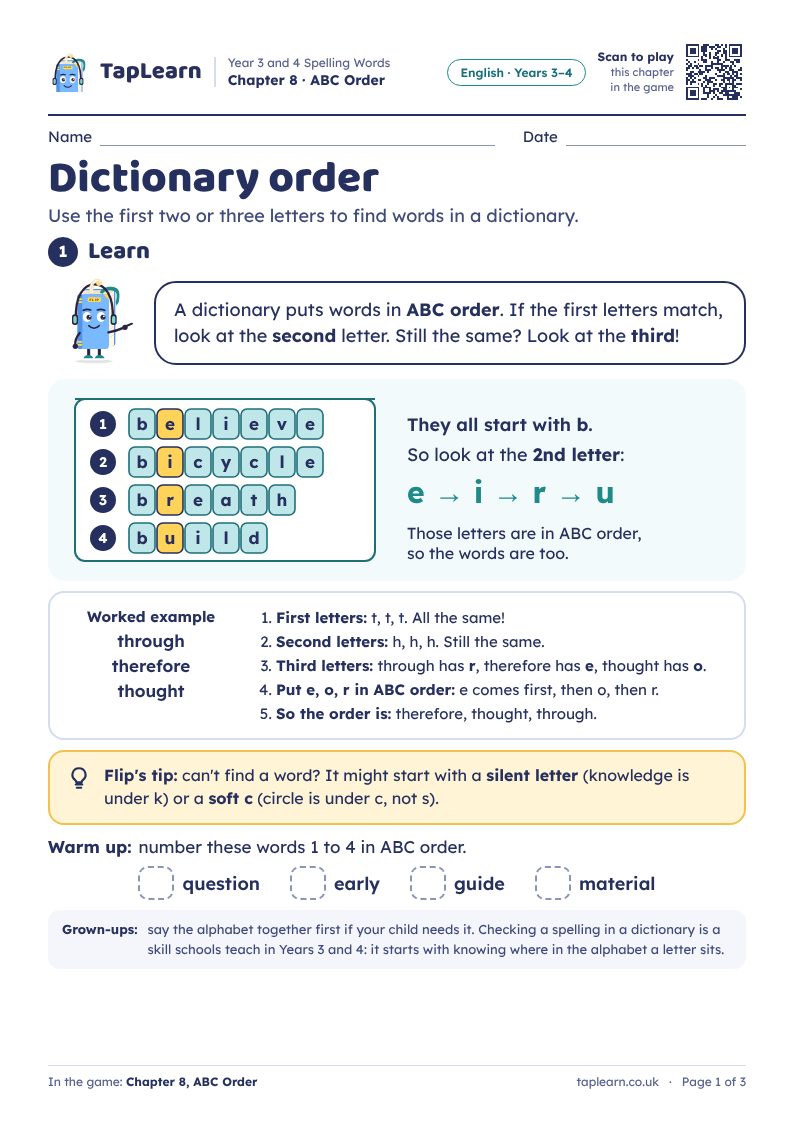
Dictionary Order is a printable alphabetical order worksheet for Years 3 and 4 (ages 7 to 9) that teaches children to look at the second and third letters when words start the same, as in therefore, thought, through. On the sheet, children order words, find which letter to look under for knowledge and circle, and decide which words belong on a dictionary page.
This worksheet is for members
Membership opens every chapter of every game and every worksheet, for all your children.
See the plansAlready a member? Log in to print it.
Start with the free one: Words inside words (chapter 1).
Print it on A4, in colour or black and white. Do it after the chapter, or before it to see what your child already knows.
What's on the worksheet
Your child puts words in ABC order using their first two or three letters, then uses that to find and check spellings in a dictionary. Includes a cupboard line-up activity and an answers sheet.
- Page 1 · Learn
- Four b words ordered by their second letter, a worked example ordering through, therefore and thought by their third letter, Flip's tip on silent letters and soft c, and a warm-up.
- Page 2 · Try it together
- Cupboard line-up: each write 4 kitchen foods on paper pieces, line all 8 up in ABC order using second and third letters, then find knowledge and circle in a dictionary.
- Page 3 · Practise
- Ring which word comes first, choose the letter to look under for knowledge and circle, number sets 1 to 4 in ABC order, find words for a dictionary page, and a challenge.
- Answers sheet
- Every answer, mix-ups like looking only at the first letter, and family line-up and halfway-trick ideas.
3 A4 pages and an answers sheet · about 25 minutes
Using it at home
- Say the alphabet together first if your child needs it: knowing where a letter sits makes the rest easier.
- For the cupboard line-up, pick foods that start with the same letter, like pasta, peas and peppers, so your child has to use the second and third letters.
- Line up everyone's names, or some toys, in ABC order.
Watch out for
- Looking only at the first letter when words start the same.
- Cover the first letter with a finger and compare the next ones.
- Looking under the sound, not the letter: knowledge under n, circle under s.
- If a word isn't there, think of silent letters and soft c.
Questions from the worksheet
- Which word comes first in a dictionary? Draw a ring round it: pressure or potatoes, guide or guard, eight or early.
- Which letter would you look under to find each word? Watch out for silent letters and soft c: knowledge, circle, certain, island.
- Number each set 1 to 4 in ABC order: through, that, thought, therefore.
- Ava says, "bicycle, believe, build and breath all start with b, so they can go in any order." Is she right? Write them in ABC order.
The answers are on the answers sheet, for grown-ups.
National curriculum in England
This worksheet practises these statements from the Years 3–4 english programme of study:
- Read further exception words, noting the unusual correspondences between spelling and sound, and where these occur in the word
- Spell words that are often misspelt (English appendix 1)
In the classroom
- Run the cupboard line-up with class names or topic words in groups.
- Teach the halfway trick: open a dictionary in the middle and decide whether the word is before or after that page.
Questions and answers
How do you put words in alphabetical order when they start with the same letter?
Look at the second letter. If that's the same too, look at the third: therefore, thought, through.
Why can't my child find knowledge in the dictionary?
Knowledge starts with a silent k, so it is under k, not n. Circle is under c, not s.
What are the words at the top of a dictionary page?
They show the first and last words on that page, so you can tell quickly whether your word is there.
More worksheets from Year 3 and 4 Spelling Words: A Space Mission with Nova
- Chapter 1: Statutory spelling words worksheet: Words inside words Free
- Chapter 2: Spelling voice worksheet: Say every letter Members
- Chapter 3: Silent letters worksheet: Shh! Silent letters Members
- Chapter 4: Soft c worksheet: When c says s Members
- Chapter 5: Double letters worksheet: Spot the twins Members
- Chapter 6: Ough, augh and eigh words worksheet: Tricky letter strings Members
- Chapter 7: Root words worksheet: Build from the root Members
- Chapter 9: Look, say, cover, write, check worksheet: My spelling toolkit Members
 TapLearn