Ordering paragraphs worksheet for Year 3: Paragraphs in order
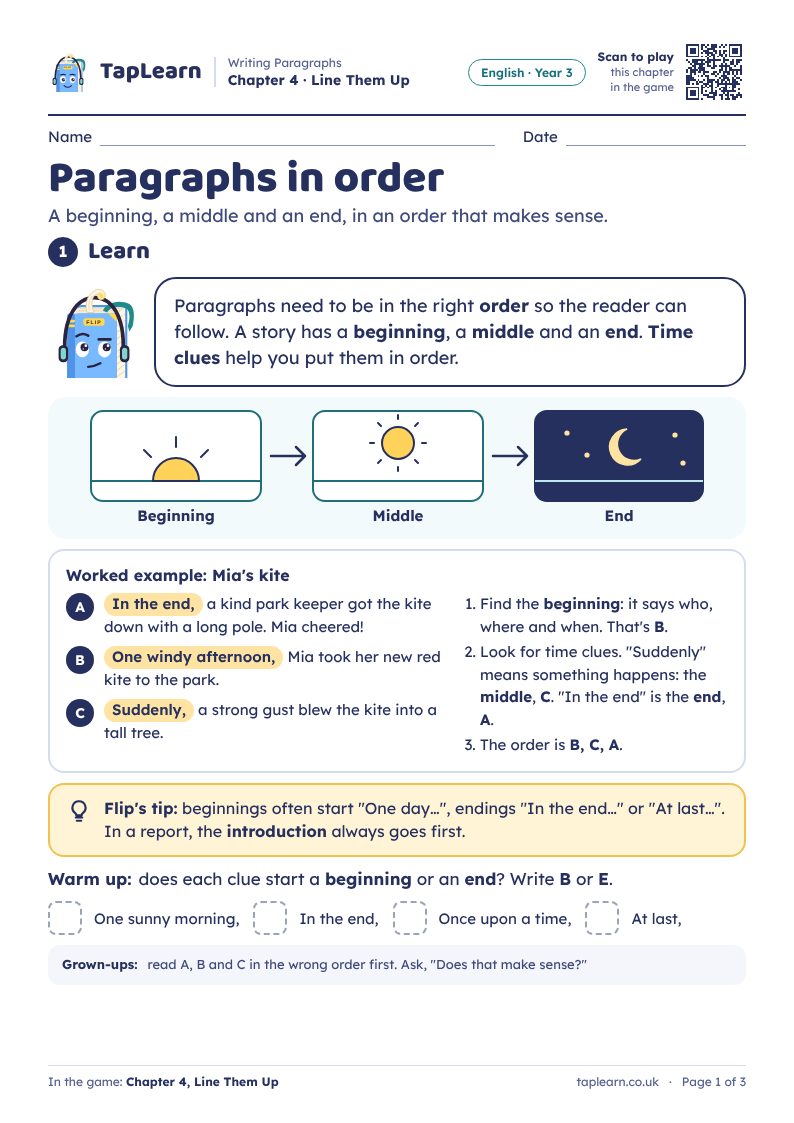
Paragraphs in Order is a printable ordering paragraphs worksheet for Year 3 (ages 7 to 8) that teaches children to find the beginning, use time clues like suddenly and in the end, and put the introduction first in a report. Children number story paragraphs, order a snowman story by its time clues and write a middle paragraph for Ava's treasure map story.
This worksheet is for members
Membership opens every chapter of every game and every worksheet, for all your children.
See the plansAlready a member? Log in to print it.
Start with the free one: What is a paragraph? (chapter 1).
Print it on A4, in colour or black and white. Do it after the chapter, or before it to see what your child already knows.
What's on the worksheet
Your child puts paragraphs in a sensible order with a beginning, middle and end, using time clues like later and by the evening. Includes a mixed-up steps game and an answers sheet.
- Page 1 · Learn
- A beginning, middle and end, a worked example ordering Mia's kite story using time clues, Flip's tip on beginnings, endings and report introductions, and a beginning-or-end warm-up.
- Page 2 · Try it together
- Mixed-up steps: the grown-up writes the steps of a job like laying the table on scraps of paper, the child puts them in order and names the clue that helped, then swap.
- Page 3 · Practise
- Number a seaside story, find the first and last paragraphs of a penguin report, ring time clues and order a snowman story, write a middle paragraph, and a challenge.
- Answers sheet
- Every answer, mix-ups like putting the ending before the middle, and mixed-up-retell and daily-order ideas.
3 A4 pages and an answers sheet · about 25 minutes
In the classroom
- Give groups a cut-up story to put in order and explain the clues they used.
- Tell a familiar story in the wrong order for the class to fix as a starter.
Questions from the worksheet
- Number the paragraphs 1, 2 and 3 to put the story in order: That evening, Tom was so tired... On Saturday morning, Tom and his gran set off... At lunchtime, they built a huge sandcastle...
- A report about penguins: write F by the paragraph that goes first and L by the one that goes last.
- Draw a ring round the time clue in each paragraph. Then number them 1 to 4.
- Write a middle paragraph of 2 or 3 sentences for this story: One rainy day, Ava found an old map in the attic.
- Leo wrote: 1. Leo found a tiny kitten. 2. In the end, the kitten became part of the family. 3. Leo carried the kitten home. Which one is in the wrong place? Why?
The answers are on the answers sheet, for grown-ups.
Using it at home
- Read Mia's kite paragraphs in the wrong order first and ask, "Does that make sense?"
- In mixed-up steps, clues can be words like "then" or "after that", or plain common sense. Put one step in the wrong place on purpose when you swap.
- At bedtime, say three things you did today and ask which came first, next and last.
Watch out for
- Putting the ending before the middle.
- Ask, "Could this happen yet?"
- Not putting the introduction first in a report.
- The introduction says what the report is about, so it goes first.
- Missing time clues like "later" or "that evening".
- Ring the time clues before ordering.
Questions and answers
How do you put paragraphs in order?
Find the beginning, which says who, where and when, then use time clues like suddenly, later and in the end to order the rest.
What are time clues?
Time clues are words and phrases that show when something happens, like one day, after breakfast, later, that evening and at last.
Which paragraph goes first in a report?
The introduction goes first, because it tells the reader what the report is about.
 TapLearn