When to start a new paragraph worksheet for Year 3: TiPToP paragraphs
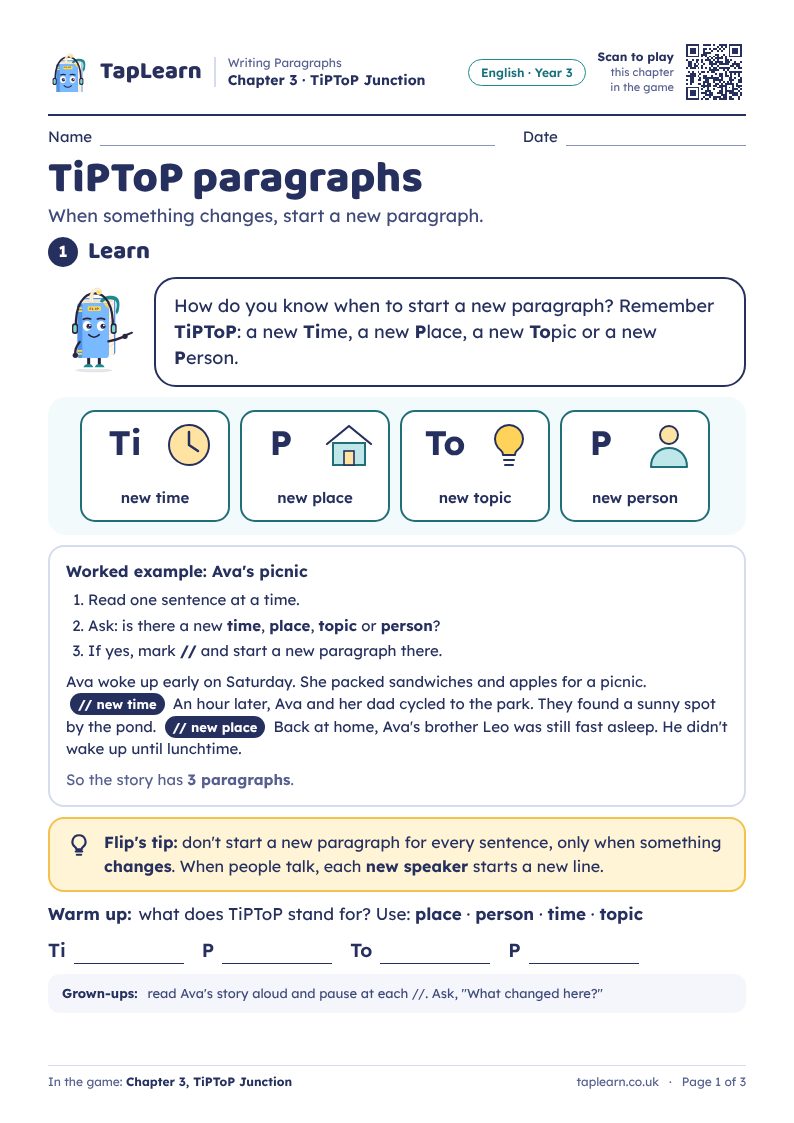
TiPToP Paragraphs is a printable when to start a new paragraph worksheet for Year 3 (ages 7 to 8) that teaches the TiPToP rule: start a new paragraph for a new time, place, topic or person. Children name the change in pairs of sentences, mark // in a story about a den and set out speech with a new line for each speaker.
This worksheet is for members
Membership opens every chapter of every game and every worksheet, for all your children.
See the plansAlready a member? Log in to print it.
Start with the free one: What is a paragraph? (chapter 1).
Print it on A4, in colour or black and white. Do it after the chapter, or before it to see what your child already knows.
What's on the worksheet
Your child uses TiPToP to decide when to start a new paragraph: a new time, place, topic or person, and a new line for each speaker. Includes a clap-the-change activity and an answers sheet.
- Page 1 · Learn
- What TiPToP stands for, a worked example marking two new paragraphs in Ava's picnic story, Flip's tip on not starting one for every sentence, and a TiPToP warm-up.
- Page 2 · Try it together
- Clap the change: the child retells their day out loud while the grown-up claps each time the time or place changes, then swap, and write a paragraph plan of the day.
- Page 3 · Practise
- Write time, place, topic or person for each change, tick new or same paragraph, mark // in a den story, set out a conversation, and a challenge about too many paragraphs.
- Answers sheet
- Every answer, mix-ups like two speakers on one line, and story-relay ideas.
3 A4 pages and an answers sheet · about 25 minutes
In the classroom
- Play story relay: pupils add a sentence each and call "new paragraph!" when they change the time or place.
- Use Practise C on the board and mark the // together, naming each change.
Questions from the worksheet
- What changed after the line? Write time, place, topic or person. Sam played football all morning. | That afternoon, he went swimming.
- Does the second sentence need a new paragraph, or the same one? The cake cooled on the table. The next day, we ate it at Gran's party.
- This story should have 3 paragraphs. Mark // where each new paragraph starts. Write what changed above each //.
- Two people are talking. Write it out again, starting a new line for each new speaker.
- Sam starts a new paragraph for every sentence. He says, "More paragraphs make my writing better!" Is he right? What would you tell him?
The answers are on the answers sheet, for grown-ups.
Using it at home
- Read Ava's story aloud and pause at each //. Ask, "What changed here?"
- In clap the change, listen for change words like "after tea" or "when we got home".
- When reading together, ask which TiPToP change started each new paragraph.
Watch out for
- Starting a new paragraph for every sentence.
- Ask, "What has changed here?" If nothing has, it stays in the same paragraph.
- Missing a change.
- Point out clue words at the start of sentences: "That night", "Later", "Inside the house", "Meanwhile".
- Putting two speakers on one line.
- Each time a different person speaks, start a new line.
Questions and answers
What does TiPToP mean in writing?
TiPToP is a way to remember when to start a new paragraph: a new Time, a new Place, a new Topic or a new Person.
When should you start a new paragraph?
Start a new paragraph when something changes, such as the time, the place, the topic or the person. Don't start one for every sentence.
Do you start a new line for speech?
Yes. Each time a different person speaks, start a new line.
 TapLearn