Grouping sentences worksheet for Year 3: Sorting sentences
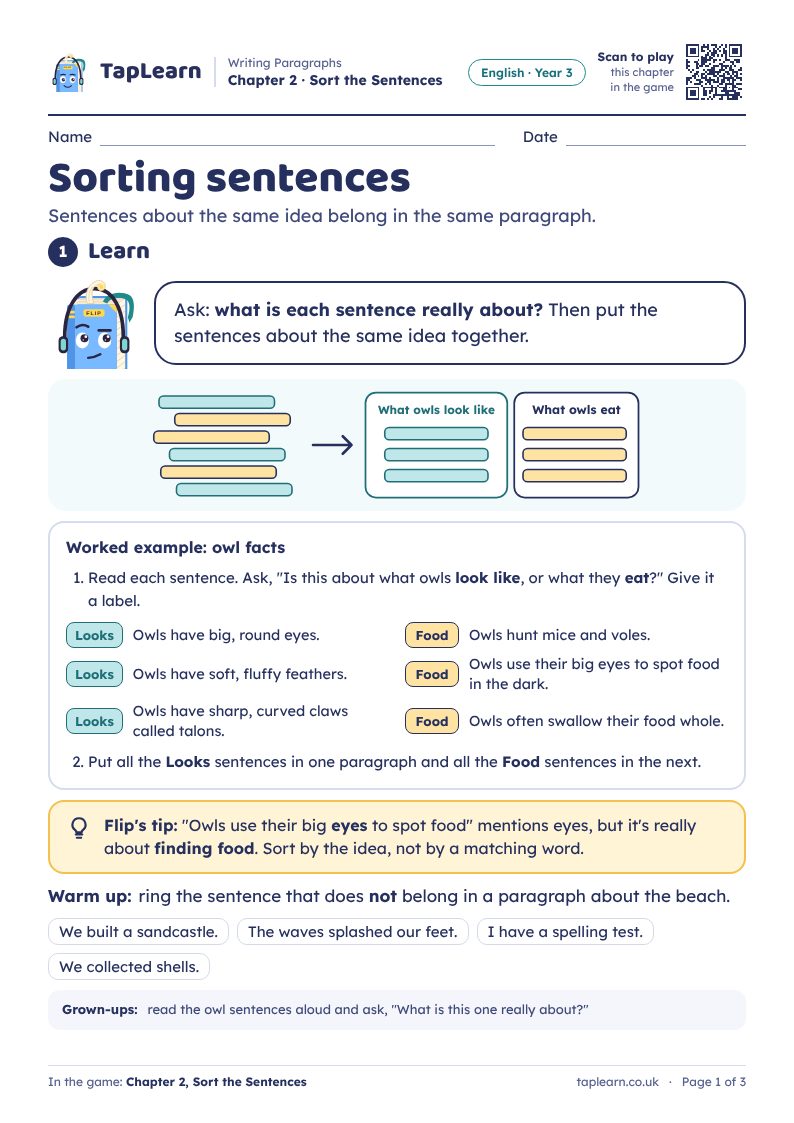
Sorting Sentences is a printable grouping sentences worksheet for Year 3 (ages 7 to 8) that teaches children to ask what each sentence is really about and put sentences on the same idea into one paragraph. Children sort facts about a dog, cross out sentences that don't belong and add sentences to a paragraph about the weekend.
This worksheet is for members
Membership opens every chapter of every game and every worksheet, for all your children.
See the plansAlready a member? Log in to print it.
Start with the free one: What is a paragraph? (chapter 1).
Print it on A4, in colour or black and white. Do it after the chapter, or before it to see what your child already knows.
What's on the worksheet
Your child sorts sentences about the same idea into one paragraph and spots a sentence that doesn't belong, even when it shares a word. Includes a fact-piles sorting activity and an answers sheet.
- Page 1 · Learn
- Two paragraphs about owls, a worked example labelling owl facts as looks or food, Flip's tip to sort by idea and not a matching word, and a which-doesn't-belong warm-up.
- Page 2 · Try it together
- Fact piles: choose an animal and two ideas, such as what it looks like and what it eats, write 6 facts on scraps of paper, mix them up and sort them into two piles.
- Page 3 · Practise
- Label sentences about Max the dog as food or play, cross out the sentence that doesn't belong, sort library and playground sentences, add two sentences, and a challenge.
- Answers sheet
- Every answer, mix-ups like grouping by a matching word, and odd-one-out and shopping-sort ideas.
3 A4 pages and an answers sheet · about 25 minutes
In the classroom
- Play odd one out as a starter: say three sentences on one idea and one off-topic for pupils to spot.
- Run fact piles in pairs with sentence strips about a class topic.
Questions from the worksheet
- Is each sentence about Max the dog's food or how he plays? Write F or P. Max loves crunchy carrots. Max chases his red ball round the garden.
- Each paragraph has one sentence that doesn't belong. Cross it out. Rain falls from clouds. It fills puddles and helps plants grow. My cousin has a new bike. Rain is made of tiny drops of water.
- Sort these sentences into a paragraph about the library and a paragraph about the playground.
- This paragraph is about what I like to do at the weekend. Add two more sentences that belong.
- Mia put "Frogs lay their eggs in water" and "I drink a glass of water at lunch" in the same paragraph because they both say "water". Is she right? Why?
The answers are on the answers sheet, for grown-ups.
Using it at home
- Read the owl sentences aloud and ask, "What is this one really about?"
- In fact piles, if a fact fits both piles, ask, "What is it mostly about?" and let your child decide.
- When unpacking shopping, say which pile each item would go in: fridge, cupboard or fruit bowl.
Watch out for
- Grouping by a matching word instead of the idea, like "foot" and "football".
- Ask, "What is this sentence really telling us about?"
- Leaving an off-topic sentence in.
- Read the paragraph aloud and ask, "Does every sentence fit the idea?"
Questions and answers
How do you group sentences into paragraphs?
Ask what each sentence is really about, then put the sentences about the same idea together in one paragraph.
Can two sentences with the same word go in different paragraphs?
Yes. Sentences belong together because they share an idea, not a word. "Frogs lay eggs in water" and "I drink water" are about different things.
What should you do with a sentence that doesn't fit?
Take it out of the paragraph. It usually belongs in a different paragraph, or not at all.
 TapLearn