A or an worksheet for Year 3: A or an?
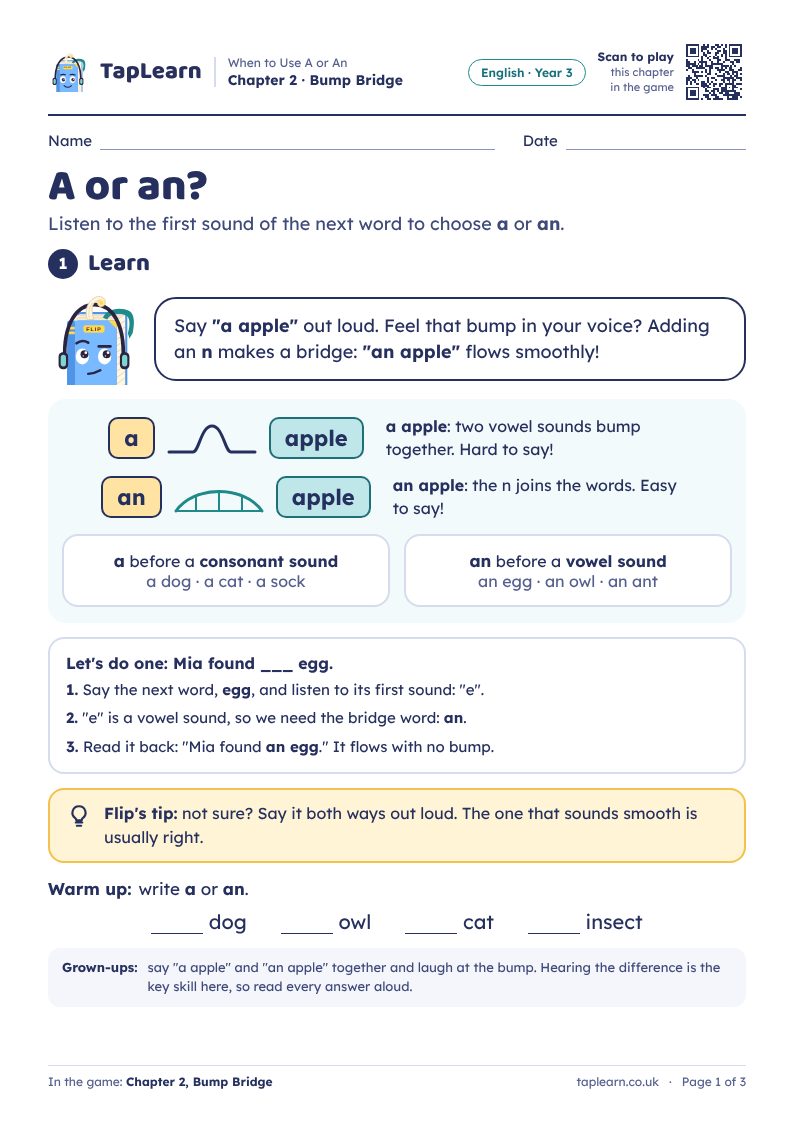
A or An? is a printable a or an worksheet for Year 3 (ages 7 to 8) that teaches children to use a before a consonant sound and an before a vowel sound, and that the n in an stops two vowel sounds bumping, as in an apple. It covers the Year 3 statement on using a or an according to whether the next word begins with a consonant or a vowel.
This worksheet is for members
Membership opens every chapter of every game and every worksheet, for all your children.
See the plansAlready a member? Log in to print it.
Start with the free one: Vowels and consonants (chapter 1).
Print it on A4, in colour or black and white. Do it after the chapter, or before it to see what your child already knows.
What's on the worksheet
Your child uses a before a consonant sound (a dog) and an before a vowel sound (an egg), and hears why an makes words easier to say together. Includes a mystery bag guessing game and an answers sheet.
- Page 1 · Learn
- "a apple" and "an apple" compared, a before consonant sounds and an before vowel sounds, a worked example with "Mia found an egg", Flip's say-it-both-ways tip, and a warm-up.
- Page 2 · Try it together
- Mystery bag: the grown-up puts safe things like an apple, an orange and a sock in a bag, the child feels one and guesses with a or an, then you check its first sound and swap.
- Page 3 · Practise
- Write a or an, tick and correct phrases like "a apple", fill gaps in sentences, write your own a and an sentences, and a challenge about "a octopus".
- Answers sheet
- Every answer, mix-ups like "an dog", and I-went-shopping and animal-a-or-an ideas.
3 A4 pages and an answers sheet · about 20 minutes
Using it at home
- Say "a apple" and "an apple" together and laugh at the bump. Hearing the difference is the key skill, so read every answer aloud.
- For the mystery bag, put in at least three things that start with a vowel sound. If your child says "a orange", say both versions and ask which is smoother.
- Name an animal and your child says it with a or an: an eagle, a tiger, an iguana.
Watch out for
- Saying "a apple" or "a egg".
- It's very common in speech. Say both versions and ask, "Which one has a bump?"
- Over-using an, like "an dog".
- Sometimes children over-use an once they learn it. Listen to the first sound of the next word.
- Being puzzled by words starting with u.
- Umbrella takes an, but unicorn takes a: the first sound decides.
Questions from the worksheet
- Write a or an: ant, bed, igloo, lemon, orange, umbrella, rabbit, elephant.
- Tick the ones that are right. Cross the wrong ones and write them correctly: a apple, an dog, an elephant, a ostrich, a pencil, an ink pot.
- Fill each gap with a or an: I saw ___ owl sitting in the tree. There is ___ insect crawling on my arm!
- Ava says, "A octopus sounds fine to me." Is she right? Explain why we say an octopus.
The answers are on the answers sheet, for grown-ups.
National curriculum in England
This worksheet practises this statement from the Year 3 english programme of study:
- Word: use of the forms a or an according to whether the next word begins with a consonant or a vowel
In the classroom
- Play I went shopping round the class, adding items with a or an.
- Use Practise C as a mini-whiteboard a-or-an check.
Questions and answers
When do you use a or an?
Use a before a word that starts with a consonant sound (a dog) and an before a word that starts with a vowel sound (an egg).
Why do we say an apple, not a apple?
In "a apple" two vowel sounds bump together. The n in an joins the words so they flow smoothly.
How can children check a or an?
Say it both ways out loud. The one that sounds smooth is usually right.
 TapLearn