A or an before adjectives worksheet for Year 3: The very next word
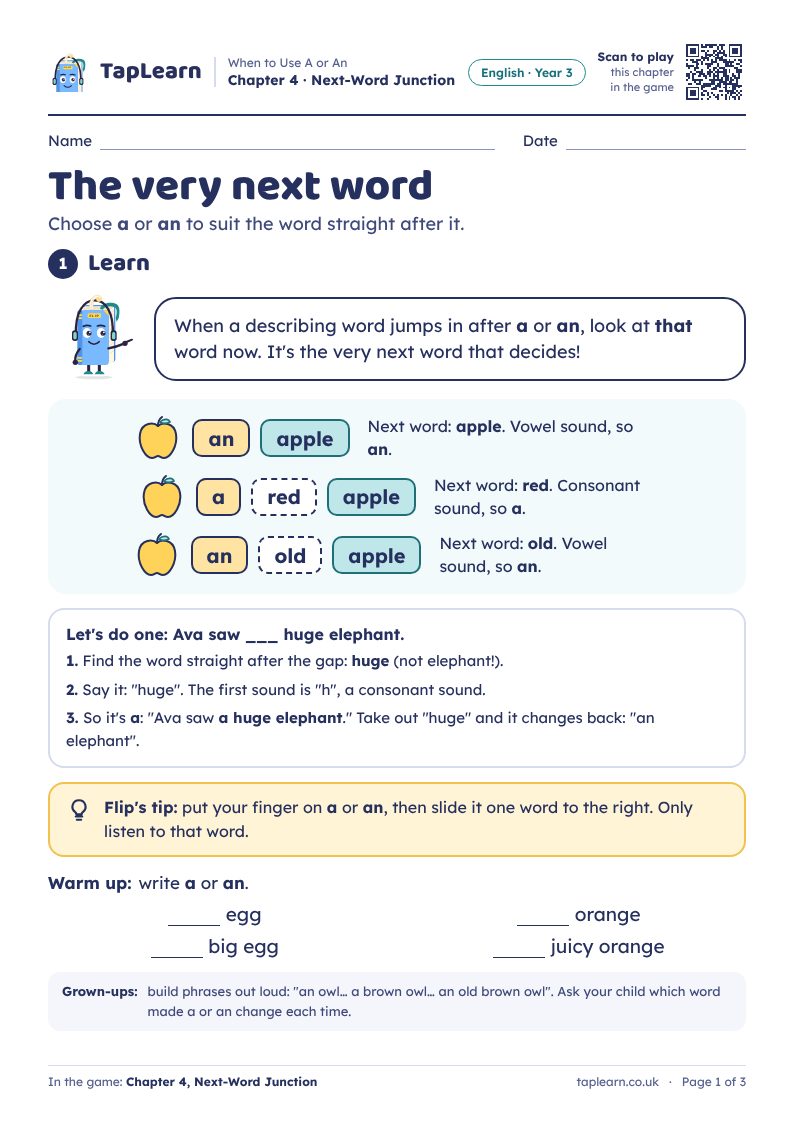
The Very Next Word is a printable a or an before adjectives worksheet for Year 3 (ages 7 to 8) that teaches children that the word straight after a or an decides which to use, so it's an apple but a red apple. It covers the Year 3 statement on using a or an according to whether the next word begins with a consonant or a vowel.
This worksheet is for members
Membership opens every chapter of every game and every worksheet, for all your children.
See the plansAlready a member? Log in to print it.
Start with the free one: Vowels and consonants (chapter 1).
Print it on A4, in colour or black and white. Do it after the chapter, or before it to see what your child already knows.
What's on the worksheet
Your child chooses a or an to suit the word straight after it, even when a describing word comes first: a red apple, an old dog. Includes a describe-it game with things from home and an answers sheet.
- Page 1 · Learn
- An apple, a red apple and an old apple compared, a worked example with "a huge elephant", Flip's finger-slide tip, and a warm-up with egg and big egg.
- Page 2 · Try it together
- Describe it!: hold up a thing and name it with a or an, the other person adds a describing word ("a brown egg!"), then try to find one that switches it back.
- Page 3 · Practise
- Write a or an before describing words, add describing words and change a or an, fix four mistakes in Leo's story, write your own sentence, and a challenge about a balloon.
- Answers sheet
- Every answer, mix-ups like "an red apple", and grow-the-phrase and proofreading ideas.
3 A4 pages and an answers sheet · about 20 minutes
Using it at home
- Build phrases out loud ("an owl… a brown owl… an old brown owl") and ask which word made a or an change.
- In describe it!, describing words that start with a vowel sound, like old, empty, enormous, orange and itchy, switch a to an.
- Look back at your child's own writing together and check each a and an against the next word.
Watch out for
- Matching a or an to the naming word, like "an red apple".
- Use the finger slide: one word to the right of a or an, and only that word.
- Forgetting tricky words after a describing word, like "an unicorn".
- Say it aloud and listen to the first sound.
Questions from the worksheet
- Write a or an. Look only at the very next word: old car, new car, empty box, full box, tiny ant, itchy jumper, ugly troll.
- Add the describing word. Write the new phrase, and change a or an if you need to: an egg + big; a cat + angry; an owl + brown; a box + empty.
- Leo's story has 4 mistakes with a and an. Ring each one, then write it correctly: "Leo found an red apple and a old map in the garden…"
- Mia wrote "an orange balloon" and "an big orange balloon". One is right and one is wrong. Which is wrong, and why?
The answers are on the answers sheet, for grown-ups.
National curriculum in England
This worksheet practises this statement from the Year 3 english programme of study:
- Word: use of the forms a or an according to whether the next word begins with a consonant or a vowel
In the classroom
- Play grow the phrase round the class, saying a or an each time a word is added.
- Use Leo's story as a whole-class proofreading task.
Questions and answers
Does a or an go with the noun or the next word?
With the very next word. It's an apple, but a red apple, because red starts with a consonant sound.
Is it an orange balloon or a orange balloon?
It's an orange balloon, because orange starts with a vowel sound. But it's a big orange balloon.
How can children check a or an before a describing word?
Put a finger on a or an, slide it one word to the right, and listen only to that word's first sound.
 TapLearn