Vowels and consonants worksheet for Year 3
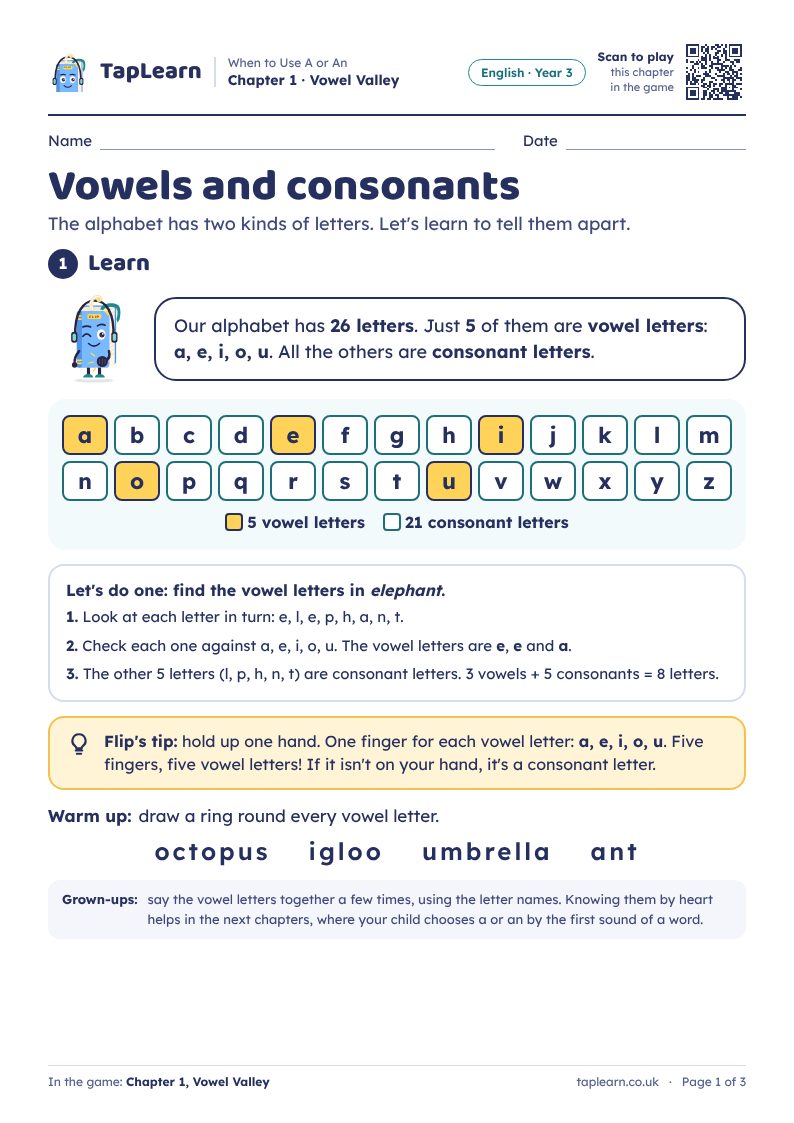
Vowels and Consonants is a printable vowels and consonants worksheet for Year 3 (ages 7 to 8) that teaches children the five vowel letters, a, e, i, o and u, and that the other 21 letters are consonants, using a one-hand trick. It covers the Year 3 statement on using a or an according to whether the next word begins with a consonant or a vowel.
Free to print, no account needed.
Print it on A4, in colour or black and white. Do it after the chapter, or before it to see what your child already knows.
What's on the worksheet
Your child learns the five vowel letters (a, e, i, o, u) and the 21 consonant letters, and spots them in words: the first step to choosing a or an. Includes a kitchen letter hunt and an answers sheet.
- Page 1 · Learn
- The alphabet split into 5 vowel and 21 consonant letters, a worked example finding the vowels in elephant, Flip's five-fingers tip, and a ring-the-vowels warm-up.
- Page 2 · Try it together
- Kitchen letter hunt: write the names of five things in the kitchen, ring each vowel letter, count the vowels and consonants, and spot which name starts with a vowel.
- Page 3 · Practise
- Sort letters into vowels and consonants, write a word starting with each vowel, label first letters V or C, add missing vowels to clue words, and a challenge about 20 consonants.
- Answers sheet
- Every answer, mix-ups like calling t a vowel, and a vowel-clap idea.
3 A4 pages and an answers sheet · about 20 minutes
Using it at home
- Say the vowel letters together a few times, using the letter names. Knowing them by heart helps with choosing a or an later.
- In the kitchen hunt, include something whose name starts with a vowel, like an apple, an orange or an egg.
- Spell a word aloud letter by letter and your child claps on every vowel letter.
Watch out for
- Calling a consonant letter a vowel, often t, m or a letter in the child's name.
- Go back to the hand: a, e, i, o, u. Is it on your hand?
- Mixing up letter names and sounds.
- Here we're sorting the letters themselves. Later, the first sound matters most for a or an.
- Being unsure about the letter y.
- In some words y makes a vowel sound (my, gym), but it is counted as a consonant letter in this work.
Questions from the worksheet
- Sort the letters. Write each one in the right box, vowel or consonant: t, a, m, e, s, o, b, i, k, u, r, g.
- Write a word that starts with each vowel letter: a, e, i, o, u.
- Look at the first letter of each word. Write V for a vowel letter or C for a consonant letter: apple, dog, egg, monkey, insect, table, owl, uncle.
- Each word is missing its vowel letter. Read the clue and write the missing vowel: A pet that barks: d_g. A farm animal that says oink: p_g.
- Mia says, "There are 5 vowel letters, so there must be 20 consonant letters." Is she right? Show how you know.
The answers are on the answers sheet, for grown-ups.
National curriculum in England
This worksheet practises this statement from the Year 3 english programme of study:
- Word: use of the forms a or an according to whether the next word begins with a consonant or a vowel
In the classroom
- Play vowel clap as a whole-class starter.
- Use Practise C as a quick V-or-C mini-whiteboard check.
Questions and answers
What are the vowel letters?
The five vowel letters are a, e, i, o and u. All the other 21 letters of the alphabet are consonant letters.
How many consonants are in the alphabet?
There are 21 consonant letters: 26 letters minus the 5 vowel letters.
Why do vowels matter for a or an?
We use an before a word that starts with a vowel sound, like an egg, so children need to know the vowels first.
 TapLearn