Friction on different surfaces worksheet for Year 3: Rough and smooth surfaces
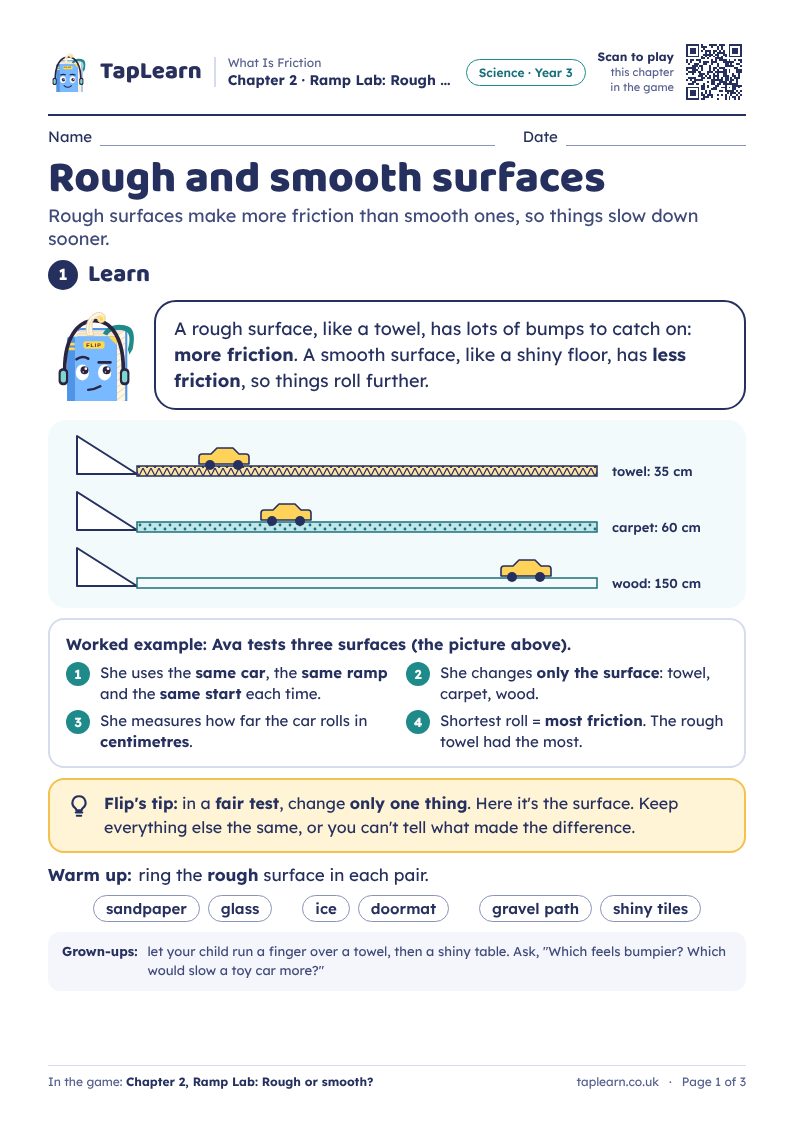
Rough and Smooth Surfaces is a printable friction on different surfaces worksheet for Year 3 (ages 7 to 8) that teaches children that rough surfaces make more friction than smooth ones and how to plan a fair test. It follows the Year 3 national curriculum in England: compare how things move on different surfaces.
This worksheet is for members
Membership opens every chapter of every game and every worksheet, for all your children.
See the plansAlready a member? Log in to print it.
Start with the free one: What is friction? (chapter 1).
Print it on A4, in colour or black and white. Do it after the chapter, or before it to see what your child already knows.
What's on the worksheet
Compare how far a toy car rolls on rough and smooth surfaces, read results and plan a fair test that changes only the surface. With a hands-on ramp test, practice questions and answers.
- Page 1 · Learn
- Flip compares rough and smooth surfaces, a picture shows one car rolling 35 cm on a towel, 60 cm on carpet and 150 cm on wood, and a worked example explains Ava's fair test. A warm-up rings rough surfaces.
- Page 2 · Try it together
- Ramp test: lean a tray on some books, let a toy car roll onto a smooth floor, a towel and a rug from the same start line, and measure each roll in centimetres.
- Pages 2–3 · Practise
- Ring which surface stops a car sooner, read Leo's results table and put surfaces in order, decide what to change and keep the same, and spot an unfair test. Then a challenge about ice.
- Answers sheet
- Every answer by page, what to watch out for (mixing up rough and smooth, thinking ice has no friction, changing two things at once) and quick ideas to go further.
3 A4 pages and an answers sheet · about 30 minutes
Using it at home
- Set up the ramp test on a hard floor with a tray and a few books. Roll the car once on each surface, then a second time if a result looks odd.
- If your child gives the car a push, ask, "Is that still fair?" Letting it go from the same line each time is the key idea of this sheet.
Watch out for
- Mixing up rough and smooth, thinking smooth surfaces make more friction.
- Ask, "Did the car go further or less far on it?" Less far means more friction, and that surface is the rougher one.
- Thinking very smooth surfaces, like ice, have no friction at all.
- Smooth surfaces have less friction, not none. A skater who stops pushing still slows down and stops in the end.
- Changing more than one thing at a time in a test.
- Ask, "If it rolled further, was it the car or the surface?" Change only the surface and keep the car, ramp and start the same.
Questions from the worksheet
- A toy car rolls onto each surface. Ring the surface where it will stop sooner: a sheet of foil or a woolly rug?
- Leo's car rolled 40 cm on grass, 300 cm on ice, 70 cm on carpet and 160 cm on tiles. Which surface had the most friction?
- Mia wants to find out if the surface changes how far a car rolls. Should she change or keep the same: the toy car, the ramp height, the start?
- Test 1: a small car on a low ramp onto carpet. Test 2: a big truck on a high ramp onto wood. Is this a fair test? Explain why.
- Ava says, "Ice is so smooth that it has no friction at all." Is she right?
The answers are on the answers sheet, for grown-ups.
National curriculum in England
This worksheet practises these statements from the Year 3 science programme of study:
- Compare how things move on different surfaces
- Notice that some forces need contact between 2 objects, but magnetic forces can act at a distance
Source: National curriculum in England: science programmes of study (DfE)
In the classroom
- Run the ramp test in groups with one surface each, then pool the results on the board and order the surfaces together.
- Use Sam's unfair test (set D) as a talk-partner question: how many things did he change, and which one should he keep?
Questions and answers
Do rough surfaces make more friction?
Yes. Rough surfaces have more bumps that catch as things rub over them, so they make more friction. A toy car rolls a shorter way on a towel or carpet than on a smooth floor.
How do you make a friction test fair in Year 3?
Change only one thing, the surface, and keep everything else the same: the same car, the same ramp height and the same start line, with no push. Then any difference must be caused by the surface.
Does ice have friction?
Yes, but very little. Ice is very smooth, so things slide a long way on it, but they still slow down and stop in the end because some friction is there.
 TapLearn