Reducing friction worksheet for Year 3
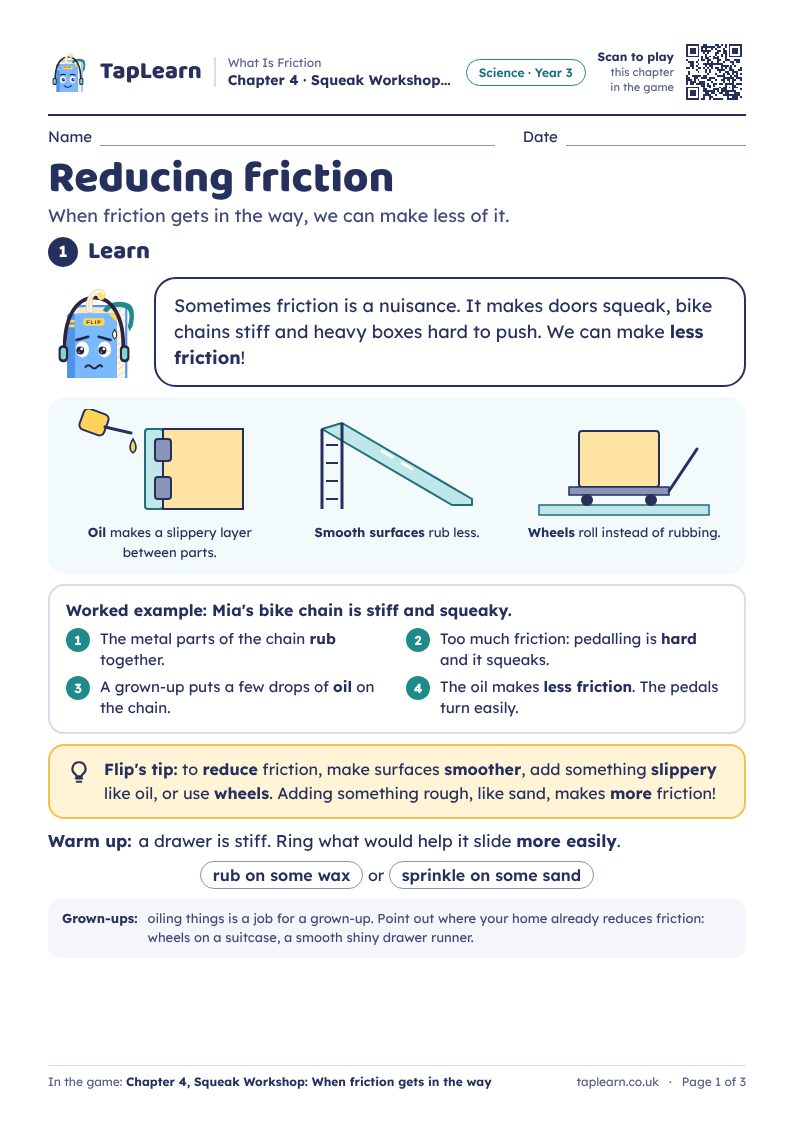
Reducing Friction is a printable reducing friction worksheet for Year 3 (ages 7 to 8) that teaches children to spot when friction gets in the way and to reduce it with oil, smoother surfaces or wheels. It follows the Year 3 national curriculum in England: compare how things move on different surfaces.
This worksheet is for members
Membership opens every chapter of every game and every worksheet, for all your children.
See the plansAlready a member? Log in to print it.
Start with the free one: What is friction? (chapter 1).
Print it on A4, in colour or black and white. Do it after the chapter, or before it to see what your child already knows.
What's on the worksheet
Spot when friction gets in the way and learn ways to reduce it, such as oil, smooth surfaces and wheels. With a hands-on test rolling a heavy book on pencils, practice questions and answers.
- Page 1 · Learn
- Flip shows three ways to reduce friction: oil on a hinge, a smooth slide and a box on wheels, then a worked example of oiling a squeaky bike chain. A warm-up chooses wax or sand for a stiff drawer.
- Page 2 · Try it together
- Roll it, don't drag it: push a heavy book with one finger on a bare table, on a tea towel and on a row of round pencils, and rate how easy each push feels.
- Pages 2–3 · Practise
- Ring the way that makes less friction, match problems to fixes, write two ways to move a heavy toy box more easily and explain ice skates. Then a challenge about sand on a slide.
- Answers sheet
- Every answer by page, what to watch out for (adding something rough to make things move, mixing up helping and in the way) and quick ideas to go further.
3 A4 pages and an answers sheet · about 30 minutes
Using it at home
- Do the book and pencils test on a kitchen table: it takes about 10 minutes, and feeling the difference in the push is the heart of the sheet.
- Keep oiling as a grown-up job. Instead, let your child spot things at home that already reduce friction, like suitcase wheels and smooth drawer runners.
Watch out for
- Thinking adding something rough, like sand, makes things move more easily.
- Ask, "Does sand feel smooth or bumpy?" Rough, gritty things make more friction, so moving gets harder, not easier.
- Mixing up when friction helps and when it gets in the way.
- Ask, "Do we want this to move easily?" If yes, friction is in the way and we reduce it. Brakes and shoe soles need it.
Questions from the worksheet
- Ring the way that makes less friction: for a squeaky hinge, a drop of oil or a pinch of sand?
- Draw a line to match each problem to a way to fix it: a squeaky door hinge, a heavy suitcase, a rough slow slide.
- Ava is pushing a heavy toy box across the carpet. Write two ways she could make it easier.
- Ice skates have smooth metal blades. Why do they help a skater glide? Use the word friction.
- Sam says, "Let's sprinkle sand on the slide so we go down faster." Is Sam right? Explain what would happen.
The answers are on the answers sheet, for grown-ups.
National curriculum in England
This worksheet practises these statements from the Year 3 science programme of study:
- Compare how things move on different surfaces
- Notice that some forces need contact between 2 objects, but magnetic forces can act at a distance
Source: National curriculum in England: science programmes of study (DfE)
In the classroom
- Run the book on pencils test in pairs, then discuss why heavy things such as suitcases and trolleys have wheels.
- Use the sand on the slide challenge as an exit question on mini-whiteboards: right or wrong, and why?
Questions and answers
How can you reduce friction?
You can reduce friction by making surfaces smoother, adding something slippery such as oil between moving parts, or using wheels or rollers so things roll instead of rubbing.
Why does oil reduce friction?
Oil makes a thin slippery layer between two surfaces, so they rub less. That is why a few drops of oil stop a door hinge squeaking and help a bike chain turn easily.
When does friction get in the way?
Friction gets in the way when we want something to move easily, such as pushing a heavy box, opening a stiff door or going down a slide. It also wears parts down and can make them squeak.
 TapLearn