Friction worksheet for Year 3: What is friction?
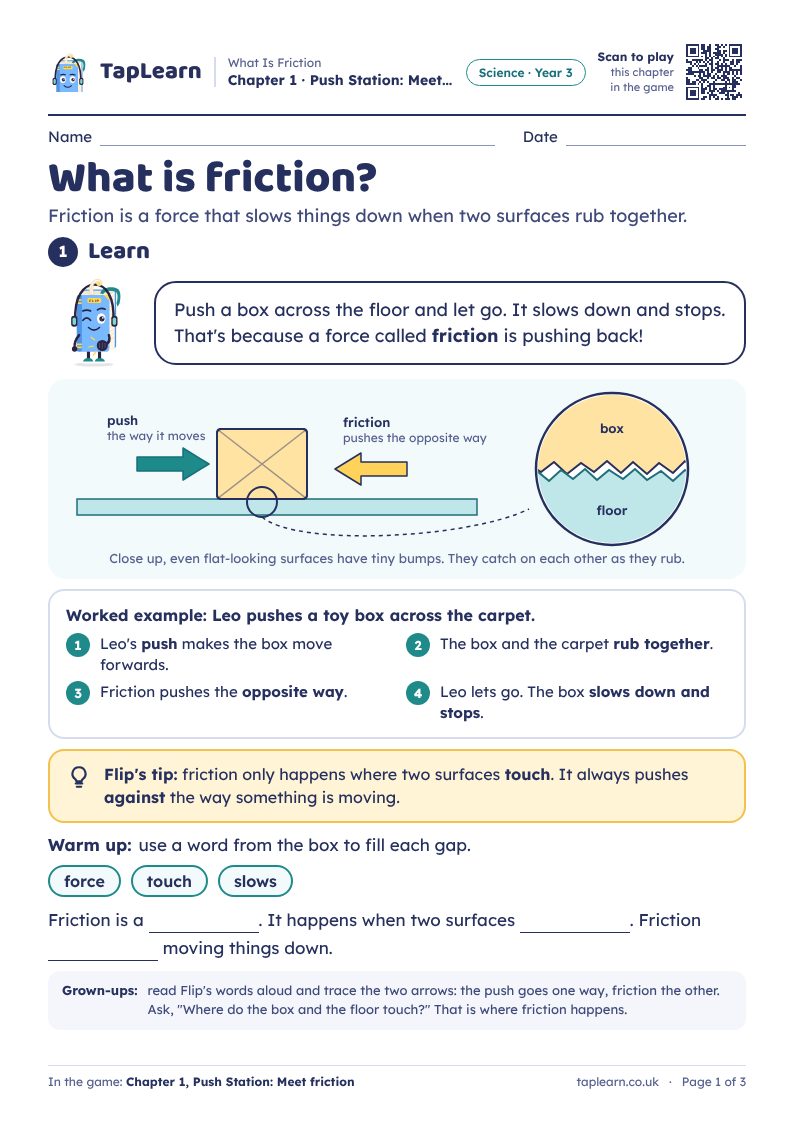
What Is Friction? is a printable friction worksheet for Year 3 (ages 7 to 8) that teaches children that friction is a force between two touching surfaces which pushes against movement and slows things down. It follows the Year 3 national curriculum in England: notice that some forces need contact between two objects, and compare how things move on different surfaces.
Free to print, no account needed.
Print it on A4, in colour or black and white. Do it after the chapter, or before it to see what your child already knows.
What's on the worksheet
Learn that friction is a force between two surfaces that touch, that it pushes against movement and slows things down. With a slide-and-stop activity using a book, practice questions and answers.
- Page 1 · Learn
- Flip explains friction with a picture of a pushed box and a close-up of the tiny bumps that catch, then a four-step worked example of Leo pushing a toy box. A warm-up fills gaps with force, touch and slows.
- Page 2 · Try it together
- Slide and stop: rub palms together to feel friction, then give a book a gentle, medium and strong push across a table and measure how far it slides in hand spans.
- Pages 2–3 · Practise
- Draw friction arrows on a sledge, a box and a toy car, ring true or false, ring where surfaces rub, and explain why a rolling ball stops. Then a challenge about a box that 'ran out of push'.
- Answers sheet
- Every answer by page, what to watch out for (thinking things run out of push, friction arrows pointing the wrong way) and three quick ideas to go further without paper.
3 A4 pages and an answers sheet · about 25 minutes
In the classroom
- Use the true or false set as a quick show-me check with mini-whiteboards or thumbs up and down.
- Run Slide and stop in pairs with reading books on tables, then share which push went furthest and why every book still stopped.
Questions from the worksheet
- Each thing is moving the way the teal arrow points. Draw an arrow to show which way friction pushes.
- True or false: friction pushes the same way that something is moving.
- Mia rolls a ball across the playground. It slows down and stops. Explain why. Use the word friction.
- Sam says, "It stopped because it ran out of push." Is Sam right? What really made the box stop?
The answers are on the answers sheet, for grown-ups.
National curriculum in England
This worksheet practises these statements from the Year 3 science programme of study:
- Compare how things move on different surfaces
- Notice that some forces need contact between 2 objects, but magnetic forces can act at a distance
Source: National curriculum in England: science programmes of study (DfE)
Using it at home
- Start with Try it together: feeling a book slow down on the table makes the idea of friction real before any writing. It takes about 10 minutes.
- When your child draws a friction arrow, ask them to show you with their hand which way the thing moves first, then point the other way.
Watch out for
- Thinking moving things stop because they run out of push.
- Ask, "What was slowing it down?" and point to where it touched the floor: friction there pushes against it until it stops.
- Drawing the friction arrow the same way as the movement.
- Slide your hand along the table and feel it being held back. Friction always points against the way something moves.
Questions and answers
What is friction in Year 3 science?
Friction is a force that acts when two surfaces rub together. It pushes against the way something is moving, so it slows moving things down. In Year 3, children learn it is a contact force: the surfaces have to touch.
Why does a ball stop rolling?
A rolling ball stops because friction between the ball and the ground pushes against its movement. It does not run out of push: once nothing is pushing it, friction slows it until it stops.
Is friction a contact force?
Yes. Friction only happens where two surfaces touch. Magnetic forces are different, because magnets can push or pull without touching.
 TapLearn