Useful friction worksheet for Year 3: When friction helps
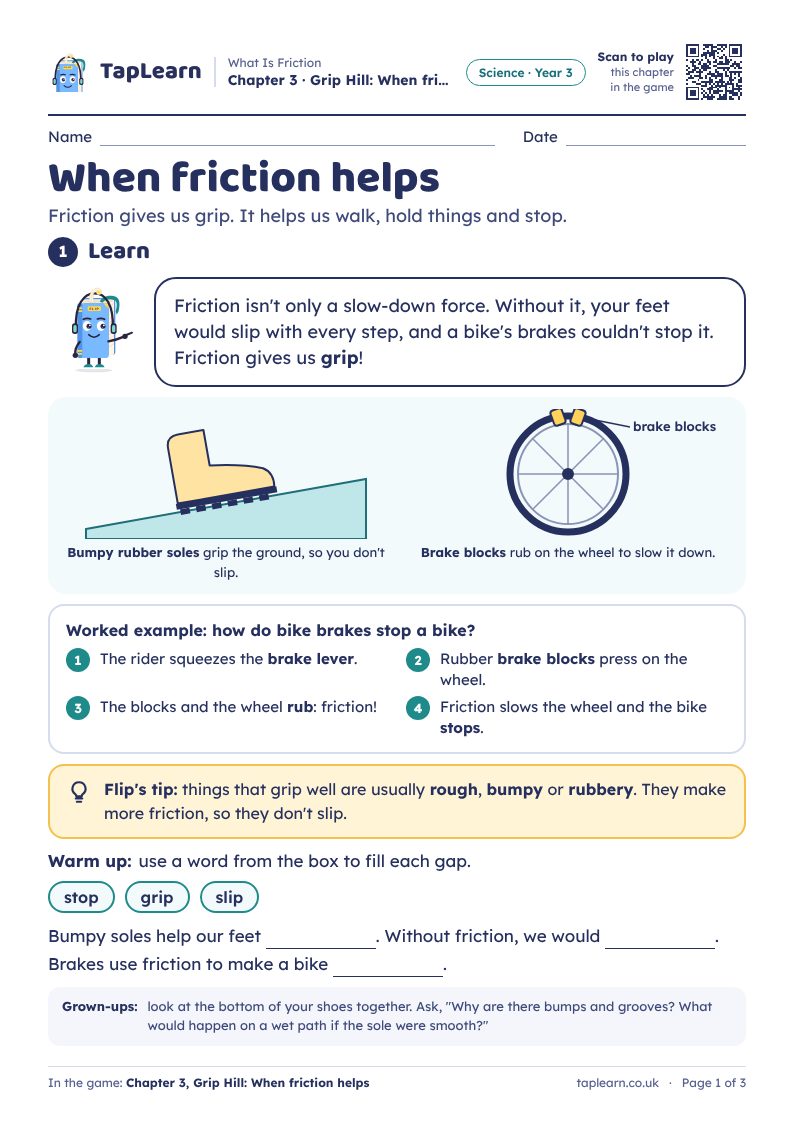
When Friction Helps is a printable useful friction worksheet for Year 3 (ages 7 to 8) that teaches children how friction gives us grip for walking, holding things and braking. It follows the Year 3 national curriculum in England: compare how things move on different surfaces and notice that some forces need contact between two objects.
This worksheet is for members
Membership opens every chapter of every game and every worksheet, for all your children.
See the plansAlready a member? Log in to print it.
Start with the free one: What is friction? (chapter 1).
Print it on A4, in colour or black and white. Do it after the chapter, or before it to see what your child already knows.
What's on the worksheet
Spot when friction is helpful, such as for grip, walking and bike brakes, and why grippy things are rough or rubbery. With a grip slope test using a tray and small objects, practice questions and answers.
- Page 1 · Learn
- Flip explains grip with pictures of a bumpy boot sole on a slope and brake blocks on a bike wheel, then a four-step worked example of how bike brakes stop a bike. A warm-up fills gaps with grip, slip and stop.
- Page 2 · Try it together
- Grip slope: put a rubber, a coin, a plastic lid and a sock on a tray, slowly lift one end and record the order they slide off and what each surface is like.
- Pages 2–3 · Practise
- Match grippy things to how they help, ring whether friction is helping or in the way, explain football boot studs and design a welly sole for ice. Then a challenge about smooth shoes.
- Answers sheet
- Every answer by page, what to watch out for (thinking smooth things grip better, mixing up helping and in the way) and quick ideas to go further.
3 A4 pages and an answers sheet · about 30 minutes
Using it at home
- Before the sheet, turn over a few pairs of shoes together and compare the soles. Ask which would be best on a muddy field and why.
- In the grip slope, lift the tray slowly and let your child call out each slide. Guessing first, then checking, matters more than the exact order.
Watch out for
- Thinking smooth or slippery things give better grip.
- Put a plastic lid and a rubber on a sloping book: the rubber grips longer. Rough and rubbery means more friction and more grip.
- Mixing up when friction helps and when it gets in the way.
- Ask, "Do we want it to grip or slow down here?" If yes, friction is helping. If it makes a job harder, it is in the way.
Questions from the worksheet
- Draw a line to match each thing to how friction helps: trainers with bumpy soles, bike brakes, a rubber bath mat, deep grooves on tyres.
- Is friction helping or getting in the way when you push a heavy box across a carpet?
- Football boots have studs on the bottom. Why? Use the word grip or friction.
- Design a sole for a welly boot to wear on an icy path. Draw it and label what makes it grip.
- Leo says, "Smooth, shiny shoes would be best for running on a wet floor." Is he right? Explain.
The answers are on the answers sheet, for grown-ups.
National curriculum in England
This worksheet practises these statements from the Year 3 science programme of study:
- Compare how things move on different surfaces
- Notice that some forces need contact between 2 objects, but magnetic forces can act at a distance
Source: National curriculum in England: science programmes of study (DfE)
In the classroom
- Collect a few shoes and let groups rank the soles for grip before testing them on a sloping board.
- Use set B as a quick vote: hands up for helping, hands on heads for in the way, then ask a few children to explain.
Questions and answers
How is friction useful?
Friction gives us grip. It stops our feet slipping when we walk, helps us hold a pencil, lets tyres grip the road and lets brakes slow a bike or car down.
Why do shoes have grooves on the bottom?
Grooves and bumps make the sole rough, which makes more friction with the ground. That gives better grip, so you are less likely to slip, especially on wet or muddy ground.
How do bike brakes use friction?
Squeezing the brake lever presses rubber brake blocks onto the wheel. The blocks rub on the wheel, and that friction slows the wheel until the bike stops.
 TapLearn