Skeleton functions worksheet for Year 3: Skeleton jobs
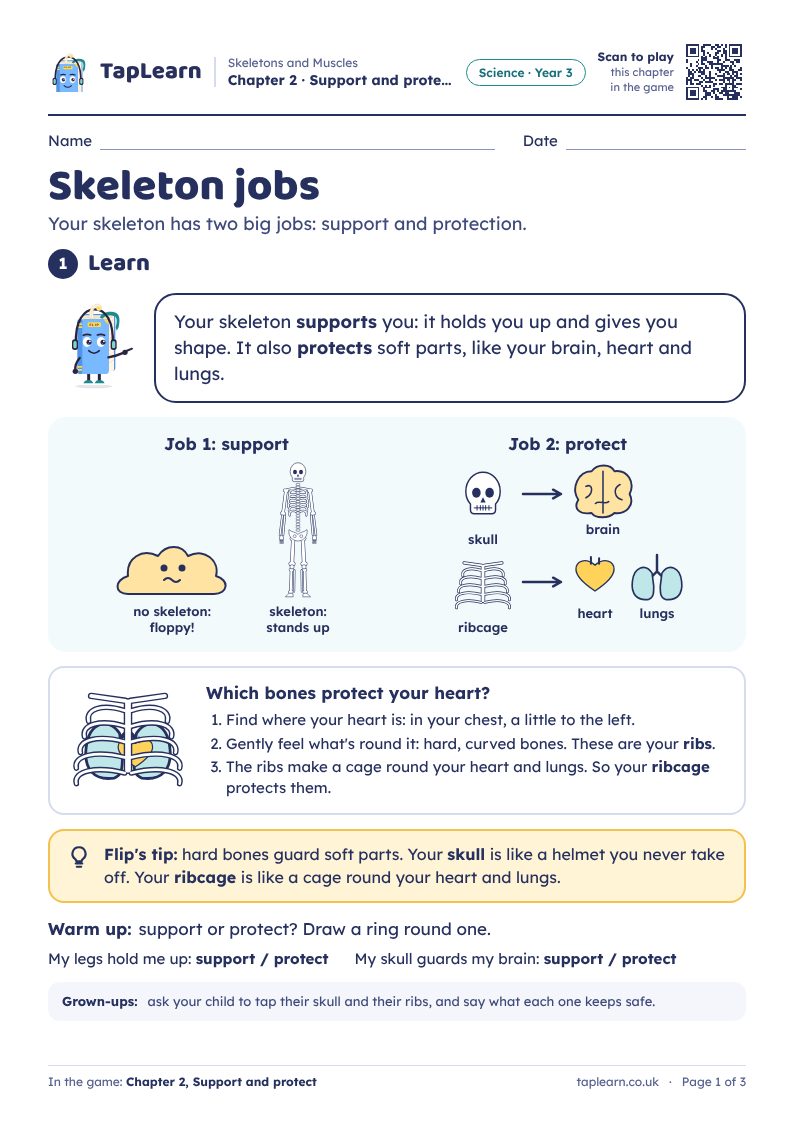
Skeleton Jobs is a printable skeleton functions worksheet for Year 3 (ages 7 to 8) that teaches children how the skeleton supports the body and protects soft organs, with the skull guarding the brain and the ribcage guarding the heart and lungs. It covers the Year 3 science statement that humans and some other animals have skeletons for support and protection.
This worksheet is for members
Membership opens every chapter of every game and every worksheet, for all your children.
See the plansAlready a member? Log in to print it.
Start with the free one: Naming bones (chapter 1).
Print it on A4, in colour or black and white. Do it after the chapter, or before it to see what your child already knows.
What's on the worksheet
Your child learns the skeleton's two jobs: holding the body up and protecting the brain, heart and lungs. Includes a glove-and-straws test and a paper tube test to try at home, practice questions and an answers sheet.
- Page 1 · Learn
- The skeleton's two jobs, support and protection, shown with pictures, a guided search for the ribs round your heart and a support-or-protect warm-up.
- Page 2 · Try it together
- Give it a skeleton: stand up a rubber glove with and without straws in its fingers, and test flat paper against a paper tube holding a small book. Then match organs to the bones that protect them.
- Page 3 · Practise
- Sort sentences into support or protect, fill the gaps, decide whether a skeleton with no skull or no leg bones would be worse, and a challenge about life with no skeleton.
- Answers sheet
- Every answer, what the glove and tube tests should show, notes on the spine's two jobs and ideas to spot 'guards' like helmets at the park.
3 A4 pages and an answers sheet · about 25 minutes
In the classroom
- Demonstrate the glove test at the front, then let groups try the paper tube with books of different sizes and record what holds.
- Use Practise B as a mini-whiteboard check: read each sentence aloud and children show S or P.
Questions from the worksheet
- Support or protect? My ribs guard my heart and lungs.
- Support or protect? My spine helps me stand up straight.
- Without a skeleton, my body would be ___.
- Which would be worse: a skeleton with no skull, or a skeleton with no leg bones? Explain your answer.
- Mia says, "If we had no skeleton, we would look just the same, only a bit softer." Is she right? Explain.
The answers are on the answers sheet, for grown-ups.
National curriculum in England
This worksheet practises this statement from the Year 3 science programme of study:
- Identify that humans and some other animals have skeletons and muscles for support, protection and movement
Source: National curriculum in England: science programmes of study (DfE)
Using it at home
- Do the glove test at the kitchen sink with a washing-up glove: let your child predict what will happen before the straws go in.
- Ask your child to tap their skull and then their ribs and tell you what each one keeps safe.
- Question D has no single right answer. Praise any choice that comes with a reason about protection or standing up.
Watch out for
- Remembering only one job, usually protect.
- Ask "What are the two jobs?" every time, and hold up the floppy glove as a reminder of support.
- Thinking muscles alone hold the body up.
- Muscles help us move and hold a position, but the stiff skeleton gives the body its shape. Compare a cuddly toy with a toy robot.
- Marking 'the spine protects' as wrong.
- It's right too: the spine holds us upright and also protects the spinal cord, the bundle of nerves inside it.
Questions and answers
What are the main jobs of the skeleton?
The skeleton supports the body, holding it up and giving it shape, and protects soft organs. It also lets us move, because muscles pull on bones.
Which bones protect the heart and lungs?
The ribs protect the heart and lungs. Together they form the ribcage, a cage of curved bones around the chest.
What does the skull protect?
The skull protects the brain. It works like a helmet that you never take off.
 TapLearn