How muscles work worksheet for Year 3: Muscles that pull
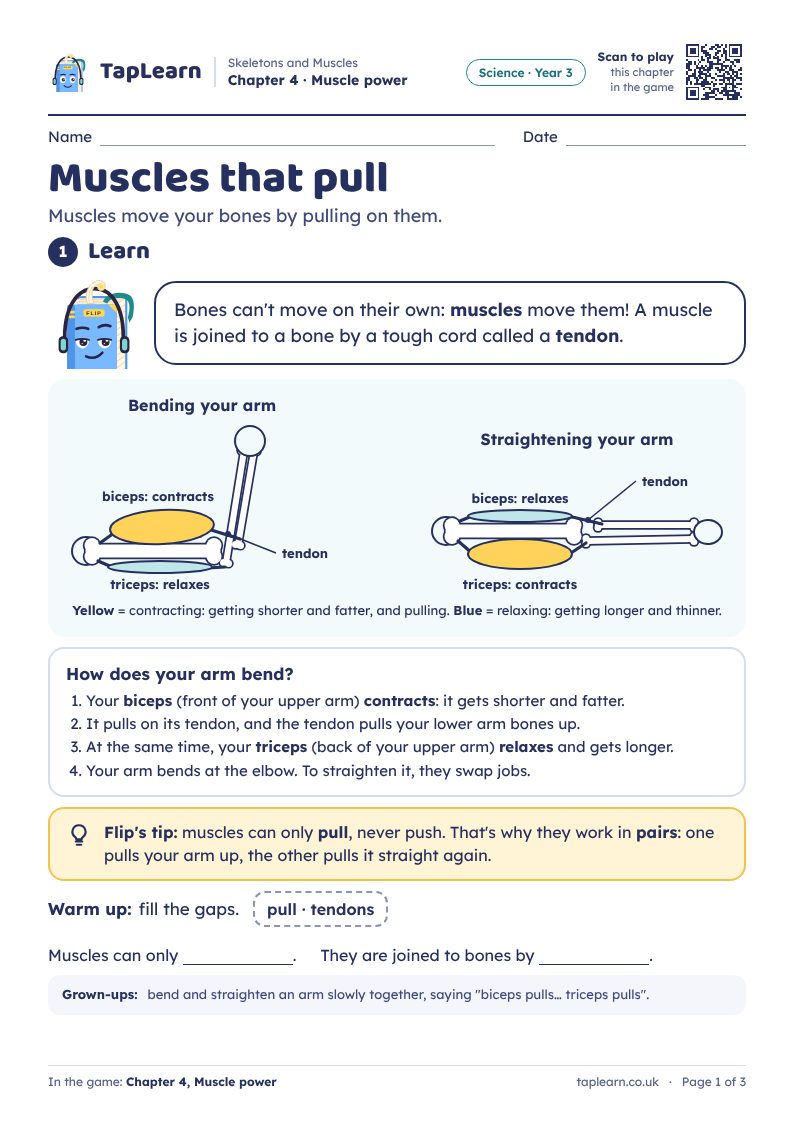
Muscles That Pull is a printable how muscles work worksheet for Year 3 (ages 7 to 8) that teaches children that muscles move bones by pulling on them through tendons, and that the biceps and triceps take turns to bend and straighten the arm. It covers the Year 3 science statement that humans have skeletons and muscles for movement.
This worksheet is for members
Membership opens every chapter of every game and every worksheet, for all your children.
See the plansAlready a member? Log in to print it.
Start with the free one: Naming bones (chapter 1).
Print it on A4, in colour or black and white. Do it after the chapter, or before it to see what your child already knows.
What's on the worksheet
Your child learns that muscles move bones by pulling through tendons, and that the biceps and triceps work as a pair to bend and straighten the arm. Includes a feel-your-muscles activity with string and a ruler, and an answers sheet.
- Page 1 · Learn
- Pictures of the arm bending and straightening, showing which muscle contracts and which relaxes, steps explaining how the biceps pulls through its tendon, and a warm-up.
- Page 2 · Try it together
- Feel your muscles: measure the upper arm straight and bent with string, then feel which muscle goes hard when lifting a bag and pressing on a table. Then label an arm diagram.
- Page 3 · Practise
- Fill a contracts-or-relaxes table, ring the right words, explain why muscles work in pairs, spot when the triceps contracts, and a challenge about muscles pushing.
- Answers sheet
- Every answer, what the measuring activity usually shows, the most common mix-ups and a leg-muscle activity to try sitting down.
3 A4 pages and an answers sheet · about 25 minutes
In the classroom
- Do the string measurements in pairs and record straight and bent arm sizes in a class table to see the biceps get fatter as it contracts.
- Use Practise C as a quick show-me check: children hold up one or two fingers for the first or second word.
Questions from the worksheet
- Muscles can only push / pull. Draw a ring round the right word.
- Tendons join muscles to bones / skin.
- Write contracts or relaxes for the biceps and triceps when you straighten your arm.
- Why do muscles need to work in pairs to bend and straighten your arm?
- Leo straightens his arm and says, "My biceps is pushing my arm straight!" Is he right? Explain what really happens.
The answers are on the answers sheet, for grown-ups.
National curriculum in England
This worksheet practises this statement from the Year 3 science programme of study:
- Identify that humans and some other animals have skeletons and muscles for support, protection and movement
Source: National curriculum in England: science programmes of study (DfE)
Using it at home
- Bend and straighten an arm slowly together while saying "biceps pulls… triceps pulls", so your child hears that both muscles only pull.
- Keep the bag light for the lifting test: one book is plenty to feel the biceps go hard.
- Show your child the tendon just above their heel and let them feel how tough it is compared with the muscle above it.
Watch out for
- Thinking muscles push bones.
- This is the most common mix-up. Say "contract means pull": a muscle only gets shorter and pulls, so another muscle must pull the other way.
- Thinking a relaxed muscle is doing nothing.
- Explain that it gets longer to let its partner pull. The two muscles take turns.
- Mixing up tendons and muscles.
- A tendon is the tough cord that ties a muscle to a bone. Feel the one above the heel together.
Questions and answers
How do muscles move bones?
Muscles move bones by pulling on them. A muscle contracts, getting shorter and fatter, and pulls on a tendon, which pulls the bone.
Why do muscles work in pairs?
Muscles work in pairs because they can only pull, never push. In the arm, the biceps pulls it bent and the triceps pulls it straight again.
What is a tendon?
A tendon is a tough cord that joins a muscle to a bone. When the muscle contracts, the tendon passes the pull on to the bone.
 TapLearn