Animal skeletons worksheet for Year 3: Inside or outside?
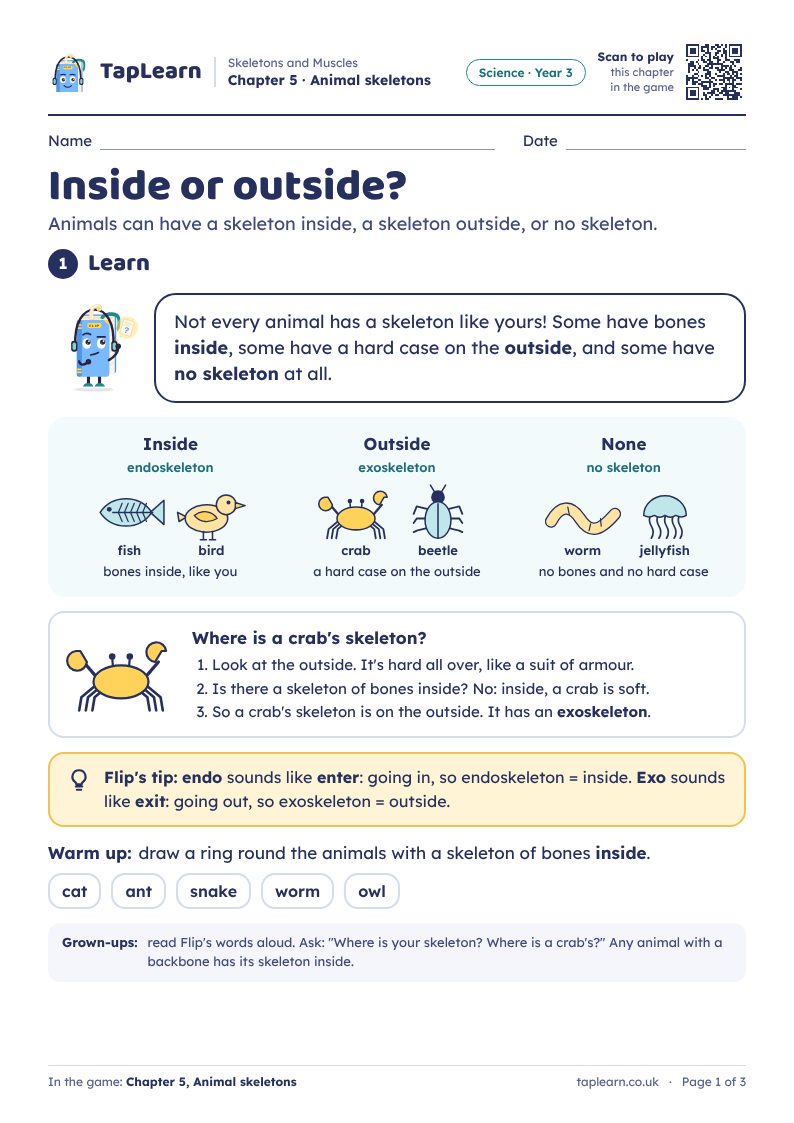
Inside or Outside? is a printable animal skeletons worksheet for Year 3 (ages 7 to 8) that teaches children to sort animals into those with an endoskeleton, an exoskeleton or no skeleton at all. It covers the Year 3 science statement that humans and some other animals have skeletons for support, protection and movement.
This worksheet is for members
Membership opens every chapter of every game and every worksheet, for all your children.
See the plansAlready a member? Log in to print it.
Start with the free one: Naming bones (chapter 1).
Print it on A4, in colour or black and white. Do it after the chapter, or before it to see what your child already knows.
What's on the worksheet
Your child sorts animals into those with a skeleton inside (endoskeleton), a skeleton outside (exoskeleton) or no skeleton. Includes a 12-animal sorting game to play together, practice questions and an answers sheet.
- Page 1 · Learn
- Endoskeleton, exoskeleton and no skeleton explained with fish, birds, crabs, beetles, worms and jellyfish, a crab example, Flip's 'endo = enter, exo = exit' tip and a warm-up.
- Page 2 · Try it together
- Skeleton sort: write 12 animals on scraps of paper, from goldfish to octopus, and take turns placing them on Inside, Outside or None sheets. Then label six more animals.
- Page 3 · Practise
- True or false questions, fill the gaps, compare a beetle's skeleton with yours, odd one out, and a challenge about how a jellyfish keeps its shape.
- Answers sheet
- Every answer with the full sort, notes on tricky animals like spiders and octopuses, and a 20 questions game and garden safari for home.
3 A4 pages and an answers sheet · about 25 minutes
In the classroom
- Turn the skeleton sort into a group activity with picture cards and three hoops labelled Inside, Outside and None.
- Play 20 questions as a plenary: one child thinks of an animal and the class must start with "Is its skeleton inside?"
Questions from the worksheet
- True or false? A crab's skeleton is on the outside.
- True or false? Every animal has a skeleton.
- A beetle has a hard case on the outside. It has an ___.
- Compare a beetle's skeleton with yours. Write one way it's the same and one way it's different.
- Ava says, "A jellyfish must have a skeleton, because every animal has one." Is she right? How does a jellyfish keep its shape?
The answers are on the answers sheet, for grown-ups.
National curriculum in England
This worksheet practises this statement from the Year 3 science programme of study:
- Identify that humans and some other animals have skeletons and muscles for support, protection and movement
Source: National curriculum in England: science programmes of study (DfE)
Using it at home
- Before the sort, ask "Where is your skeleton? Where is a crab's?" so your child starts from their own body.
- Let your child argue for where each animal goes in the skeleton sort, then check together. The spider, ladybird and octopus are the tricky ones.
- Add a real animal from the garden or window at the end, watching from a distance.
Watch out for
- Mixing up skeletons inside and outside.
- Use Flip's tip: endo sounds like enter (in), exo sounds like exit (out). Fish have bones inside; crabs wear their skeleton outside.
- Thinking every animal has a skeleton.
- Worms, jellyfish and octopuses have no bones and no hard case. Ask how a jellyfish looks on a beach: it flops flat out of the water.
- Thinking big animals must have bones.
- An octopus is big but has no bones at all. Size doesn't tell you; look for bones inside or a hard case outside.
Questions and answers
What is the difference between an endoskeleton and an exoskeleton?
An endoskeleton is a skeleton of bones inside the body, like ours or a fish's. An exoskeleton is a hard case on the outside, like a crab's or a beetle's.
Which animals have no skeleton?
Worms, jellyfish and octopuses have no bones and no hard case, so at Year 3 they are sorted as having no skeleton. A jellyfish is held up by the water around it.
Do insects have a skeleton?
Yes. Insects such as ants, beetles and ladybirds have an exoskeleton, a hard case on the outside of their bodies, which they shed to grow bigger.
 TapLearn