Human skeleton worksheet for Year 3: Naming bones
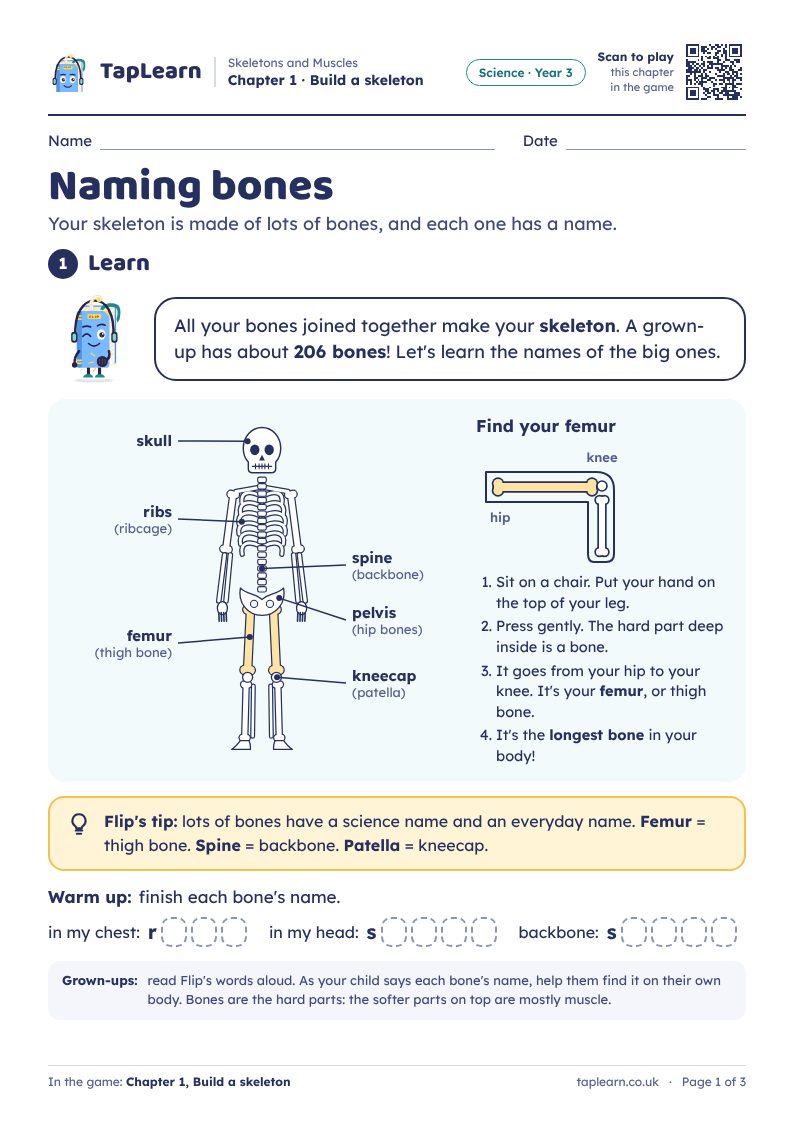
Naming Bones is a printable human skeleton worksheet for Year 3 (ages 7 to 8) that teaches children the names of the main bones, from the skull and ribcage to the spine, pelvis, kneecap and femur. It supports the Year 3 science statement that humans and some other animals have skeletons and muscles for support, protection and movement.
Free to print, no account needed.
Print it on A4, in colour or black and white. Do it after the chapter, or before it to see what your child already knows.
What's on the worksheet
Your child learns the names of the main bones, including the skull, ribs, spine, pelvis, kneecap and femur, and their everyday names. Includes a bone detective hunt on their own body, labelling practice and an answers sheet.
- Page 1 · Learn
- A labelled skeleton with science and everyday names (femur = thigh bone, patella = kneecap), a step-by-step hunt for your own femur and a warm-up to finish bone names.
- Page 2 · Try it together
- Bone detective: press gently to find the skull, ribs, spine and kneecap, then use string and a ruler to compare your femur with a grown-up's. Then label six bones on a skeleton.
- Page 3 · Practise
- Match science names to everyday names, true or false questions, fill the gaps, a challenge about whether a skeleton is just one big bone, and an 'I can' checklist.
- Answers sheet
- Every answer, what a good answer to the challenge says, common mix-ups to watch out for and two five-minute games with no paper.
3 A4 pages and an answers sheet · about 25 minutes
In the classroom
- Use the warm-up as a starter: children finish the bone names, then point to each bone on themselves while a partner checks.
- Run Try it together in pairs, with each child measuring the other's femur, and collect the lengths to compare across the class.
Questions from the worksheet
- Match each science name to its everyday name: femur, spine, pelvis, patella.
- True or false? Your ribs make a cage round your chest.
- True or false? Your spine is made of lots of small bones.
- A grown-up has about ___ bones.
- Sam says, "My skeleton is just one big bone, like a statue." Is he right? Explain how you know.
The answers are on the answers sheet, for grown-ups.
National curriculum in England
This worksheet practises this statement from the Year 3 science programme of study:
- Identify that humans and some other animals have skeletons and muscles for support, protection and movement
Source: National curriculum in England: science programmes of study (DfE)
Using it at home
- Do the bone detective hunt with your child sitting down, and bend forwards together so they can feel the bumps of the spine down their back.
- When you measure femurs with string, ask "Why is yours shorter?" so your child links bone length to growing.
- Turn the names into a quick game of "Bone says" (like Simon says) before bed: "Bone says touch your kneecap!"
Watch out for
- Thinking the femur is in the arm.
- Link the word to the thigh every time: "The femur is my thigh bone." Have your child press the top of their leg as they say it.
- Thinking the spine is one long bone.
- Ask them to curl forwards and feel the bumps: each bump is a small bone, stacked up, which is why we can bend our back.
- Saying everyone has exactly 206 bones.
- 206 is for grown-ups. Explain that babies have more, and some join together as they grow.
Questions and answers
Which bones should Year 3 children know?
Year 3 children usually learn the skull, ribs (ribcage), spine (backbone), pelvis (hip bones), kneecap and femur (thigh bone). The aim is to know that these bones together make a skeleton, not to learn every bone.
What is the longest bone in the body?
The femur, or thigh bone, is the longest bone in the human body. It runs from the hip to the knee.
How many bones are in the human skeleton?
A grown-up has about 206 bones. Babies are born with more, because some bones join together as children grow.
 TapLearn