Square numbers worksheet for Year 5: Square facts
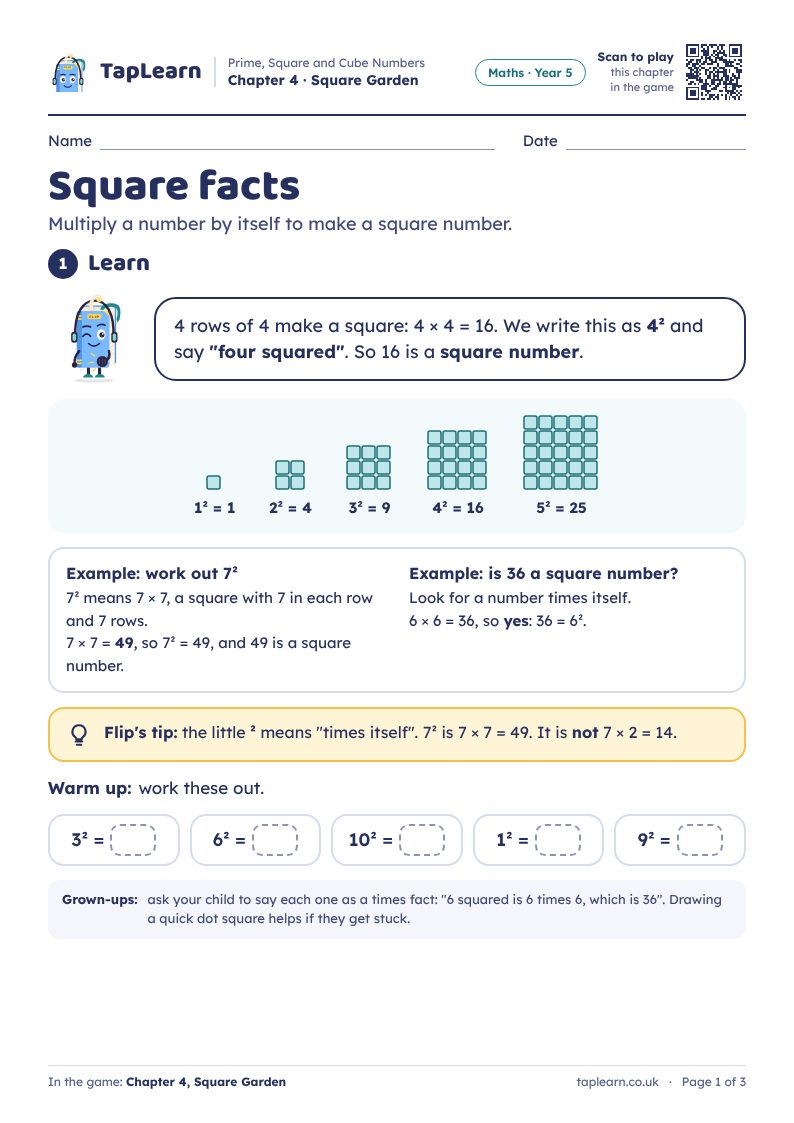
Square Facts is a printable square numbers worksheet for Year 5 (ages 9 to 10) that teaches children what the little ² means, how to work out squares up to 12² and how to spot square numbers. It covers the Year 5 maths national curriculum statement: recognise and use square numbers and cube numbers, and the notation for squared (²) and cubed (³).
Free to print, no account needed.
Print it on A4, in colour or black and white. Do it after the chapter, or before it to see what your child already knows.
What's on the worksheet
Learn what the little ² means, work out squares up to 12² and spot square numbers, then solve problems with them. With a square patio to build from coins or crackers, and full answers.
- Page 1 · Learn
- How 4 rows of 4 make 4² = 16, the first five square numbers, and worked examples for 7² and whether 36 is square. Warm-up: work out squares from 1² to 10².
- Page 2 · Try it together
- Square patio: grow a square of coins or crackers from 1 by 1 to 5 by 5, record how many you add each time, and use the pattern to predict 6 by 6.
- Page 3 · Practise
- Ring the square numbers, finish a table to 12², work backwards from 49, 100 and 144, solve a paving slab problem and a riddle, and Sam's "7² = 14" challenge.
- Answers sheet
- All answers, three mix-ups to watch for, and square snap and chessboard ideas.
3 A4 pages and an answers sheet · about 25 minutes
Using it at home
- Ask your child to say each one as a times fact: "6 squared is 6 times 6, which is 36".
- When building the patio, ask "Why does it need one more row and one more column, plus a corner?"
Watch out for
- Squaring as doubling, like 7² as 14.
- Read ² aloud as "times itself" and draw the dot square: 7 rows of 7.
- Reading 4² as 42.
- Point out that the little 2 is raised and smaller: it's an instruction, not a digit.
- Mixing up 9² and 3².
- 81 is 9²; 9 is 3². Ask "What times itself?"
Questions from the worksheet
- Work backwards. Which number has been squared to make 144?
- A square garden is 6 m long on each side. How many 1 m square paving slabs cover it?
- I am a square number. I am more than 40 and less than 60. What am I?
- Sam says, "7² = 14." Is he right? What mistake has he made?
The answers are on the answers sheet, for grown-ups.
National curriculum in England
This worksheet practises these statements from the Year 5 maths programme of study:
- Know and use the vocabulary of prime numbers, prime factors and composite (non-prime) numbers
- Establish whether a number up to 100 is prime and recall prime numbers up to 19
- Recognise and use square numbers and cube numbers, and the notation for squared (²) and cubed (³)
- Solve problems involving multiplication and division, including using their knowledge of factors and multiples, squares and cubes
Source: National curriculum in England: mathematics programmes of study (DfE)
In the classroom
- Square snap starter: call out a number up to 12 and pupils write its square on mini-whiteboards, then reverse it.
- Groups build the square patio with counters and explain the odd-number pattern to the class.
Questions and answers
What is a square number?
A square number is a number multiplied by itself, like 4 × 4 = 16. It can be drawn as a square of dots with the same number in each row and column.
What does the little ² mean in maths?
The little ² means squared, or "times itself". 7² is 7 × 7 = 49, not 7 × 2.
 TapLearn