Prime numbers worksheet for Year 5: Prime or not?
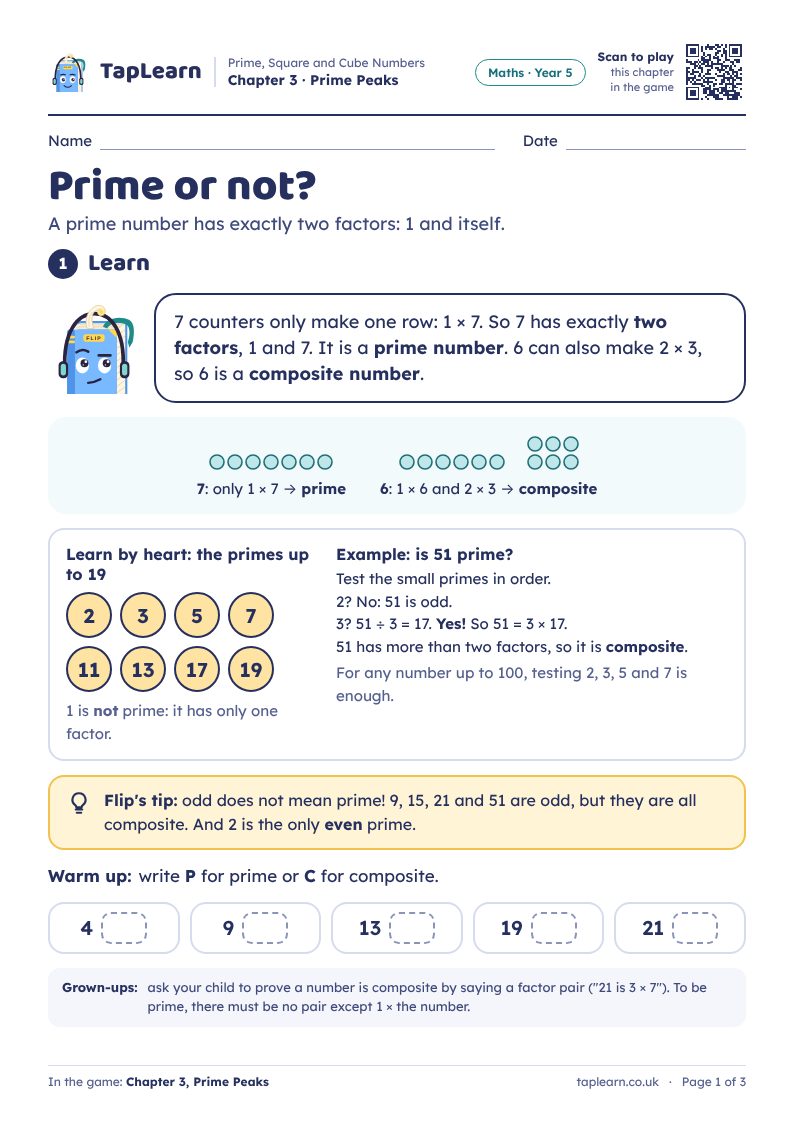
Prime or Not? is a printable prime numbers worksheet for Year 5 (ages 9 to 10) that teaches children to tell prime from composite numbers and write numbers as a product of prime factors. It covers the Year 5 maths national curriculum statements: know the vocabulary of prime numbers, prime factors and composite numbers, establish whether a number up to 100 is prime, and recall primes up to 19.
Free to print, no account needed.
Print it on A4, in colour or black and white. Do it after the chapter, or before it to see what your child already knows.
What's on the worksheet
Tell prime from composite numbers, learn the primes up to 19, check numbers up to 100 and write numbers as a product of prime factors. With a prime sieve to colour together, and full answers.
- Page 1 · Learn
- Why 7 is prime and 6 is composite, the primes up to 19, and testing whether 51 is prime by trying 2, 3, 5 and 7. Warm-up: write P or C.
- Page 2 · Try it together
- Prime sieve: cross out 1, then multiples of 2, 3, 5 and 7 on a number grid to 50, and ring every number left, since they are all prime.
- Page 3 · Practise
- Ring the primes, decide prime or composite for 57, 91, 61 and 87 and prove it with a factor pair, draw factor trees for 24, 45 and 70, and Mia's odd-numbers challenge.
- Answers sheet
- All answers, three mix-ups to watch for, and prime-spotting and prime ping-pong ideas.
3 A4 pages and an answers sheet · about 25 minutes
Using it at home
- Take turns with each step of the prime sieve, using two colours, and ask "Why could we stop after 7?"
- Ask your child to prove a number is composite by saying a factor pair, like "21 is 3 × 7".
Watch out for
- Thinking odd means prime.
- Ask for a factor pair: 51 = 3 × 17. Check for 3 by adding the digits.
- Thinking 1 is prime.
- A prime has exactly two different factors; 1 has only one.
- Stopping a factor tree too soon.
- Every end must be prime: 4 and 6 still split.
Questions from the worksheet
- Draw a ring round every prime number: 29, 33, 37, 39, 51.
- Prime or composite? If it is composite, prove it with a factor pair: 57, 91, 61, 87.
- Write 70 as a product of prime factors using a factor tree.
- Mia says, "All odd numbers are prime." Is she right? Give an example to explain.
The answers are on the answers sheet, for grown-ups.
National curriculum in England
This worksheet practises these statements from the Year 5 maths programme of study:
- Know and use the vocabulary of prime numbers, prime factors and composite (non-prime) numbers
- Establish whether a number up to 100 is prime and recall prime numbers up to 19
- Recognise and use square numbers and cube numbers, and the notation for squared (²) and cubed (³)
- Solve problems involving multiplication and division, including using their knowledge of factors and multiples, squares and cubes
Source: National curriculum in England: mathematics programmes of study (DfE)
In the classroom
- Project a 1 to 100 grid and build the prime sieve together as a class.
- Prime ping-pong: pairs take turns saying the primes in order and see how far they get.
Questions and answers
What is a prime number?
A prime number has exactly two factors: 1 and itself. 2, 3, 5, 7, 11, 13, 17 and 19 are the primes up to 19.
Is 1 a prime number?
No, 1 is not prime, because it has only one factor. 2 is the only even prime number.
How do you check if a number up to 100 is prime?
Test whether 2, 3, 5 or 7 divide into it exactly. If none do, the number is prime.
 TapLearn