Factor pairs worksheet for Year 5
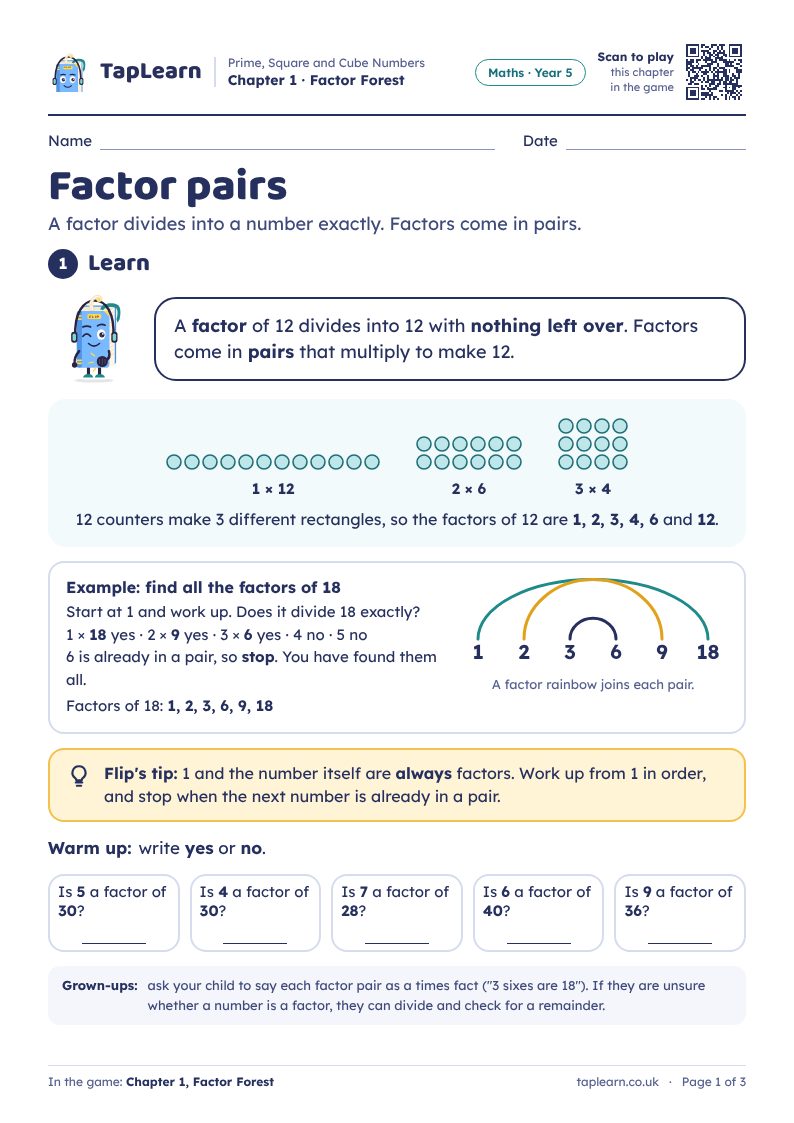
Factor Pairs is a printable factors worksheet for Year 5 (ages 9 to 10) that teaches children to find every factor pair of a number in order and work out common factors and the highest common factor. It supports the Year 5 maths national curriculum statement: solve problems involving multiplication and division, including using their knowledge of factors and multiples.
Free to print, no account needed.
Print it on A4, in colour or black and white. Do it after the chapter, or before it to see what your child already knows.
What's on the worksheet
Find every factor pair of a number, then spot common factors and the highest common factor of two numbers. With a rectangle hunt using buttons or coins, and full answers.
- Page 1 · Learn
- What a factor is, the factor pairs of 12 shown as rectangles, and a worked example finding all the factors of 18 with a factor rainbow. Warm-up: is it a factor?
- Page 2 · Try it together
- Rectangle hunt: arrange 24 buttons or coins into every rectangle you can, write each as a factor pair, then try 13 and see why it makes only one row.
- Page 3 · Practise
- Ring the factors of 20, draw a factor rainbow for 28, finish factor pairs for 36, 30 and 48, sort common factors of 12 and 18, a bead bracelet problem and Leo's challenge.
- Answers sheet
- All answers, three mix-ups to watch for, and factor-of-the-day and biggest-list ideas.
3 A4 pages and an answers sheet · about 25 minutes
Using it at home
- Ask your child to say each factor pair as a times fact ("3 sixes are 18"), and to divide and check for a remainder when unsure.
- In the rectangle hunt, ask "Is 2 rows of 12 different from 12 rows of 2?" It's the same rectangle turned round, so the same pair.
Watch out for
- Missing a pair by jumping about.
- Test 1, 2, 3, 4… in order and stop when the pairs meet.
- Forgetting 1 and the number itself, or writing 6 twice for 36.
- Remind them 1 and the number are always factors, and a square number's middle factor is written once.
- Mixing up factors and multiples.
- Factors go into a number, so they are smaller or equal. Multiples are in its times table, so they are equal or bigger.
Questions from the worksheet
- Draw a ring round every factor of 20.
- Finish the factor pairs. For 48, find all 5 pairs yourself.
- Mia has 18 red beads and 24 blue beads. She makes identical bracelets and uses every bead. What is the greatest number of bracelets she can make?
- Leo says, "The factors of 16 are 1, 2, 4, 8, 16 and 32." Is he right? Explain how you know.
The answers are on the answers sheet, for grown-ups.
National curriculum in England
This worksheet practises these statements from the Year 5 maths programme of study:
- Know and use the vocabulary of prime numbers, prime factors and composite (non-prime) numbers
- Establish whether a number up to 100 is prime and recall prime numbers up to 19
- Recognise and use square numbers and cube numbers, and the notation for squared (²) and cubed (³)
- Solve problems involving multiplication and division, including using their knowledge of factors and multiples, squares and cubes
Source: National curriculum in England: mathematics programmes of study (DfE)
In the classroom
- Pairs race to find all the factor pairs of a number on mini-whiteboards, then check with counters in rectangles.
- Use the bracelet problem as a talk task: how does the highest common factor help?
Questions and answers
What are factor pairs?
Factor pairs are two numbers that multiply to make a given number. The factor pairs of 12 are 1 × 12, 2 × 6 and 3 × 4.
What is the highest common factor?
The highest common factor (HCF) is the biggest number that is a factor of two numbers. The common factors of 12 and 18 are 1, 2, 3 and 6, so the HCF is 6.
 TapLearn