Common multiples worksheet for Year 5: Multiple hops
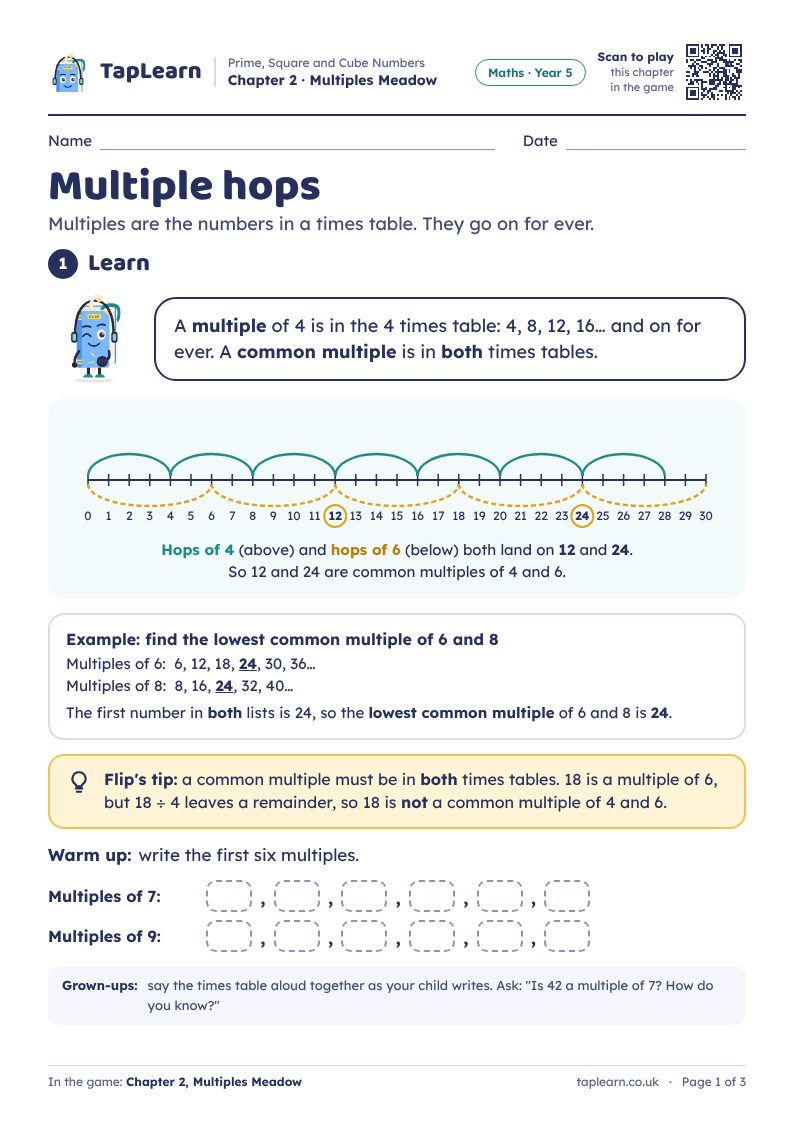
Multiple Hops is a printable common multiples worksheet for Year 5 (ages 9 to 10) that teaches children to list multiples, find common multiples of two numbers and work out the lowest common multiple. It supports the Year 5 maths national curriculum statement: solve problems involving multiplication and division, including using their knowledge of factors and multiples.
Free to print, no account needed.
Print it on A4, in colour or black and white. Do it after the chapter, or before it to see what your child already knows.
What's on the worksheet
List multiples of a number, find common multiples of two numbers and the lowest common multiple, and use them to solve problems. With a clap-and-stamp counting game, and full answers.
- Page 1 · Learn
- What multiples and common multiples are, hops of 4 and 6 on a number line, and a worked example finding the lowest common multiple of 6 and 8. Warm-up: first six multiples of 7 and 9.
- Page 2 · Try it together
- Clap and stamp: count to 40, clapping on multiples of 4 and stamping on multiples of 6, and write down the numbers that get both. Then try 3 and 5.
- Page 3 · Practise
- Ring multiples of 6, fill gaps in times-table lists, sort numbers in a Venn diagram, find the LCM of four pairs, a bus timetable problem and Sam's challenge.
- Answers sheet
- All answers, three mix-ups to watch for, and more clap-and-stamp pairs and everyday multiples.
3 A4 pages and an answers sheet · about 25 minutes
Using it at home
- Before each clap-and-stamp round, ask your child to predict the first number that gets both.
- Say the times tables aloud together as your child writes, and ask "Is 42 a multiple of 7? How do you know?"
Watch out for
- Picking a multiple of only one number, like 18 for 4 and 6.
- Check it by dividing by both numbers.
- Mixing up factors and multiples.
- 3 is a factor of 6, not a multiple. Multiples of 6 are 6 or more.
- Always multiplying the two numbers.
- 4 × 10 = 40 is a common multiple, but the lowest is 20. Listing both times tables finds it.
Questions from the worksheet
- Find the lowest common multiple of 4 and 10.
- Find the lowest common multiple of 6 and 9.
- A red bus leaves every 6 minutes. A blue bus leaves every 8 minutes. They both leave at 9:00. When will they next leave together?
- Sam says, "18 is a common multiple of 4 and 6, because 18 is in the 6 times table." Is he right? Explain how you know.
The answers are on the answers sheet, for grown-ups.
National curriculum in England
This worksheet practises these statements from the Year 5 maths programme of study:
- Know and use the vocabulary of prime numbers, prime factors and composite (non-prime) numbers
- Establish whether a number up to 100 is prime and recall prime numbers up to 19
- Recognise and use square numbers and cube numbers, and the notation for squared (²) and cubed (³)
- Solve problems involving multiplication and division, including using their knowledge of factors and multiples, squares and cubes
Source: National curriculum in England: mathematics programmes of study (DfE)
In the classroom
- Play clap and stamp as a whole class, with half the room clapping and half stamping.
- Mini-whiteboard check: give two numbers and pupils write their LCM.
Questions and answers
What is a common multiple?
A common multiple is a number that is in the times tables of two numbers. 12 and 24 are common multiples of 4 and 6.
How do you find the lowest common multiple?
List the multiples of both numbers and find the first one that is in both lists. For 6 and 8, that is 24.
 TapLearn