Partitioning worksheet for Year 2: Splitting numbers
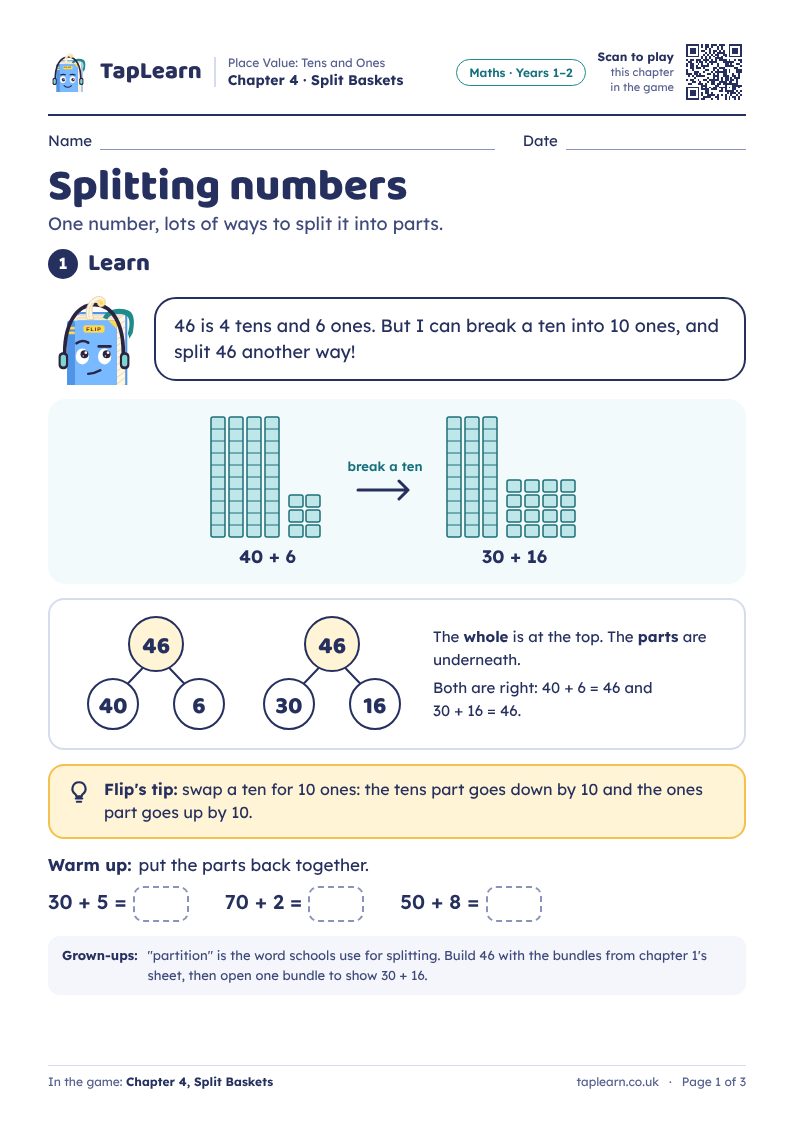
Splitting Numbers is a printable partitioning worksheet for Year 2 (ages 6 to 7) that teaches children to split two-digit numbers into tens and ones, and in other ways by breaking a ten, such as 46 = 30 + 16. It covers the Year 2 maths statements to recognise the place value of each digit and to represent numbers in different ways.
Free to print, no account needed.
▶ Play chapter 4 in the game · How the partitioning works
Print it on A4, in colour or black and white. Do it after the chapter, or before it to see what your child already knows.
What's on the worksheet
Your child partitions 2-digit numbers into tens and ones, then in other ways by breaking a ten (46 = 40 + 6 = 30 + 16), using part-whole models. Includes a two-plates sharing activity and an answers sheet.
- Page 1 · Learn
- Two part-whole models show 46 split as 40 + 6 and as 30 + 16 by breaking a ten, with Flip's tip on swapping a ten for 10 ones and a warm-up putting parts back together.
- Page 2 · Try it together
- Two plates: make 35 with bundles of ten and loose ones, share it between two plates in as many ways as you can, and check each split still makes 35.
- Page 3 · Practise
- Missing numbers in part-whole models, split 52, 37 and 64 two ways, missing parts, ring every way to make 44, and a challenge to split 63 three ways.
- Answers sheet
- Every answer, accepted splits for the open questions, mix-ups like writing 52 = 40 + 2, and two splitting games with hands and coins.
3 A4 pages and an answers sheet · about 25 minutes
Using it at home
- Use the word schools use, "partition", as you go. Build 46 with bundles, then open one bundle in front of your child to show 30 + 16.
- In Two plates, ask "Did we lose any? Did we get any more?" after each split so your child sees the total stays 35.
- Accept any correct split on the open questions: 10 + 25 and 0 + 35 are right too.
Watch out for
- Losing the ten when breaking it, such as writing 52 = 40 + 2.
- When a ten is broken, its 10 ones join the ones part, so it becomes 40 + 12. Open a bundle to show it.
- Thinking only one split is right.
- Every split is right if the parts add up to the whole. Check by putting the parts back together.
- Writing a part where the whole should go in a part-whole model.
- The whole is the top circle. Add the two parts underneath: 40 + 9 = 49.
Questions from the worksheet
- Split each number two ways: 52 = 50 + ___ and 52 = 40 + ___
- Fill in the missing parts: 40 + ___ = 46, ___ + 9 = 89
- Ring every way to make 44: 40 + 4, 30 + 14, 4 + 40, 34 + 1, 20 + 24, 14 + 20
- Draw a part-whole model for 27. Split it any way you like.
- Ava says 63 can only be split as 60 + 3. Show her two more ways to split 63.
The answers are on the answers sheet, for grown-ups.
National curriculum in England
This worksheet practises these statements from the Year 2 maths programme of study:
- Recognise the place value of each digit in a two-digit number (10s, 1s)
- Identify, represent and estimate numbers using different representations, including the number line
- Read and write numbers to at least 100 in numerals and in words
- Use place value and number facts to solve problems
Source: National curriculum in England: mathematics programmes of study (DfE)
In the classroom
- Run Two plates as a group challenge: each group finds as many ways to split 35 as they can and records them on a class chart.
- Use Practise D as a starter: show the six sums and children hold up a thumb for each one that makes 44.
Questions and answers
What does partitioning mean in Year 2?
Partitioning means splitting a number into parts. In Year 2, children split two-digit numbers into tens and ones, such as 46 = 40 + 6, and in other ways, such as 46 = 30 + 16.
What is a part-whole model?
A part-whole model shows a whole number at the top and the parts it splits into underneath. It helps children see that the parts always add up to the whole.
How can 46 be split in different ways?
Break one ten into 10 ones: 46 = 40 + 6 becomes 30 + 16, then 20 + 26. The tens part goes down by 10 and the ones part goes up by 10.
 TapLearn