Tens and ones worksheet for Year 2: Making tens
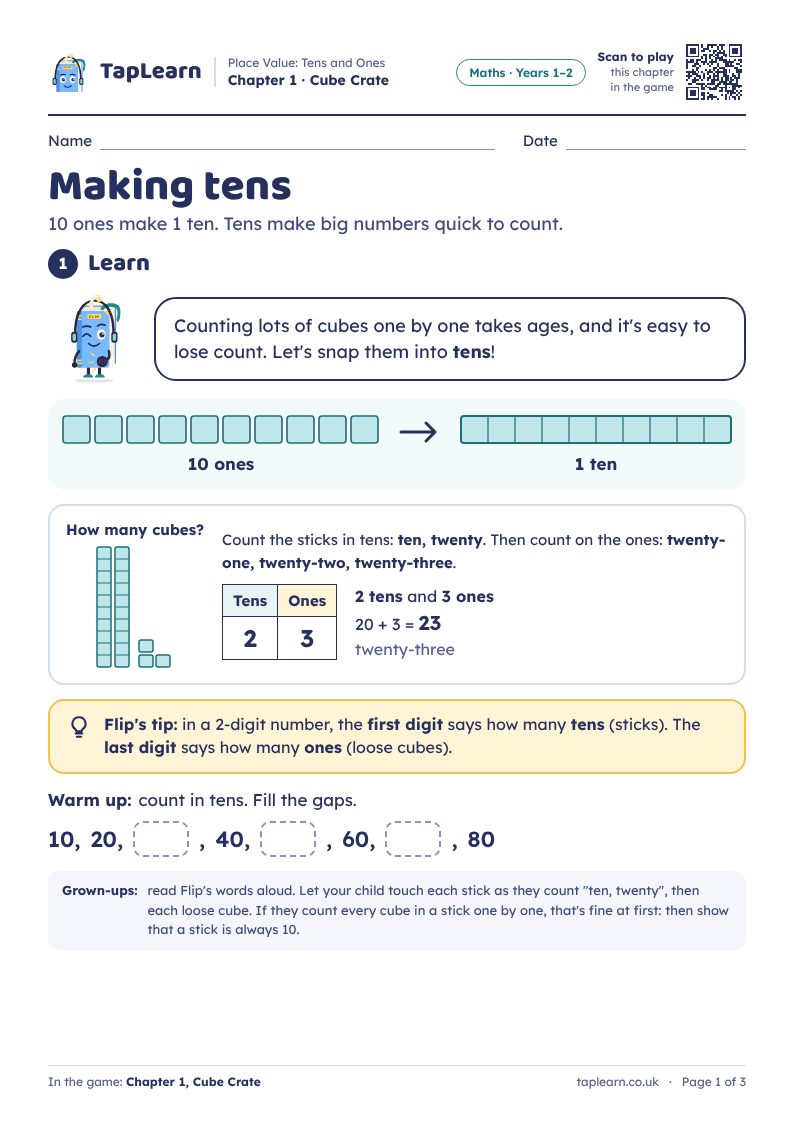
Making Tens is a printable tens and ones worksheet for Year 2 (ages 6 to 7) that teaches children to group 10 ones into a ten and count in tens and ones to 99. It supports the Year 2 maths statement to recognise the place value of each digit in a two-digit number (tens and ones).
Free to print, no account needed.
▶ Play chapter 1 in the game · How the dienes (base ten blocks) works
Print it on A4, in colour or black and white. Do it after the chapter, or before it to see what your child already knows.
What's on the worksheet
Your child groups 10 ones into 1 ten, counts the tens and then the ones, and says how many tens and ones make a number up to 99. Includes a bundling activity with pasta or buttons and an answers sheet.
- Page 1 · Learn
- Sticks of ten and loose cubes show how 2 tens and 3 ones make 23, with a tens and ones chart and a warm-up counting in tens to 80.
- Page 2 · Try it together
- Bundle it: guess a handful of pasta or buttons, band them into tens, then count in tens and ones to check the guess. Then ring groups of 10 buttons.
- Page 3 · Practise
- Count sticks and cubes, quick-draw numbers with lines and dots, fill a tens and ones chart for 67, 80, 9 and 94, and a challenge about 2 tens and 15 ones.
- Answers sheet
- Every answer, how to check a bundling round, the mix-ups to watch for with 0s and numbers under 10, and two five-minute games.
3 A4 pages and an answers sheet · about 25 minutes
Using it at home
- Let your child touch each stick as they count "ten, twenty", then each loose cube. Counting every cube in a stick is fine at first.
- In Bundle it, ask "Why is it quicker to count in tens?" before you check the guess together.
- Keep the bundles from this sheet: the later sheets in the pack use them again for splitting numbers.
Watch out for
- Writing the digits back to front, such as 64 for 46.
- Say the number with its tens first: "forty-six: 4 tens and 6 ones".
- Writing 7 for "7 tens".
- Explain that the 0 in 70 shows there are no loose ones and keeps the 7 in the tens place.
- Thinking a number under 10, like 9, has 1 ten.
- There are 0 tens in 9, because there isn't a full ten yet. Build it with loose cubes only.
Questions from the worksheet
- Each stick is 10. Each small cube is 1. How many cubes?
- Fill in the chart: how many tens and ones are in 67, 80 and 9?
- Quick draw: a line for each ten, a dot for each one. Draw 34 and 58.
- Ava has 2 tens and 15 ones. She says, "That's 215 cubes!" Is she right? How many cubes does she really have?
The answers are on the answers sheet, for grown-ups.
National curriculum in England
This worksheet practises these statements from the Year 2 maths programme of study:
- Recognise the place value of each digit in a two-digit number (10s, 1s)
- Identify, represent and estimate numbers using different representations, including the number line
- Read and write numbers to at least 100 in numerals and in words
- Use place value and number facts to solve problems
Source: National curriculum in England: mathematics programmes of study (DfE)
In the classroom
- Use Bundle it as a table activity: each group bundles a tub of counters, records tens and ones, and swaps tubs to check.
- Show numbers as lines and dots on the board and have children write the number on mini-whiteboards.
Questions and answers
What are tens and ones in Year 2?
Tens and ones are the two parts of a two-digit number. In 23, the 2 means 2 tens (20) and the 3 means 3 ones, so 23 = 20 + 3.
Why do children group objects into tens?
Grouping into tens makes big numbers quick to count and check, because you count "ten, twenty, thirty" and then the loose ones. It also shows why 10 ones can be swapped for 1 ten.
How many tens are in a number like 9?
There are 0 tens in 9, because there isn't a full group of ten. It is 0 tens and 9 ones.
 TapLearn