Comparing numbers worksheet for Year 2: Bigger or smaller?
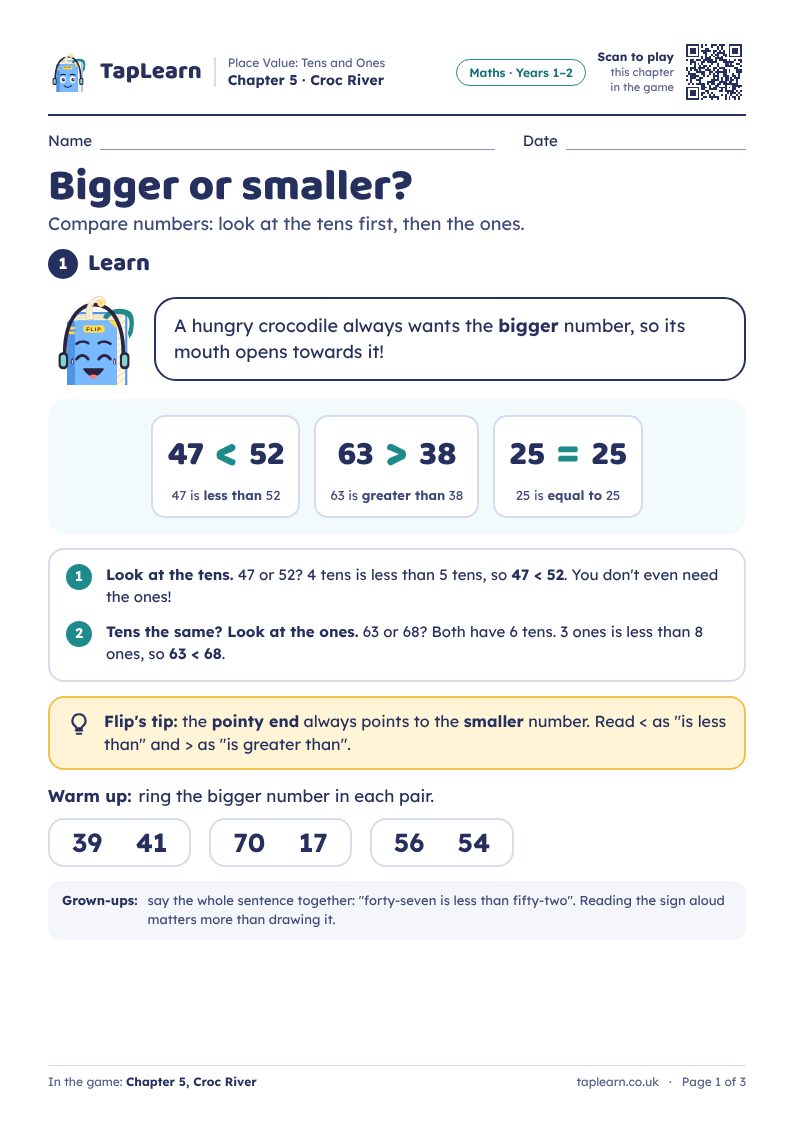
Bigger or Smaller? is a printable comparing numbers worksheet for Year 2 (ages 6 to 7) that teaches children to compare numbers to 100 using the <, > and = signs by looking at the tens first and then the ones. It builds on the Year 2 maths statement to recognise the place value of each digit in a two-digit number.
Free to print, no account needed.
Print it on A4, in colour or black and white. Do it after the chapter, or before it to see what your child already knows.
What's on the worksheet
Your child compares 2-digit numbers by looking at the tens first, then the ones, uses the <, > and = signs, and orders numbers from smallest to biggest. Includes a card crocodile game and an answers sheet.
- Page 1 · Learn
- A hungry crocodile explains <, > and =, with two steps for comparing: look at the tens, then the ones if the tens match. Warm-up: ring the bigger number.
- Page 2 · Try it together
- Card crocodile: each player makes a 2-digit number from two playing cards, says both numbers, then compares them aloud with the right sign.
- Page 3 · Practise
- Write <, > or = between pairs like 34 and 43, order sets of four numbers, compare sticks-and-cubes pictures, fill digits to make it true, and a challenge about 9 and 21.
- Answers sheet
- Every answer, all the digits that make the open questions true, mix-ups like comparing the ones first, and higher-or-lower and shopping games.
3 A4 pages and an answers sheet · about 25 minutes
Using it at home
- Say the whole sentence together, such as "forty-seven is less than fifty-two". Reading the sign aloud matters more than drawing it.
- In Card crocodile, ask "Which order of your two cards makes the bigger number?", then play rounds where the smaller number wins.
- When your child orders a list, ask them to check it from both ends: is the first the smallest and the last the biggest?
Watch out for
- Looking at the ones first, such as thinking 39 > 41 because 9 > 1.
- Always start with the tens. 3 tens is less than 4 tens, so 39 < 41.
- Mixing up < and >.
- The open side faces the bigger number and the point faces the smaller one. Read < as "is less than".
- Comparing a 1-digit number with a 2-digit number, like 90 and 9.
- Remind them that a 1-digit number has 0 tens, so any 2-digit number is bigger.
Questions from the worksheet
- Write <, > or = in each circle: 34 and 43, 58 and 51, 90 and 9.
- Write each set of numbers in order, from smallest to biggest: 45, 54, 15, 51.
- Write a digit in the box to make it true: 4__ > 47
- Leo says 9 > 21, "because 9 is bigger than 2 and bigger than 1". Is he right? Explain.
The answers are on the answers sheet, for grown-ups.
National curriculum in England
This worksheet practises these statements from the Year 2 maths programme of study:
- Recognise the place value of each digit in a two-digit number (10s, 1s)
- Identify, represent and estimate numbers using different representations, including the number line
- Read and write numbers to at least 100 in numerals and in words
- Use place value and number facts to solve problems
Source: National curriculum in England: mathematics programmes of study (DfE)
In the classroom
- Play Card crocodile in pairs with a recording sheet, then share the closest pair of numbers anyone made.
- Use Practise A as a show-me check: children make a crocodile mouth with their arms to show which way the sign faces.
Questions and answers
How do you compare two-digit numbers?
Look at the tens first: the number with more tens is bigger. If the tens are the same, compare the ones.
How do children remember which way < and > go?
Many schools use a hungry crocodile whose mouth opens towards the bigger number. The pointy end always points to the smaller number.
What does the = sign mean when comparing?
The = sign means both sides are worth the same, as in 25 = 25. It is read as "is equal to".
 TapLearn