Place value chart worksheet for Year 2: Tens and ones houses
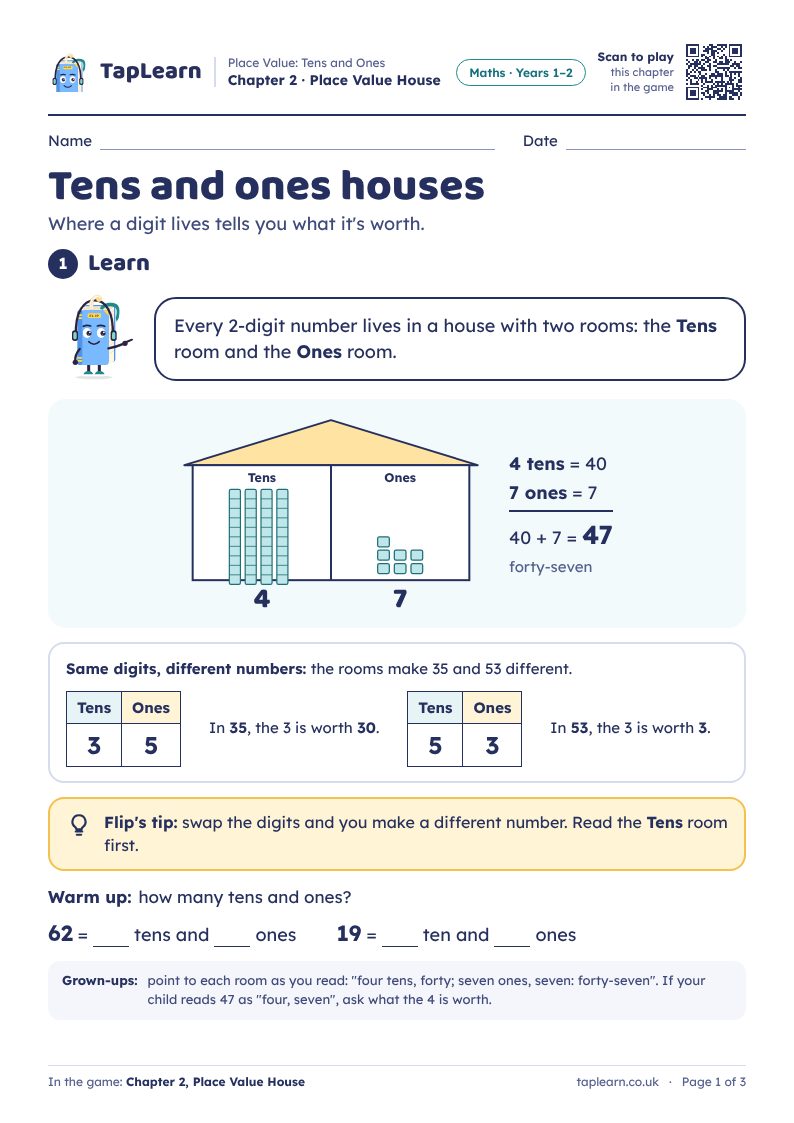
Tens and Ones Houses is a printable place value chart worksheet for Year 2 (ages 6 to 7) that teaches children what each digit in a two-digit number is worth and why swapping the digits makes a different number. It covers the Year 2 maths statement to recognise the place value of each digit in a two-digit number (tens and ones).
Free to print, no account needed.
▶ Play chapter 2 in the game · How the place value chart works
Print it on A4, in colour or black and white. Do it after the chapter, or before it to see what your child already knows.
What's on the worksheet
Your child uses a tens and ones house to find what each digit in a 2-digit number is worth, and sees why 35 and 53 are different numbers. Includes a digit card game to play together and an answers sheet.
- Page 1 · Learn
- A house with a Tens room and a Ones room shows 47 as 40 + 7, and compares 35 with 53 to show where a digit lives changes its value. Warm-up on 62 and 19.
- Page 2 · Try it together
- Card houses: fold paper into Tens and Ones rooms, place two digit cards, read the number, then swap the cards and decide which number is bigger. Then read numbers from houses.
- Page 3 · Practise
- Say what an underlined digit is worth, fill gaps like 80 + 2 and 57 = __ tens and __ ones, make two numbers from two cards, and a challenge about the 6 in 64 and 46.
- Answers sheet
- Every answer, mix-ups such as writing 802 for 80 + 2 and reading teen numbers, and two place value games for a walk or the kitchen table.
3 A4 pages and an answers sheet · about 25 minutes
Using it at home
- Point to each room as you read a number together: "four tens, forty; seven ones, seven: forty-seven".
- If the 0 card lands in the Tens room during Card houses, stop and talk about it: 0 tens and 6 ones is just 6.
- After a few rounds, ask "How can we make the biggest number with these two cards?" and let your child test their idea.
Watch out for
- Reading the digits one by one, like "four, seven" for 47.
- Ask what the 4 is worth, then read it as one number: forty-seven.
- Writing 80 + 2 as 802.
- Show that the 2 goes in the ones place, where the 0 was, to make 82.
- Writing teen numbers back to front, like 91 for nineteen.
- We hear the 9 first, but the 1 ten is written first. Build 19 with 1 stick and 9 cubes.
Questions from the worksheet
- What is the underlined digit worth? 34, 71, 58, 90, 16, 42.
- 6 tens and 3 ones = ___
- 57 = ___ tens and ___ ones
- Use the two cards 2 and 8 to make two numbers. Ring the bigger one.
- Leo says the 6 in 64 and the 6 in 46 are worth the same. Is he right? Explain how you know.
The answers are on the answers sheet, for grown-ups.
National curriculum in England
This worksheet practises these statements from the Year 2 maths programme of study:
- Recognise the place value of each digit in a two-digit number (10s, 1s)
- Identify, represent and estimate numbers using different representations, including the number line
- Read and write numbers to at least 100 in numerals and in words
- Use place value and number facts to solve problems
Source: National curriculum in England: mathematics programmes of study (DfE)
In the classroom
- Play Card houses in pairs with a large Tens and Ones mat on each table, recording each number and its swap.
- Use Practise B as a mini-whiteboard check: show a number, point to one digit and ask what it is worth.
Questions and answers
What is a place value chart?
A place value chart is a grid with a column for each place, such as tens and ones. Writing a number in it shows what each digit is worth, so 47 is 4 tens and 7 ones.
Why are 35 and 53 different numbers?
They use the same digits in different places. In 35 the 3 is worth 30, but in 53 the 3 is worth just 3.
What does the 0 in 70 mean?
The 0 shows there are no ones. It keeps the 7 in the tens place, so the number is 7 tens, or seventy.
 TapLearn