One-armed robot letters worksheet for Reception
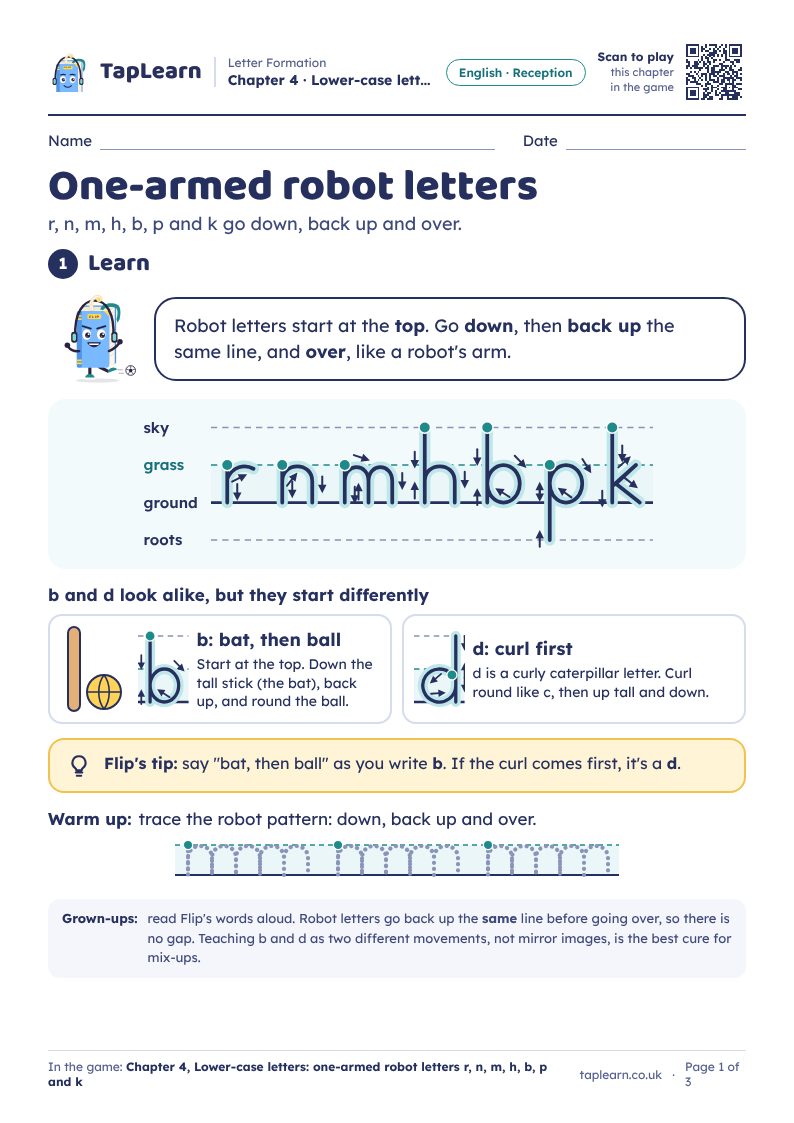
One-Armed Robot Letters is a printable one-armed robot letters worksheet for Reception (ages 4 to 5) that teaches children to go down, back up the same line and over, and to write b as "bat, then ball". It covers the Reception (EYFS) English goals to form lower-case and capital letters correctly and to write recognisable letters, most of which are correctly formed.
Free to print, no account needed.
Print it on A4, in colour or black and white. Do it after the chapter, or before it to see what your child already knows.
What's on the worksheet
Your child traces and writes r, n, m, h, b, p and k (down, back up and over) and tells b and d apart with "bat, then ball". Includes a robots, bats and balls activity and an answers sheet.
- Page 1 · Learn
- How robot letters go down, back up and over, how b (bat, then ball) and d (curl first) start differently, Flip's tip, and a trace-the-robot-pattern warm-up.
- Page 2 · Try it together
- Robots, bats and balls: move one arm like a robot saying the words, guess n or r drawn on your back, then use a wooden spoon and a ball to make b and d and say which is which.
- Page 3 · Practise
- Trace robot letters from the start dots, trace two then write your own, write b or d for bat-first or ball-first pictures, and a challenge about b and d being the same.
- Answers sheet
- Every answer, mix-ups like lifting the pencil before going back up, and robot-dance and sky-letter ideas.
3 A4 pages and an answers sheet · about 15 minutes
In the classroom
- Teach b and d as two different movements with the bat and ball actions.
- Play a quick b-or-d game with cards on the carpet.
Questions from the worksheet
- Look at the first letter. Then trace the rest, starting at each dot.
- Bat first or ball first? Write b or d in each box.
- Mia says, "b and d are the same letter, just turned round." Is she right? How do you start each one?
The answers are on the answers sheet, for grown-ups.
National curriculum in England
This worksheet practises these statements from the Reception english programme of study:
- Form lower-case and capital letters correctly
- Write recognisable letters, most of which are correctly formed
Using it at home
- Robot letters go back up the same line before going over, so there's no gap.
- In the spoon-and-ball activity, "after" means on the right, the way we read.
- Call "down, back up, over!" and both move your arms like robots, speeding up and slowing down.
Watch out for
- Starting n, h or r at the bottom.
- Point to the dot: "start at the top, go down".
- Lifting the pencil before going back up.
- Say "back up the same line".
- Mixing up b and d.
- Ask "bat first, or curl first?" rather than "which way does it face?"
Questions and answers
What are robot letters in handwriting?
Robot letters, like r, n, m, h, b, p and k, start at the top, go down, back up the same line and over, like a robot's arm.
How can my child stop mixing up b and d?
Teach them as different movements: b is bat, then ball, starting with the tall stick. d starts with a curl like c.
Which robot letter has a tail?
p has a stick that digs down below the line, into the roots.
More worksheets from Letter Formation: Trace and Write with Squiggle the Snail
- Chapter 1: Early writing worksheet: Say it, then write it Free
- Chapter 2: Ladder letters worksheet: Long ladder letters Free
- Chapter 3: Curly caterpillar letters worksheet Free
- Chapter 5: Zigzag letters worksheet Free
- Chapter 6: Forming capital letters worksheet: Capital letters Free
- Chapter 7: Clear handwriting worksheet: Letters everyone can read Free
 TapLearn