Ladder letters worksheet for Reception: Long ladder letters
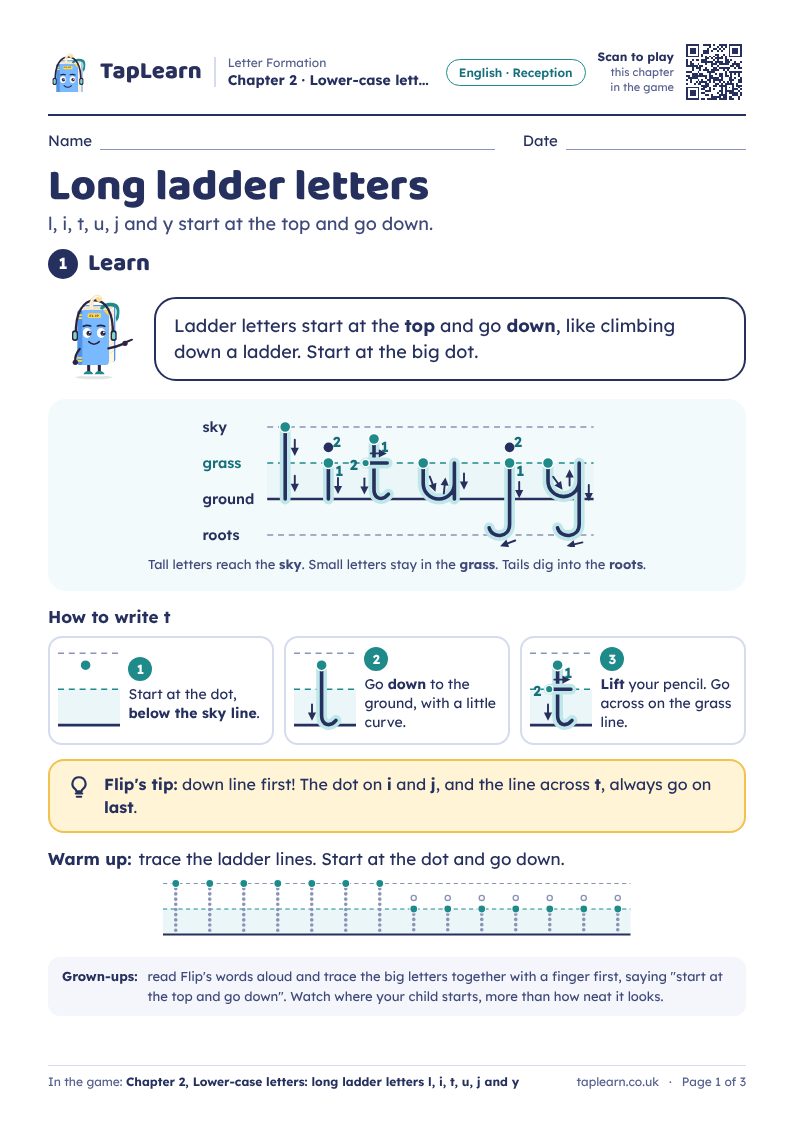
Long Ladder Letters is a printable ladder letters worksheet for Reception (ages 4 to 5) that teaches children to start l, i, t, u, j and y at the top and go down, adding dots and lines across last. It covers the Reception (EYFS) English goals to form lower-case and capital letters correctly and to write recognisable letters, most of which are correctly formed.
Free to print, no account needed.
Print it on A4, in colour or black and white. Do it after the chapter, or before it to see what your child already knows.
What's on the worksheet
Your child traces and writes l, i, t, u, j and y, starting at the top and going down, on sky, grass and ground lines. Includes an air-writing and finger-tray activity and an answers sheet.
- Page 1 · Learn
- Sky, grass, ground and roots lines, how to write t step by step, Flip's tip that the down line comes first, and a trace-the-ladder-lines warm-up.
- Page 2 · Try it together
- Giant ladder letters: draw a giant l in the air with your whole arm, guess letters drawn on your back, then write l, i, t, u, j and y with a finger in a tray of flour or salt.
- Page 3 · Practise
- Trace letters from the start dots, trace two then write your own, ring the right start dot for each letter, and a challenge about writing l from the bottom.
- Answers sheet
- Every answer, mix-ups like adding the dot first, and finger-painting and ladder-hunt ideas.
3 A4 pages and an answers sheet · about 15 minutes
In the classroom
- Practise ladder letters in the air as a class before writing, saying the movement together.
- Set up a sand or salt tray in continuous provision for finger-writing ladder letters.
Questions from the worksheet
- Look at the first letter. Then trace the rest, starting at each dot.
- Where does each letter start? Draw a ring round the right dot.
- Ava writes l from the bottom, going up. "It looks just the same!" she says. Does it matter where she starts?
The answers are on the answers sheet, for grown-ups.
National curriculum in England
This worksheet practises these statements from the Reception english programme of study:
- Form lower-case and capital letters correctly
- Write recognisable letters, most of which are correctly formed
Using it at home
- Trace the big letters together with a finger first, saying "start at the top and go down". Watch where your child starts more than how neat it looks.
- In the finger tray, if your child starts at the bottom, draw a dot at the top and say "Let's start here."
- Write ladder letters with a wet finger on a window or with a paintbrush and water outside.
Watch out for
- Starting at the bottom and pushing up.
- Put your finger on the start dot and say "top, then down".
- Adding the dot or line first on i and t.
- Say "down line first, dot last", and let your child say it too.
- Keeping the tails of j and y on the line.
- Point to the roots: "the tail digs down here".
Questions and answers
What are ladder letters?
Ladder letters, like l, i, t, u, j and y, start at the top and go down, like climbing down a ladder.
Does it matter where a child starts a letter?
Yes. Starting at the top every time teaches the hand one way to make each letter, so writing gets quicker, neater and ready for joining later.
When do you add the dot on i and the line on t?
Always last, after the down line.
More worksheets from Letter Formation: Trace and Write with Squiggle the Snail
- Chapter 1: Early writing worksheet: Say it, then write it Free
- Chapter 3: Curly caterpillar letters worksheet Free
- Chapter 4: One-armed robot letters worksheet Free
- Chapter 5: Zigzag letters worksheet Free
- Chapter 6: Forming capital letters worksheet: Capital letters Free
- Chapter 7: Clear handwriting worksheet: Letters everyone can read Free
 TapLearn