Early writing worksheet for Reception: Say it, then write it
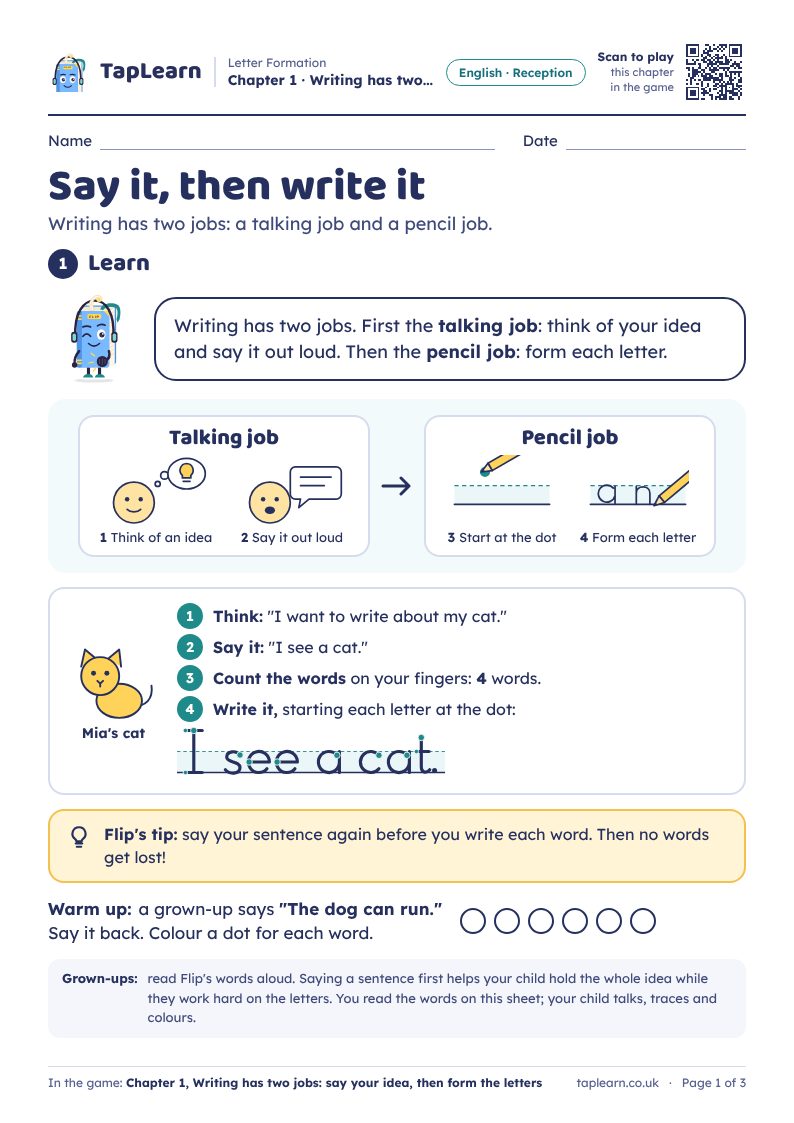
Say It, Then Write It is a printable early writing worksheet for Reception (ages 4 to 5) that teaches children that writing has a talking job, saying the idea out loud, and a pencil job, forming each letter. It covers the Reception (EYFS) English idea that writing involves composition, saying ideas in speech before writing, and transcription, which includes handwriting.
Free to print, no account needed.
Print it on A4, in colour or black and white. Do it after the chapter, or before it to see what your child already knows.
What's on the worksheet
Your child practises the two jobs of writing: saying an idea out loud and counting the words, then forming each letter from its start dot. Includes a talk-then-write activity and an answers sheet.
- Page 1 · Learn
- The talking job and the pencil job, a worked example saying "I see a cat" and counting 4 words, Flip's tip to say the sentence again before each word, and a colour-a-dot-per-word warm-up.
- Page 2 · Try it together
- Talk it, then write it: choose an idea like a toy or a card, the child says one sentence, the grown-up says it back, count the words, draw a line for each, then write it together.
- Page 3 · Practise
- Match pictures to the talking or pencil job, colour a dot for each word in a sentence, tick the sentence with every word, trace a sentence from the start dots, and a challenge.
- Answers sheet
- Every answer, mix-ups like counting claps instead of words, and sentence-of-the-day and list-helper ideas.
3 A4 pages and an answers sheet · about 20 minutes
Using it at home
- Saying a sentence first helps your child hold the whole idea while they work hard on the letters. You read the words on the sheet; your child talks, traces and colours.
- Keep sentences short: 3 to 6 words is plenty. If a word goes missing, say it together once more and count again.
- Before you write a shopping list, let your child say each item out loud while you write it.
Watch out for
- Writing before saying.
- Pause and ask "What are you going to write?" Then say it together.
- Missing words when saying it again, often a, is and the.
- Say it slowly together, one finger for each word.
- Counting beats instead of words, like to-day as two.
- Hold up one finger for each whole word, not each clap.
Questions from the worksheet
- Talking job or pencil job? Draw a line from each picture to its job: saying the sentence, starting at the dot, thinking of an idea, forming each letter.
- A grown-up reads the sentence. Say it back. Colour a dot for each word: "The fish can swim."
- Flip tried to say each sentence back. Tick the one with every word: "Dad has hat." or "Dad has a hat."
- Leo starts writing straight away. Halfway through, he forgets what he wanted to say! What should Leo do before he picks up his pencil?
The answers are on the answers sheet, for grown-ups.
National curriculum in England
This worksheet practises this statement from the Reception english programme of study:
- Writing involves transcription (spelling and handwriting) and composition (articulating ideas and structuring them in speech, before writing)
In the classroom
- Model talk it, then write it in shared writing, counting words on fingers before writing.
- Use sentence of the day at carpet time, with children saying and counting a sentence.
Questions and answers
Why should children say a sentence before writing it?
Saying it first helps them hold the whole idea in their head while they concentrate on forming the letters, so no words get lost.
What are the two jobs of writing?
The talking job is thinking of an idea and saying it out loud. The pencil job is forming each letter, starting at the right place.
How long should a Reception child's sentence be?
On this sheet, 3 to 6 words is plenty.
More worksheets from Letter Formation: Trace and Write with Squiggle the Snail
- Chapter 2: Ladder letters worksheet: Long ladder letters Free
- Chapter 3: Curly caterpillar letters worksheet Free
- Chapter 4: One-armed robot letters worksheet Free
- Chapter 5: Zigzag letters worksheet Free
- Chapter 6: Forming capital letters worksheet: Capital letters Free
- Chapter 7: Clear handwriting worksheet: Letters everyone can read Free
 TapLearn