Flowering plant life cycle worksheet for Year 5: From flower to seed
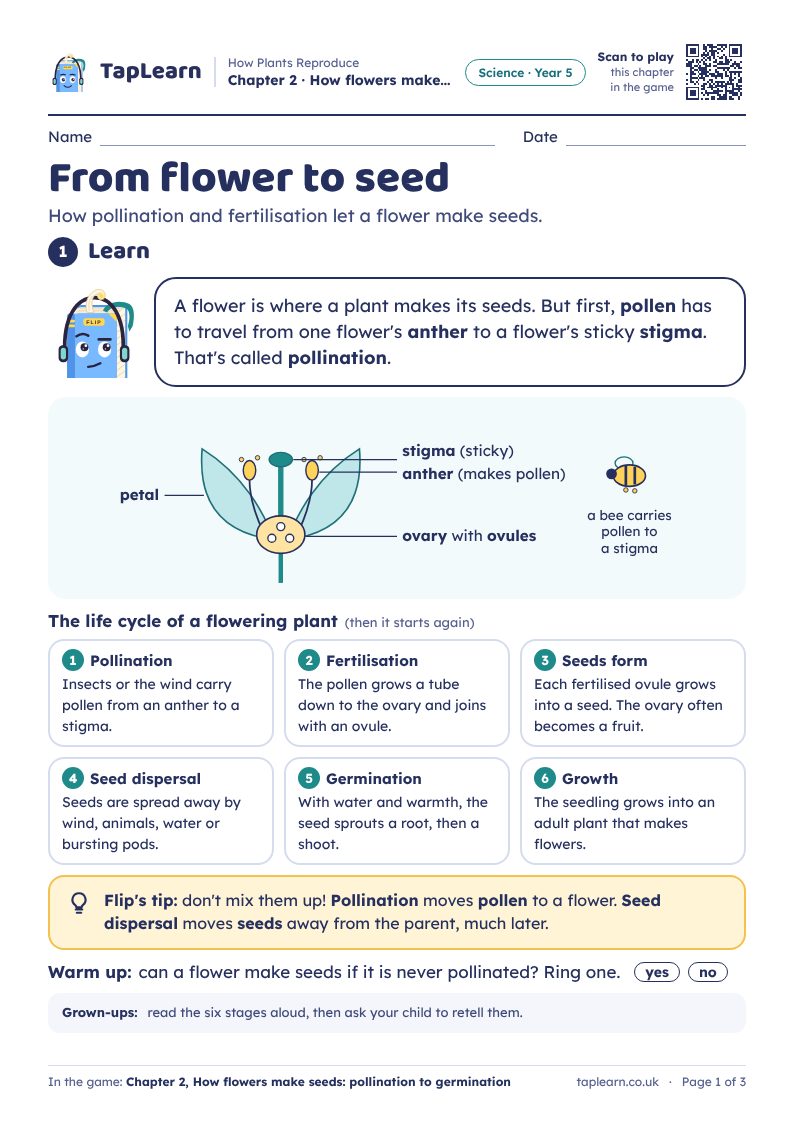
From Flower to Seed is a printable flowering plant life cycle worksheet for Year 5 (ages 9 to 10) that teaches how pollination and fertilisation let a flower make seeds, and how seeds are dispersed and germinate. It follows the Year 5 national curriculum in England: describe the life process of reproduction in some plants and animals.
This worksheet is for members
Membership opens every chapter of every game and every worksheet, for all your children.
See the plansAlready a member? Log in to print it.
Start with the free one: Parents and offspring (chapter 1).
Print it on A4, in colour or black and white. Do it after the chapter, or before it to see what your child already knows.
What's on the worksheet
Learn the parts of a flower and how pollination and fertilisation make seeds, then put the life cycle of a flowering plant in order, from pollination to germination. With a Be a Bee pollen activity and answers.
- Page 1 · Learn
- A labelled flower shows the anther, stigma, ovary and ovules, then six cards take the life cycle from pollination to growth. A yes or no warm-up asks if flowers make seeds without pollination.
- Page 2 · Try it together
- Be a bee: carry cocoa powder pollen on a cotton bud from one cupcake-case flower to a sticky tape stigma, then record which flower could make seeds. Then number the life cycle stages.
- Page 3 · Practise
- Match pollination, fertilisation, seed dispersal and germination to their meanings, say how five seeds are dispersed, explain why flowers have bright petals, and a challenge.
- Answers sheet
- Every answer by page, with notes on mixing up pollination and seed dispersal and putting the stages in the wrong order.
3 A4 pages and an answers sheet · about 30 minutes
In the classroom
- Do Be a Bee in small groups with paper flowers, then compare results as a class.
- Use the six stage cards as a sorting starter: pupils order them on mini-whiteboards before turning to the sheet.
Questions from the worksheet
- Number the stages of the life cycle in order, from 1 to 6: germination, pollination, seed dispersal, growth into an adult plant, seeds form, fertilisation.
- How is each seed dispersed? Write wind, animals, water or bursting pod.
- Why do many flowers have bright petals, a sweet smell and nectar?
- Mia says, "Seed dispersal is when a bee carries pollen to another flower." Is she right? Explain the difference.
The answers are on the answers sheet, for grown-ups.
National curriculum in England
This worksheet practises this statement from the Year 5 science programme of study:
- Describe the life process of reproduction in some plants and animals
Source: National curriculum in England: science programmes of study (DfE)
Using it at home
- Have the cupcake cases, cocoa powder and tape ready before you start: the Be a Bee activity takes about 10 minutes and works on a kitchen table.
- After the sheet, look closely at a garden flower together and find the anthers and the sticky stigma.
Watch out for
- Mixing up pollination (moving pollen between flowers) and seed dispersal (spreading seeds).
- Ask "What is moving: pollen or seeds?" Pollen moves in pollination; seeds move in seed dispersal, much later in the life cycle.
- Thinking flowers make seeds without pollination.
- Use the Be a Bee activity: flower C got no pollen on its stigma, so it can't make seeds. Pollen has to join an ovule first.
- Putting the life cycle stages in the wrong order.
- Act it out in order: be the bee (pollination), the seed forming, the seed travelling, then the sprout growing.
Questions and answers
What is the difference between pollination and fertilisation?
Pollination is when pollen moves from an anther to a stigma. Fertilisation comes next: the pollen grows a tube down to the ovary and joins with an ovule, which then grows into a seed.
What are the stages of a flowering plant's life cycle?
The stages are pollination, fertilisation, seed formation, seed dispersal, germination and growth into an adult plant that makes flowers, and then the cycle starts again.
 TapLearn