Bulbs and tubers worksheet for Year 5
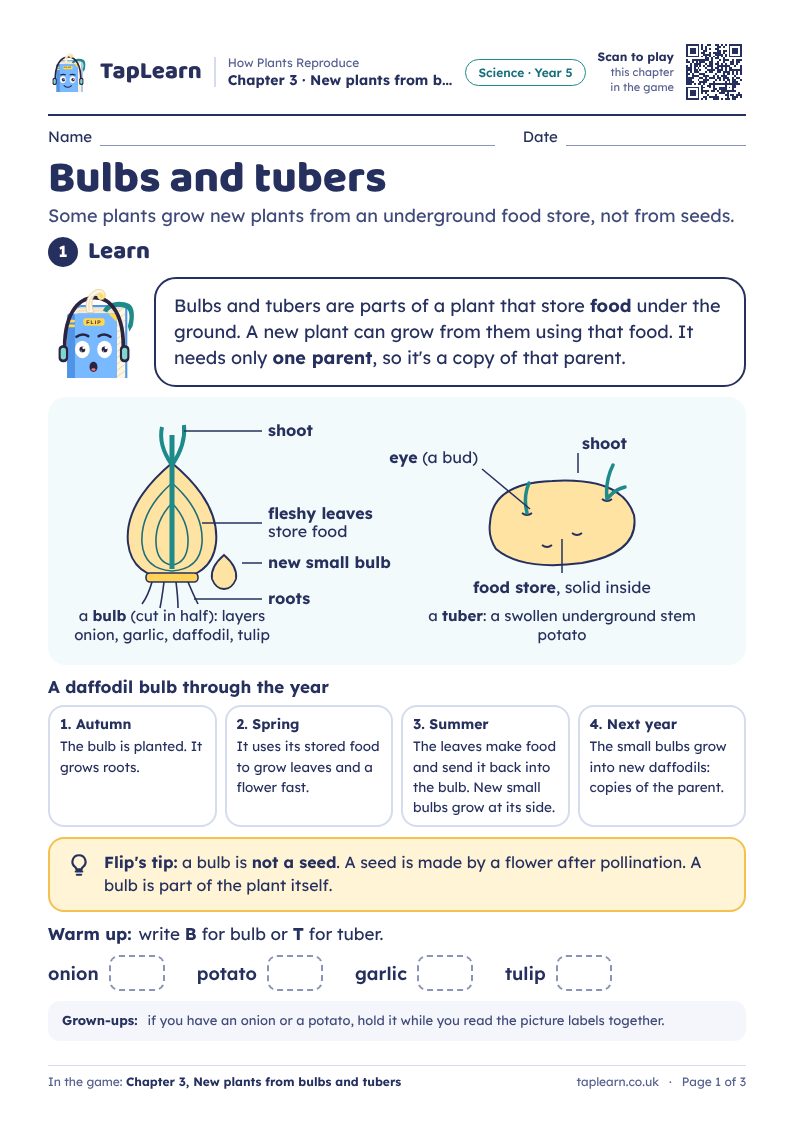
Bulbs and Tubers is a printable bulbs and tubers worksheet for Year 5 (ages 9 to 10) that teaches how bulbs such as onions and daffodils, and tubers such as potatoes, store food underground and grow new plants from one parent. It follows the Year 5 national curriculum in England: describe the life process of reproduction in some plants and animals.
This worksheet is for members
Membership opens every chapter of every game and every worksheet, for all your children.
See the plansAlready a member? Log in to print it.
Start with the free one: Parents and offspring (chapter 1).
Print it on A4, in colour or black and white. Do it after the chapter, or before it to see what your child already knows.
What's on the worksheet
Learn how bulbs and tubers store food underground and grow new plants from one parent, and how a bulb differs from a seed and a tuber. With a garlic and potato activity and answers.
- Page 1 · Learn
- A cut-open bulb and a sprouting potato are labelled, then a daffodil bulb is followed through a year. A warm-up sorts onion, potato, garlic and tulip into bulbs and tubers.
- Page 2 · Try it together
- How many new plants? Break a garlic bulb into cloves, find each clove's root and shoot ends, count the eyes on a potato and record them. Then label a bulb.
- Page 3 · Practise
- True or false statements, draw and label a sprouting potato, explain how a bulb helps daffodils flower early, and a challenge about tulip seeds.
- Answers sheet
- Every answer by page, with notes on thinking a bulb is a seed and mixing up bulbs and tubers.
3 A4 pages and an answers sheet · about 30 minutes
In the classroom
- Pass round an onion, a garlic bulb and a potato for groups to sort into bulbs and tubers before the Learn page.
- Use Sam's tulip challenge as an exit question on mini-whiteboards.
Questions from the worksheet
- Label the bulb: roots, shoot, fleshy leaves, new small bulb.
- True or false: a bulb is a kind of seed.
- Daffodils flower in early spring, before most plants. How does the bulb help them grow so fast?
- Sam says, "Tulips grow from bulbs, so tulips can't make seeds." Is he right? Explain.
The answers are on the answers sheet, for grown-ups.
National curriculum in England
This worksheet practises this statement from the Year 5 science programme of study:
- Describe the life process of reproduction in some plants and animals
Source: National curriculum in England: science programmes of study (DfE)
Using it at home
- You need just a bulb of garlic and a potato for the activity, and it takes about 10 minutes. Wash hands afterwards.
- To watch it happen, plant a garlic clove pointed end up in a pot of soil, or leave a potato in a dark cupboard for a few weeks.
Watch out for
- Thinking a bulb is a kind of seed.
- A seed is made by a flower after pollination. A bulb is a swollen part of the plant itself, made of layers of fleshy leaves.
- Thinking plants that grow from bulbs cannot make seeds.
- Daffodils, tulips and onions all flower, and their flowers can make seeds too. Gardeners plant bulbs because it is quicker.
- Mixing up bulbs (like onions) and tubers (like potatoes).
- A bulb has layers you can peel, like an onion. A tuber is solid inside, with eyes on its skin, like a potato.
Questions and answers
What is the difference between a bulb and a tuber?
A bulb is a short underground stem wrapped in layers of fleshy leaves, like an onion. A tuber is a swollen underground stem that is solid inside, with eyes on its skin, like a potato.
How does a bulb grow a new plant?
A bulb uses the food stored in its fleshy leaves to grow a shoot, leaves and flowers. Small new bulbs also grow at its side, and each can grow into a new plant that is a copy of its one parent.
 TapLearn