Plant reproduction worksheet for Year 5: Parents and offspring
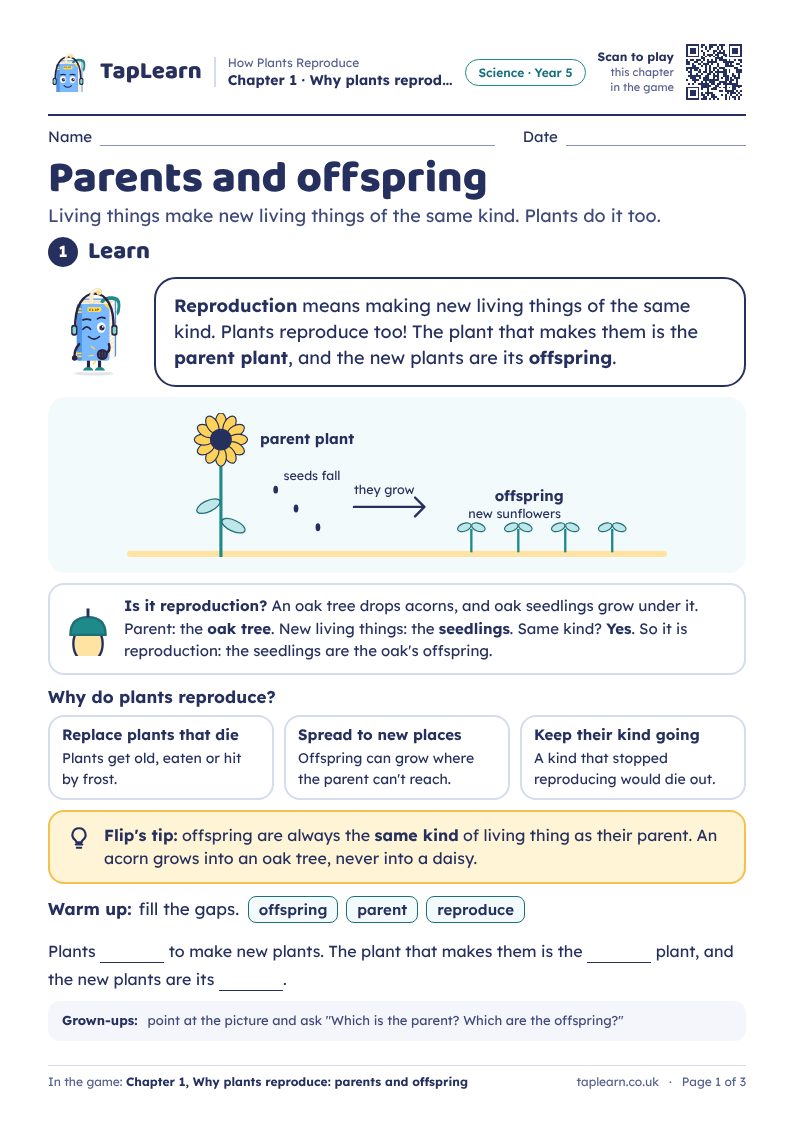
Parents and Offspring is a printable plant reproduction worksheet for Year 5 (ages 9 to 10) that teaches children what reproduction means, the words parent plant and offspring, and why plants need to reproduce. It follows the Year 5 national curriculum in England: describe the life process of reproduction in some plants and animals.
Free to print, no account needed.
Print it on A4, in colour or black and white. Do it after the chapter, or before it to see what your child already knows.
What's on the worksheet
Learn what reproduction means, use the words parent plant and offspring, and explain why plants need to reproduce. Includes a kitchen seed hunt to do together and a full answers sheet.
- Page 1 · Learn
- Flip explains reproduction with a sunflower and its seedlings, then works through an oak tree and its acorns. Three reasons plants reproduce, and a fill-the-gap warm-up.
- Page 2 · Try it together
- Seed hunt: find the seeds in a pea pod, a strawberry and an apple core, count them and record what each could grow into. Then match seeds to their parent plants.
- Page 3 · Practise
- True or false statements, label the parent and offspring in a dandelion picture, explain what would happen if bluebells stopped reproducing, and a challenge.
- Answers sheet
- Every answer by page, what to watch out for (thinking only animals reproduce) and quick ideas to go further on a walk.
3 A4 pages and an answers sheet · about 25 minutes
In the classroom
- Use the oak and acorn example as a starter: pupils say which is the parent, which are the offspring, and why it counts as reproduction.
- Leo's challenge works as a talk-partner question before pupils write their answer.
Questions from the worksheet
- Draw a line to match each seed to the parent plant it came from: acorn, apple pip, pea, striped seed.
- True or false: only animals reproduce.
- What would happen to bluebells if every bluebell plant stopped reproducing?
- Leo says, "Plants can't have babies, so plants don't reproduce. Only animals do." Is he right? Explain how you know.
The answers are on the answers sheet, for grown-ups.
National curriculum in England
This worksheet practises this statement from the Year 5 science programme of study:
- Describe the life process of reproduction in some plants and animals
Source: National curriculum in England: science programmes of study (DfE)
Using it at home
- Start with the seed hunt while you're preparing food: an apple core or a pea pod is all you need, and it takes about 10 minutes.
- On a walk, point at seedlings near a bigger plant and ask your child which is the parent and which are the offspring.
Watch out for
- Thinking only animals reproduce, because plants don't have babies.
- Point to a seedling and ask "Where did this little plant come from?" It grew from a seed made by a parent plant, so plants reproduce too.
- Thinking a seed could grow into any kind of plant.
- Offspring are always the same kind as the parent: an acorn only ever grows into an oak tree, never a daisy.
Questions and answers
What does reproduction mean in Year 5 science?
Reproduction is the life process of making new living things of the same kind. Plants and animals both reproduce; the living thing that makes the new ones is the parent, and the new ones are its offspring.
Why do plants need to reproduce?
Plants reproduce to replace plants that die from old age, being eaten or bad weather, and to spread to new places. If a kind of plant stopped reproducing, it would die out.
 TapLearn