Sexual and asexual reproduction in plants worksheet for Year 5: Seeds or copies?
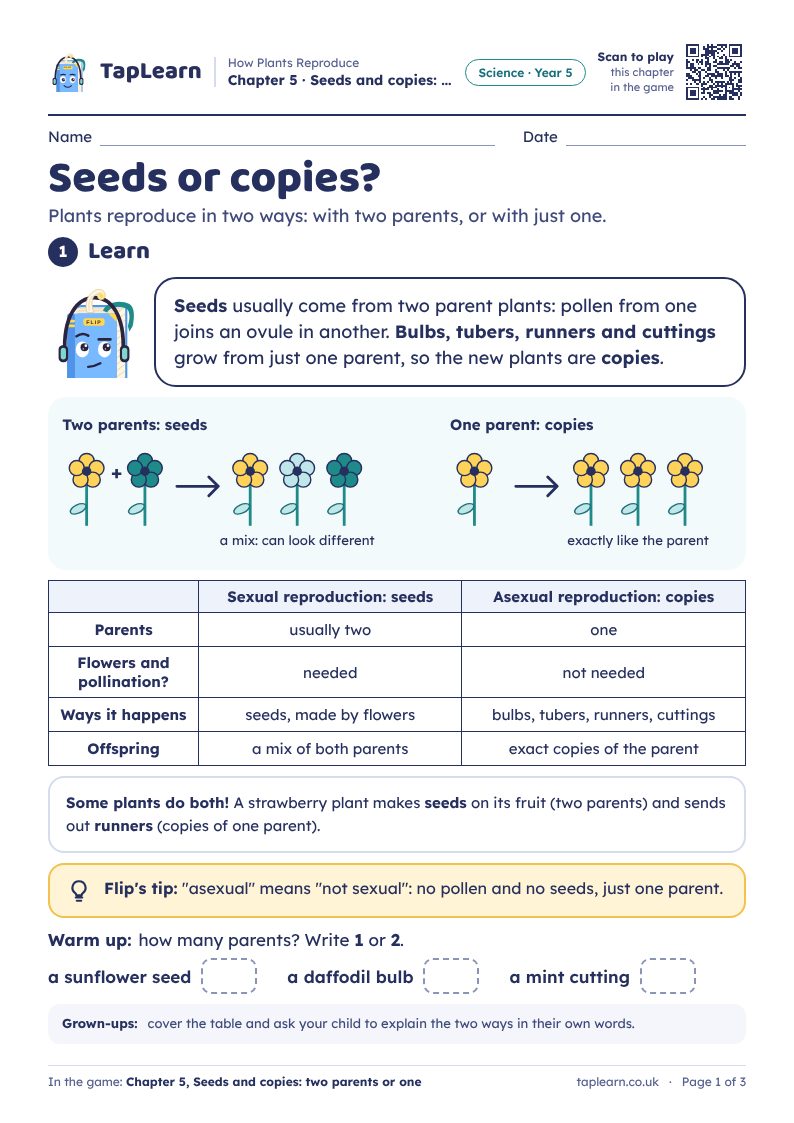
Seeds or Copies? is a printable sexual and asexual reproduction worksheet for Year 5 (ages 9 to 10) that teaches children to compare plants grown from seeds, usually with two parents, with copies grown from bulbs, tubers, runners and cuttings, with one parent. It follows the Year 5 national curriculum in England: describe the life process of reproduction in some plants and animals.
This worksheet is for members
Membership opens every chapter of every game and every worksheet, for all your children.
See the plansAlready a member? Log in to print it.
Start with the free one: Parents and offspring (chapter 1).
Print it on A4, in colour or black and white. Do it after the chapter, or before it to see what your child already knows.
What's on the worksheet
Compare sexual reproduction (seeds, usually two parents) and asexual reproduction (bulbs, tubers, runners and cuttings, one parent) in plants, and sort examples into each. With a kitchen sort activity and answers.
- Page 1 · Learn
- Pictures and a comparison table show two-parent seeds and one-parent copies, with the strawberry plant that does both. A warm-up asks how many parents a seed, bulb and cutting have.
- Page 2 · Try it together
- Kitchen sort: find the part of an apple, peas, a potato, an onion and garlic that could grow a new plant, then sort them into seeds and copies. Then ring S or C for eight examples.
- Page 3 · Practise
- Complete a comparison table, true or false statements, explain why farmers plant potato tubers, and a challenge about growing a favourite apple from a pip.
- Answers sheet
- Every answer by page, with notes on thinking every plant needs two parents and that copies look different.
3 A4 pages and an answers sheet · about 25 minutes
Using it at home
- Do the kitchen sort before cooking: five fruits and vegetables and 10 minutes is all it needs.
- Ask your child to explain the difference to you using a potato and an apple, before they fill in the table on page 3.
Watch out for
- Thinking every new plant needs two parents.
- Point to a potato or a garlic clove: it grows a whole new plant by itself. One parent is enough in asexual reproduction.
- Thinking copies from one parent look different from it.
- Plants from bulbs, tubers, runners and cuttings are exact copies, with the same flower colour or taste as the parent.
Questions from the worksheet
- Does each one grow a new plant from seeds or as a copy? Ring S or C: conker, daffodil bulb, mint cutting, sunflower seed, potato, strawberry runner, acorn, garlic clove.
- True or false: every new plant needs two parents.
- A farmer grows potatoes that taste delicious. Why does she plant tubers from them next year, not seeds?
- Leo plants a pip from his favourite apple. He says, "When my tree grows, its apples will taste exactly the same." Is he right? Explain.
The answers are on the answers sheet, for grown-ups.
National curriculum in England
This worksheet practises this statement from the Year 5 science programme of study:
- Describe the life process of reproduction in some plants and animals
Source: National curriculum in England: science programmes of study (DfE)
In the classroom
- Use the S or C cards as a sorting starter in pairs, then discuss any that were hard to sort.
- Leo's apple pip challenge makes a good class debate to end the topic.
Questions and answers
What is the difference between sexual and asexual reproduction in plants?
Sexual reproduction makes seeds: pollen joins an ovule, usually from two parents, so the offspring are a mix. Asexual reproduction uses one parent, through bulbs, tubers, runners or cuttings, so the new plants are exact copies.
Can a plant reproduce in both ways?
Yes. A strawberry plant makes seeds on its fruit after its flowers are pollinated, and it also sends out runners that grow copies of itself. Potatoes, daffodils and tulips can do both too.
 TapLearn