Counting in 10s worksheet for Year 1
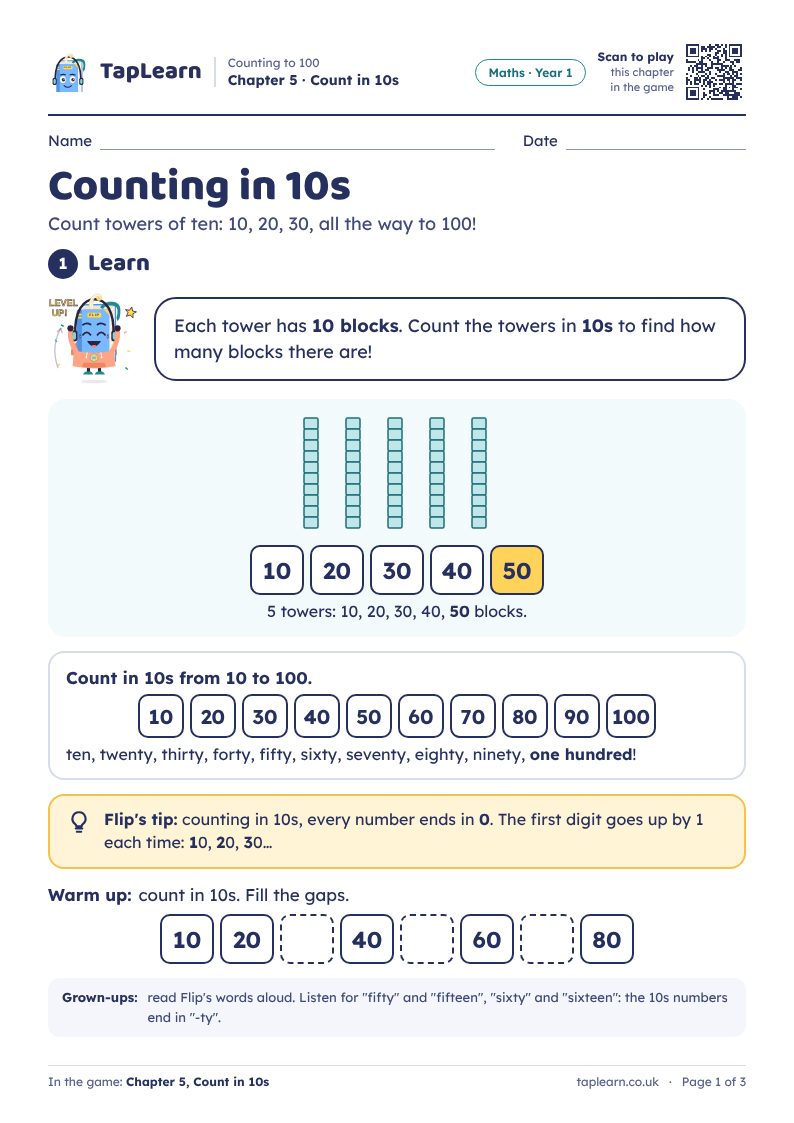
Counting in 10s is a printable counting in 10s worksheet for Year 1 (ages 5 to 6) that teaches children to count in 10s to 100 and back, and to read and write the tens numbers. It covers the Year 1 maths statement to count, read and write numbers to 100 in numerals and count in multiples of 2s, 5s and 10s.
Free to print, no account needed.
Print it on A4, in colour or black and white. Do it after the chapter, or before it to see what your child already knows.
What's on the worksheet
Your child counts towers of ten in 10s to 100 and back, fills in counting patterns and matches tens words to numbers. Includes a piles-of-ten activity with pasta and cups, and an answers sheet.
- Page 1 · Learn
- Five towers of ten counted to 50, the tens numbers from ten to one hundred in words, Flip's tip that 10s numbers end in 0, and a warm-up.
- Page 2 · Try it together
- Piles of ten: count exactly 10 pieces of pasta into each cup, line the cups up and count in 10s, then take one away and count back. Then count towers in 10s.
- Page 3 · Practise
- Fill in missing 10s numbers forwards and back, match tens words like seventy to numbers, draw towers to show 60, and a challenge about counting towers 10, 11, 12, 13.
- Answers sheet
- Every answer, mix-ups like sixteen for 60 or tenty after 90, and ten-finger count and blast-off ideas.
3 A4 pages and an answers sheet · about 20 minutes
Using it at home
- Listen for "fifty" and "fifteen", "sixty" and "sixteen": the 10s numbers end in -ty.
- In piles of ten, ask "How many pieces would 10 cups be?" before counting them.
- Count back in 10s from 100 for a blast-off and jump at 0.
Watch out for
- Counting in ones instead of 10s, like 10, 11, 12.
- Say one number for each tower or cup of ten.
- Saying sixteen for 60.
- Stress the end: six-ty. Show that 60 has 6 tens.
- Saying tenty after 90.
- After 90 comes 100, one hundred.
Questions from the worksheet
- Each tower is 10. Count in 10s. How many blocks?
- Count in 10s. Write the missing numbers. Now count back.
- Draw a line to match each word to its number: forty, seventy, twenty, one hundred.
- Ava counts towers of ten: 10, 11, 12, 13. Is she right? What should she say?
The answers are on the answers sheet, for grown-ups.
National curriculum in England
This worksheet practises these statements from the Year 1 maths programme of study:
- Count to and across 100, forwards and backwards, beginning with 0 or 1, or from any given number
- Count, read and write numbers to 100 in numerals; count in multiples of 2s, 5s and 10s
- Given a number, identify 1 more and 1 less
Source: National curriculum in England: mathematics programmes of study (DfE)
In the classroom
- Do a ten-finger count with the class: each child holds up 10 fingers and the class counts in 10s.
- Use Practise C as a word-to-number matching starter on mini-whiteboards.
Questions and answers
What is counting in 10s?
Counting in 10s means adding ten each time: 10, 20, 30 up to 100. It is a quick way to count groups of ten.
What do numbers end in when counting in 10s?
Every number ends in 0, and the first digit goes up by 1 each time: 10, 20, 30.
What comes after 90 when counting in 10s?
100, one hundred, comes after 90.
 TapLearn