Counting back worksheet for Year 1
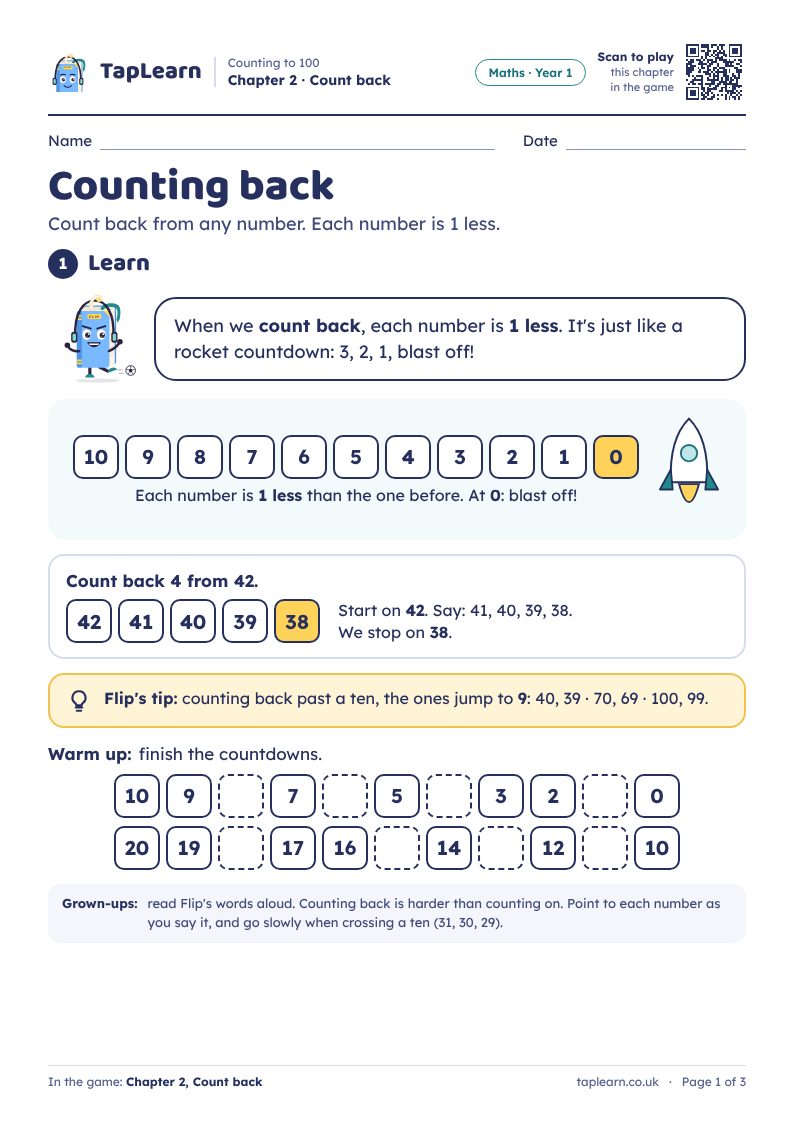
Counting Back is a printable counting back worksheet for Year 1 (ages 5 to 6) that teaches children to count back from any number up to 100, cross back over a ten and find 1 less. It covers the Year 1 maths statement to count to and across 100, forwards and backwards, from any given number, and to identify 1 less.
Free to print, no account needed.
Print it on A4, in colour or black and white. Do it after the chapter, or before it to see what your child already knows.
What's on the worksheet
Your child counts back from any number up to 100, crosses back over a ten and finds 1 less. Includes a rocket launch countdown game and an answers sheet.
- Page 1 · Learn
- A rocket countdown shows each number is 1 less, a worked example counting back 4 from 42, Flip's tip on crossing a ten, and a countdown warm-up.
- Page 2 · Try it together
- Rocket launch: crouch like a rocket, count back together from a start to a stop number, then jump up for blast off. Try one that crosses a ten. Then fill in missing numbers.
- Page 3 · Practise
- Find 1 less, ring the rocket that is counting back, count back 3 from different numbers, write the numbers from 70 to 60, and a challenge about Mia counting 32, 33, 34.
- Answers sheet
- Every answer, mix-ups like counting on instead of back, and lift countdown and 1-less ideas.
3 A4 pages and an answers sheet · about 20 minutes
Using it at home
- Counting back is harder than counting on. Point to each number as you say it and go slowly when crossing a ten (31, 30, 29).
- In rocket launch, start with 10 to 0 and 20 to 10, then try 64 to 56. If your child starts counting up, say "Back, like a rocket: getting smaller."
- Count back while going down the stairs, starting from any number.
Watch out for
- Counting on instead of back.
- Ask "Are the numbers getting bigger or smaller?" Counting back, they get smaller.
- Crossing a ten: saying 40, 30 or 40, 49.
- Practise just these: 20, 19 · 50, 49 · 100, 99.
- Counting the start number as one of the steps.
- In "count back 3 from 15", start on 15 and say 3 numbers: 14, 13, 12.
Questions from the worksheet
- What is 1 less? 10, 30, 61, 80, 45, 100
- Which rocket is counting back? Draw a ring round it: 11, 12, 13, 14 / 14, 13, 12, 11 / 14, 12, 13, 11
- Count back from 70 to 60. Write all the numbers.
- Mia counts back from 32: 32, 33, 34. Is she right? What should she say?
The answers are on the answers sheet, for grown-ups.
National curriculum in England
This worksheet practises these statements from the Year 1 maths programme of study:
- Count to and across 100, forwards and backwards, beginning with 0 or 1, or from any given number
- Count, read and write numbers to 100 in numerals; count in multiples of 2s, 5s and 10s
- Given a number, identify 1 more and 1 less
Source: National curriculum in England: mathematics programmes of study (DfE)
In the classroom
- Do rocket launch as a whole class, with everyone crouching and counting back together before jumping.
- Use Practise C as a starter: show three sequences and children point to the one counting back.
Questions and answers
What is counting back?
Counting back means saying the numbers in order from bigger to smaller, each 1 less, like a rocket countdown.
What comes before 40 when counting back?
39 comes after 40 when counting back. Crossing a ten, the ones jump to 9.
Why is counting back harder than counting on?
Children say numbers forwards much more often, so counting back needs more practice, especially when crossing a ten.
 TapLearn