Cooking tools worksheet for Reception–Year 3: Pasta chef
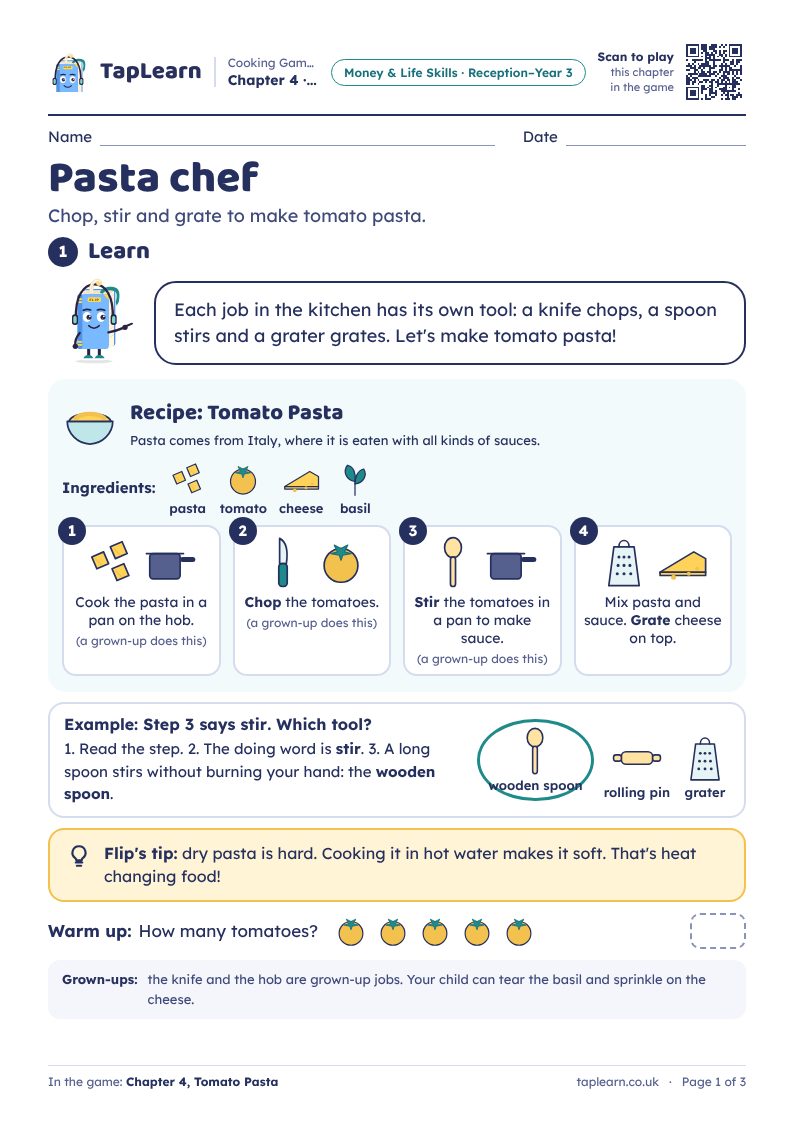
Pasta chef is a printable cooking tools worksheet for Reception to Year 3 (ages 4 to 8) that helps children match kitchen tools to their jobs and follow a tomato pasta recipe. Children follow a four-step picture recipe, try a hands-on kitchen activity with a grown-up, and practise by ringing, matching, ordering and drawing.
Free to print, no account needed.
Print it on A4, in colour or black and white. Do it after the chapter, or before it to see what your child already knows.
What's on the worksheet
Children match tools to jobs in a tomato pasta recipe (a knife to chop, a wooden spoon to stir, a grater to grate), choose the ingredients and the hob, and order the steps. Includes a pasta sort and answers.
- Page 1 · Learn
- A picture recipe shows the tomato pasta steps, a worked example picks the wooden spoon for 'stir', and Flip explains how cooking makes hard pasta soft.
- Page 2 · Try it together
- Pasta sort: Tip out the dry pasta. Sort it into the cups by shape (or into groups of 5). If you have cooked pasta, feel that too. What did cooking change?
- Page 2–3 · Practise
- Five short sets: ring the right tool, ring the ingredients, ring the machine, put the steps in order, draw. Then a Challenge and an I can list.
- Answers sheet
- Every answer by page, what to watch out for (picking a tool that doesn't fit the job, like a whisk to chop; adding a different food from the one the recipe asks for), and quick ideas to try without paper.
3 A4 pages and an answers sheet · about 25 minutes
In the classroom
- Make a 'tool and job' matching wall: pupils pin each tool picture next to its doing word.
Questions from the worksheet
- Ring the right tool for each job: to chop tomatoes; to stir sauce; to grate cheese.
- Ring the three foods in tomato pasta.
- Ring the machine that cooks the pasta.
- Leo puts jam on his pasta instead of tomato sauce. Is he following the recipe?
The answers are on the answers sheet, for grown-ups.
Using it at home
- Do the pasta sort before a pasta meal, then compare dry and cooked pasta at the table.
- When your child rings a tool, ask them to mime the job: chopping, stirring or grating.
Watch out for
- Picking a tool that doesn't fit the job, like a whisk to chop.
- Act out the job together: "Can a whisk cut? What does a whisk do?" Then try the right tool.
- Adding a different food from the one the recipe asks for.
- Point to each food on the recipe card, then find the same picture before you start.
- Choosing a different machine from the one the recipe needs.
- Ask: "Do we need to cook, bake, toast or blend?" Each machine has its own job.
Questions and answers
What does a grater do?
A grater has small, sharp holes that shred food like cheese or carrot into thin pieces. Children should grate with a grown-up, as it can catch fingers.
Why does pasta go soft when it is cooked?
Dry pasta soaks up hot water as it cooks, so it swells and turns soft. That's an example of heat changing food.
More worksheets from Cooking Game for Kids: Make Recipes from Around the World
- Chapter 1: Kitchen utensils worksheet: Pancake helper Free
- Chapter 2: How heat changes food worksheet: Omelette helper Free
- Chapter 3: Kitchen appliances worksheet: Smoothie maker Free
- Chapter 5: No-cook recipe worksheet: Mash it up Free
- Chapter 6: Raw and cooked food worksheet: Fried rice helper Free
- Chapter 7: Sequencing recipe steps worksheet: Curry cook Free
- Chapter 8: Following a picture recipe worksheet: Toast and jam Free
- Chapter 9: Pizza recipe worksheet: Pizza maker Free
- Chapter 10: Salad recipe worksheet: Salad bowl Free
- Chapter 11: Blending food worksheet: Hummus maker Free
- Chapter 12: Mashed potatoes worksheet: Mash it smooth Free
- Chapter 13: Rice balls worksheet: Rice ball maker Free
 TapLearn