How heat changes food worksheet for Reception–Year 3: Omelette helper
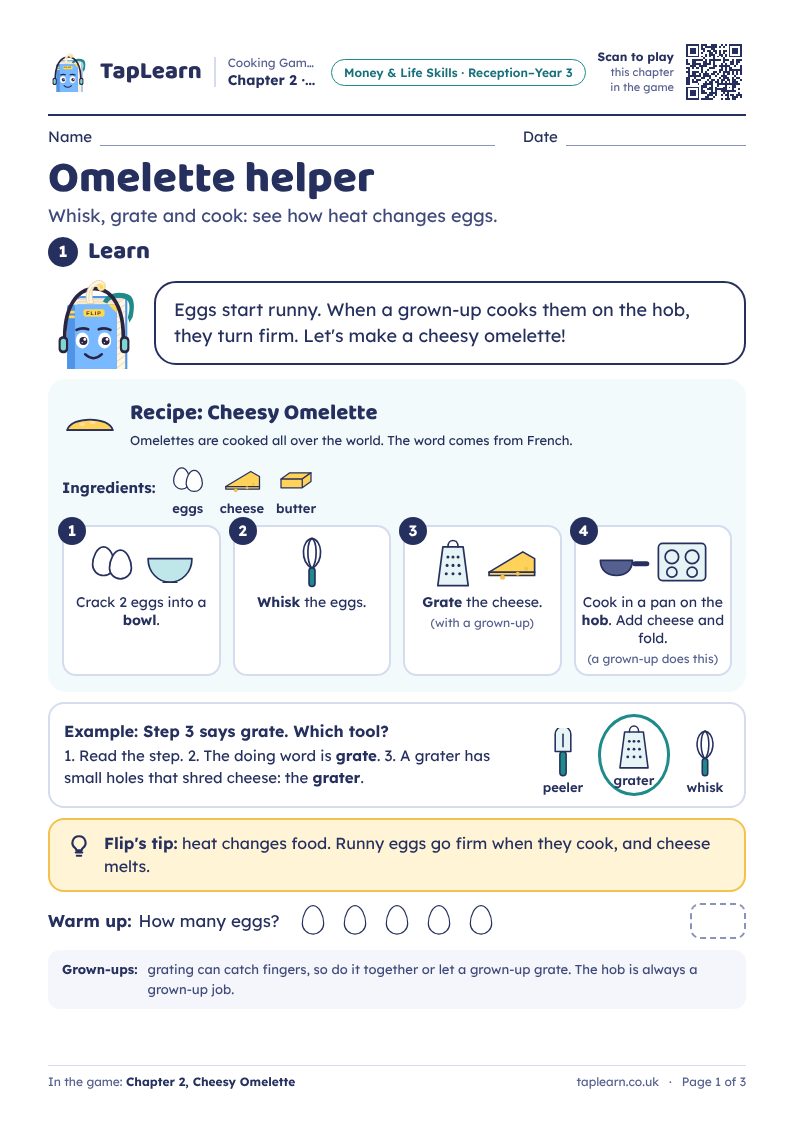
Omelette helper is a printable how heat changes food worksheet for Reception to Year 3 (ages 4 to 8) that helps children see how heat changes food, from runny egg to firm omelette, while following a simple recipe. Children follow a four-step picture recipe, try a hands-on kitchen activity with a grown-up, and practise by ringing, matching, ordering and drawing.
Free to print, no account needed.
Print it on A4, in colour or black and white. Do it after the chapter, or before it to see what your child already knows.
What's on the worksheet
Children follow an omelette recipe, choose a whisk and a grater, put the eggs in the right bowl and match foods to how they look after cooking. Includes a whisking bubbles test and an answers sheet.
- Page 1 · Learn
- A picture recipe shows the omelette steps, a worked example picks the grater for 'grate', and Flip explains how runny eggs go firm when they cook.
- Page 2 · Try it together
- Whisk it!: Add one drop of washing-up liquid to the bowl of water. Which tool made the most bubbles? Write it in the table.
- Page 2–3 · Practise
- Five short sets: ring the right tool, ring the right container, match foods before and after cooking, ring the machine, draw. Then a Challenge and an I can list.
- Answers sheet
- Every answer by page, what to watch out for (picking a tool that doesn't fit the job, like a whisk to chop; putting food in a different bowl or pan from the one the recipe asks for), and quick ideas to try without paper.
3 A4 pages and an answers sheet · about 25 minutes
In the classroom
- Run the bubbles test in small groups, comparing a spoon, a fork and a whisk, then share which made the most bubbles.
Questions from the worksheet
- Ring the right tool for each job: to whisk the eggs; to grate the cheese.
- Where do you crack the eggs? Ring it.
- Draw a line from each food to how it looks after it is cooked.
- Mia says, "I'll put the eggs in the toaster and the cheese in a glass." What should she do instead?
The answers are on the answers sheet, for grown-ups.
Using it at home
- Watch eggs cook together at breakfast and ask your child to describe the change from runny to firm.
- Let your child do all the whisking in the bubbles test: it takes about 10 minutes and needs only water, a drop of washing-up liquid and three tools.
Watch out for
- Picking a tool that doesn't fit the job, like a whisk to chop.
- Act out the job together: "Can a whisk cut? What does a whisk do?" Then try the right tool.
- Putting food in a different bowl or pan from the one the recipe asks for.
- Read the step again and listen for the container word: "in a bowl" or "in a pan"?
- Thinking cooked food can change back.
- Ask: "Can a cooked omelette turn back into runny egg?" Heat changes food for good.
Questions and answers
How does heat change food?
Heat changes food for good: runny egg turns firm, cheese melts and bread turns into crunchy toast. Most cooked food can't change back.
Why do we whisk eggs for an omelette?
Whisking mixes the yolk and white together and adds air, which makes an omelette lighter and fluffier.
More worksheets from Cooking Game for Kids: Make Recipes from Around the World
- Chapter 1: Kitchen utensils worksheet: Pancake helper Free
- Chapter 3: Kitchen appliances worksheet: Smoothie maker Free
- Chapter 4: Cooking tools worksheet: Pasta chef Free
- Chapter 5: No-cook recipe worksheet: Mash it up Free
- Chapter 6: Raw and cooked food worksheet: Fried rice helper Free
- Chapter 7: Sequencing recipe steps worksheet: Curry cook Free
- Chapter 8: Following a picture recipe worksheet: Toast and jam Free
- Chapter 9: Pizza recipe worksheet: Pizza maker Free
- Chapter 10: Salad recipe worksheet: Salad bowl Free
- Chapter 11: Blending food worksheet: Hummus maker Free
- Chapter 12: Mashed potatoes worksheet: Mash it smooth Free
- Chapter 13: Rice balls worksheet: Rice ball maker Free
 TapLearn