Comparing two-digit numbers worksheet for Year 2: Tens first
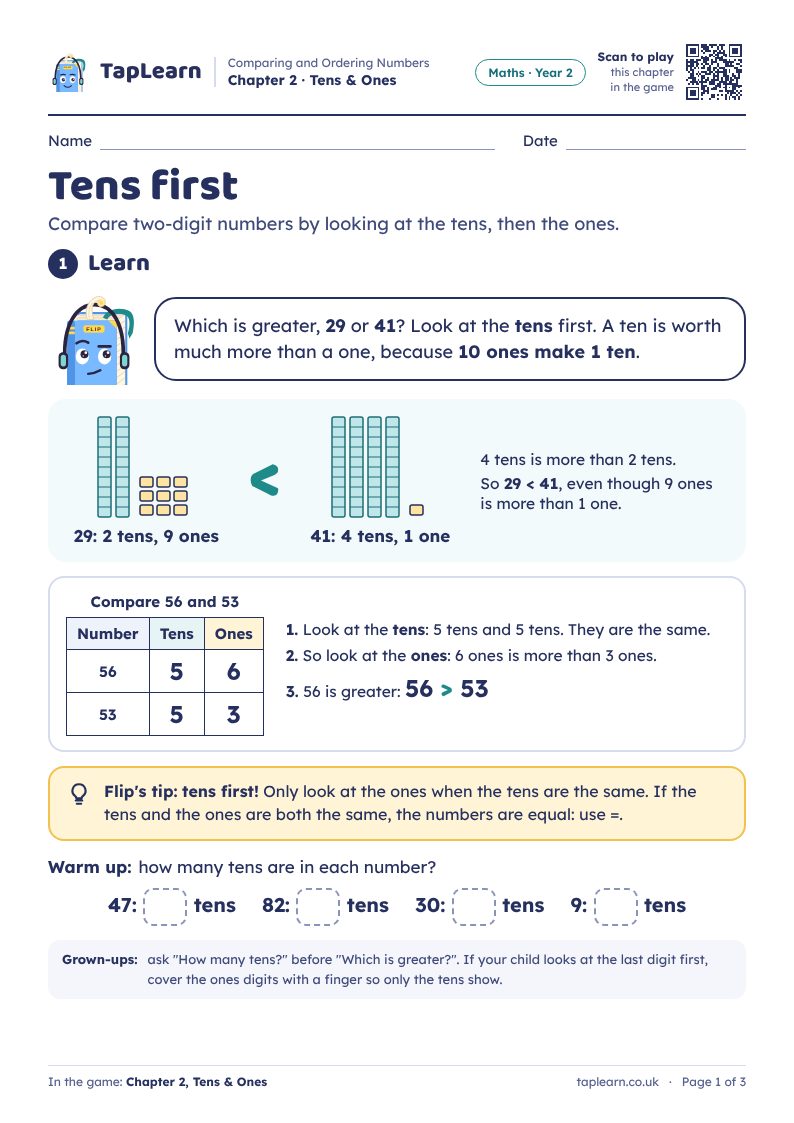
Tens First is a printable comparing two-digit numbers worksheet for Year 2 (ages 6 to 7) that teaches children to compare numbers by looking at the tens first and only checking the ones when the tens are the same. It covers the Year 2 maths statement to compare and order numbers from 0 up to 100 and use <, > and = signs.
This worksheet is for members
Membership opens every chapter of every game and every worksheet, for all your children.
See the plansAlready a member? Log in to print it.
Start with the free one: Greater than, less than (chapter 1).
Print it on A4, in colour or black and white. Do it after the chapter, or before it to see what your child already knows.
What's on the worksheet
Your child compares two-digit numbers by looking at the tens first, then the ones if the tens are the same, and writes the answer with <, > or =. Includes a greatest-number-wins digit card game and an answers sheet.
- Page 1 · Learn
- Tens sticks and ones show why 29 < 41, a tens and ones table comparing 56 and 53, Flip's tens-first tip, and a how-many-tens warm-up.
- Page 2 · Try it together
- Greatest number wins: each pick two digit cards, make the greatest number you can, compare tens first and write the sign. Then compare sticks and blocks.
- Page 3 · Practise
- Fill tens and ones tables, write <, > or = with tricky pairs like 60 and 59, write digits to make sentences true, work with 12 ones, and a challenge about 29 and 41.
- Answers sheet
- Every answer, the ones-before-tens mix-up, numbers with 0 and 100, and coin tens and swap-the-digits games.
3 A4 pages and an answers sheet · about 25 minutes
In the classroom
- Play greatest number wins in pairs, then share which rounds needed the ones digit to decide.
- Use Practise C as a quick-fire check with children writing the sign on mini-whiteboards.
Questions from the worksheet
- Write <, > or = in each box. Tens first! 29 and 41, 60 and 59, 18 and 81
- Write a digit in each box to make it true. Can you find more than one? 3__ > 35
- 10 ones make 1 ten. Write the number, then the sign: 3 tens and 12 ones ___ 41
- Mia says, "29 is greater than 41, because 9 is bigger than 1." Is she right? Tell her what to look at first.
The answers are on the answers sheet, for grown-ups.
National curriculum in England
This worksheet practises this statement from the Year 2 maths programme of study:
- Compare and order numbers from 0 up to 100; use <, > and = signs
Source: National curriculum in England: mathematics programmes of study (DfE)
Using it at home
- Ask "How many tens?" before "Which is greater?". If your child looks at the last digit first, cover the ones with a finger.
- In greatest number wins, ask "Why is 73 greater than 37?", then play a round trying to make the smallest number.
- Make two amounts with 10p and 1p coins, such as 34p and 43p, and count the 10p coins first.
Watch out for
- Looking at the ones before the tens, so thinking 29 is bigger than 41.
- Cover the ones digits and ask "How many tens?" first.
- Getting stuck on numbers with 0, like 60 and 59.
- 60 has 6 tens and 59 has 5, so 60 is greater. 100 is 10 tens, greater than any two-digit number.
Questions and answers
How do you compare two-digit numbers?
Look at the tens first: more tens means a greater number. Only look at the ones when the tens are the same.
Why is 29 less than 41?
29 has 2 tens and 41 has 4 tens, so 41 is greater even though 9 ones is more than 1 one.
Why is a ten worth more than a one?
10 ones make 1 ten, so each ten is worth ten times as much as a one.
 TapLearn