Greater than and less than worksheet for Year 2: Greater than, less than
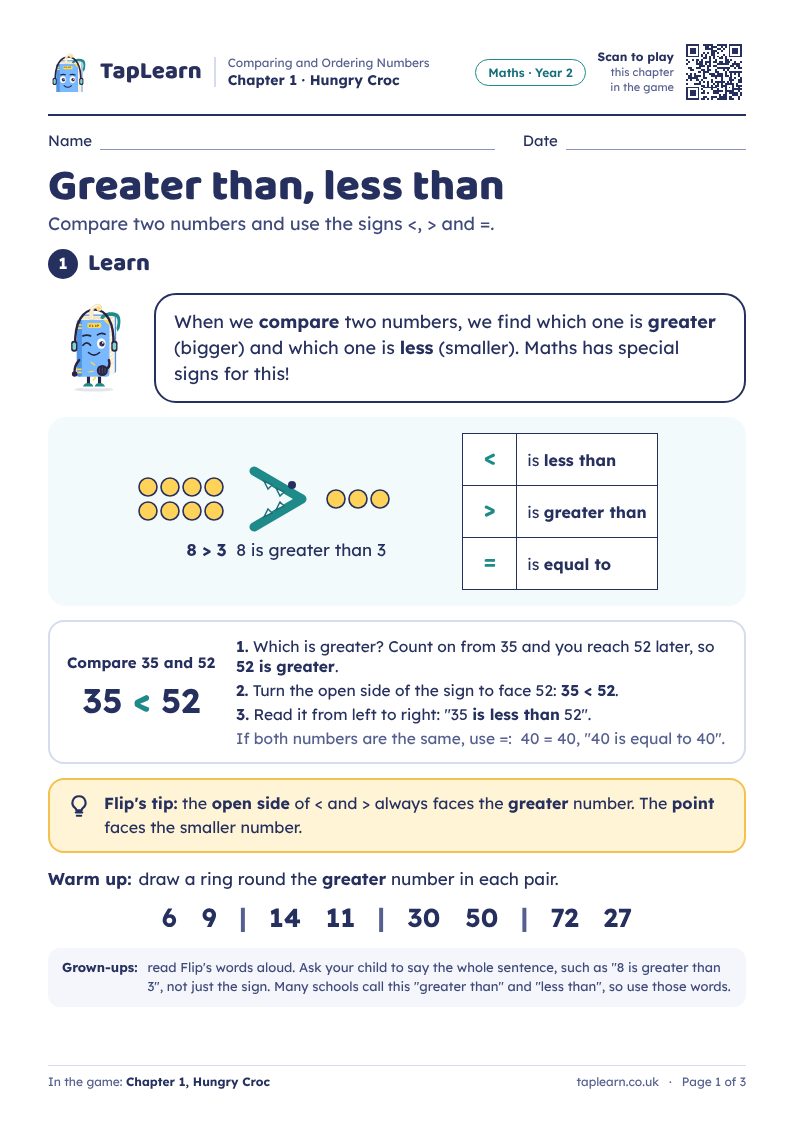
Greater Than, Less Than is a printable greater than and less than worksheet for Year 2 (ages 6 to 7) that teaches children to say which number is greater and to use the <, > and = signs with the open side facing the greater number. It covers the Year 2 maths statement to compare and order numbers from 0 up to 100 and use <, > and = signs.
Free to print, no account needed.
▶ Play chapter 1 in the game · How the greater than and less than works
Print it on A4, in colour or black and white. Do it after the chapter, or before it to see what your child already knows.
What's on the worksheet
Your child says which of two numbers is greater or less and uses the <, > and = signs to compare numbers up to 100. Includes a handful face-off with pasta and two pencils, and an answers sheet.
- Page 1 · Learn
- What <, > and = mean, a worked example comparing 35 and 52, Flip's tip that the open side faces the greater number, and a ring-the-greater warm-up.
- Page 2 · Try it together
- Handful face-off: each take a handful of pasta, count it, then lay two pencils between the piles as a sign and read it aloud. Then count counters and write the sign.
- Page 3 · Practise
- Write <, > or = between pairs like 45 and 54, ring the greatest and underline the smallest in sets, turn words into signs, and a challenge about 15 > 51.
- Answers sheet
- Every answer, mix-ups like using = for nearly the same, and arm signs and door number games.
3 A4 pages and an answers sheet · about 25 minutes
In the classroom
- Play arm signs as a starter: say two numbers and children make < or > with their arms, open side towards the greater.
- Use Practise B as a mini-whiteboard check, asking children to read each sentence aloud.
Questions from the worksheet
- Write <, > or = in each box: 45 and 54, 70 and 17, 9 and 19.
- In each set, draw a ring round the greatest number. Draw a line under the smallest: 51, 50, 88, 80, 8
- Fill the gap: 25 > 12. 25 is ___ than 12.
- Leo writes 15 > 51. He says, "15 comes first, so it's the greater number." Is he right? Write the correct number sentence.
The answers are on the answers sheet, for grown-ups.
National curriculum in England
This worksheet practises this statement from the Year 2 maths programme of study:
- Compare and order numbers from 0 up to 100; use <, > and = signs
Source: National curriculum in England: mathematics programmes of study (DfE)
Using it at home
- Ask your child to say the whole sentence, such as "8 is greater than 3", not just the sign.
- In the face-off, swap the piles round and show the sign turns too: 23 > 17 becomes 17 < 23. Both are true.
- For round 3, take a pinch out of one pile to make the numbers equal and use the = sign.
Watch out for
- Mixing up < and >.
- Ask "Which number is greater?" first, then turn the open side towards it. Reading the sentence aloud is a good check.
- Using = for "nearly the same", such as 83 = 88.
- Equal means exactly the same amount.
- Thinking 9 is greater than 19 because 9 is a big digit.
- Ask "Which comes later when we count?"
Questions and answers
What do the greater than and less than signs mean?
The > sign means "is greater than" and the < sign means "is less than". The open side always faces the greater number.
When do you use the equals sign to compare numbers?
Use = only when both numbers are exactly the same, such as 40 = 40.
How do you read 35 < 52?
Read it from left to right: "35 is less than 52".
 TapLearn