Ordering numbers worksheet for Year 2: Putting numbers in order
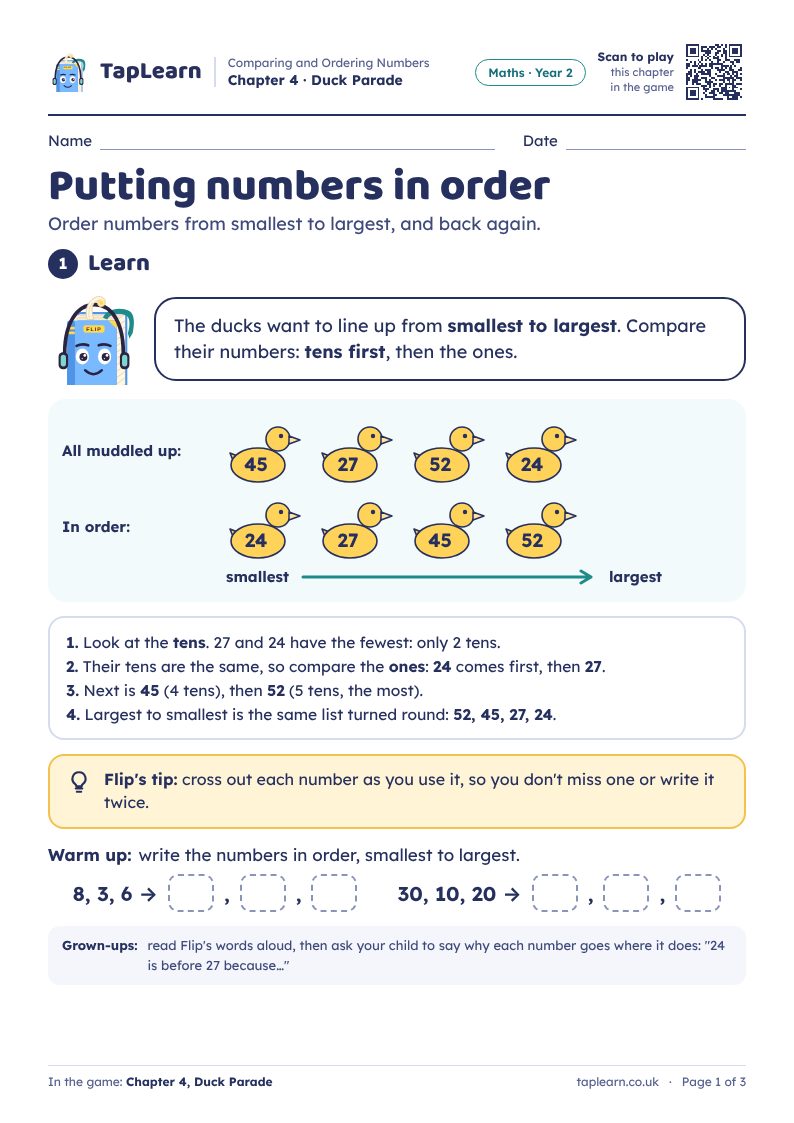
Putting Numbers in Order is a printable ordering numbers worksheet for Year 2 (ages 6 to 7) that teaches children to order numbers up to 100 from smallest to largest and largest to smallest by comparing the tens first. It covers the Year 2 maths statement to compare and order numbers from 0 up to 100 and use <, > and = signs.
This worksheet is for members
Membership opens every chapter of every game and every worksheet, for all your children.
See the plansAlready a member? Log in to print it.
Start with the free one: Greater than, less than (chapter 1).
Print it on A4, in colour or black and white. Do it after the chapter, or before it to see what your child already knows.
What's on the worksheet
Your child puts sets of numbers up to 100 in order from smallest to largest and back again, comparing the tens and then the ones. Includes a number line-up with toys and an answers sheet.
- Page 1 · Learn
- Ducks with muddled numbers are put in order step by step, tens first and then ones, with a tip on crossing out each number as you use it, and a warm-up.
- Page 2 · Try it together
- Number line-up: line up five numbers on scraps by toys, smallest on the left, read the order aloud, turn it round, then find where a new number fits. Then order the ducks' numbers.
- Page 3 · Practise
- Order numbers largest to smallest, ring the duck in the wrong place, fill gaps to keep lists in order, and a challenge about ordering by the last digit.
- Answers sheet
- Every answer, mix-ups like forgetting one-digit numbers have 0 tens, and family line-up and where-do-I-fit games.
3 A4 pages and an answers sheet · about 25 minutes
Using it at home
- Ask your child to say why each number goes where it does: "24 is before 27 because…"
- In the line-up, include a one-digit number like 9 and two numbers with the same tens, like 63 and 68.
- Line the family up by age, or order the house numbers on your street.
Watch out for
- Ordering by the ones digit.
- Ask "How many tens?" for each number before deciding.
- Putting one-digit numbers, like 7 or 9, in the wrong place.
- They have 0 tens, so they come before every two-digit number.
- Missing or repeating a number.
- Cross each one out as it is used, then count the list.
Questions from the worksheet
- Write the ducks' numbers in order, smallest to largest: 71, 17, 70, 7
- Now write the numbers in order, largest to smallest: 92, 29, 100, 9
- These ducks should be smallest to largest, but one duck is in the wrong place. Draw a ring round it: 12, 18, 45, 27, 33, 50
- Leo put these in order, smallest to largest: 30, 21, 8, 19. He says, "I looked at the last digits." Is he right? Write the correct order.
The answers are on the answers sheet, for grown-ups.
National curriculum in England
This worksheet practises this statement from the Year 2 maths programme of study:
- Compare and order numbers from 0 up to 100; use <, > and = signs
Source: National curriculum in England: mathematics programmes of study (DfE)
In the classroom
- Give five children number cards and ask the class to direct them into order at the front, then reverse it.
- Use Practise C as a starter: show a list with one number out of place and ask children to spot it.
Questions and answers
How do you order numbers from smallest to largest?
Compare the tens first and put the number with the fewest tens first. If two numbers have the same tens, compare the ones.
Where do one-digit numbers go when ordering?
One-digit numbers have 0 tens, so they come before all two-digit numbers when ordering smallest to largest.
How do you order from largest to smallest?
Order smallest to largest first, then turn the list round so the largest number comes first.
 TapLearn