Numbers on a number line worksheet for Year 2: Number line hops
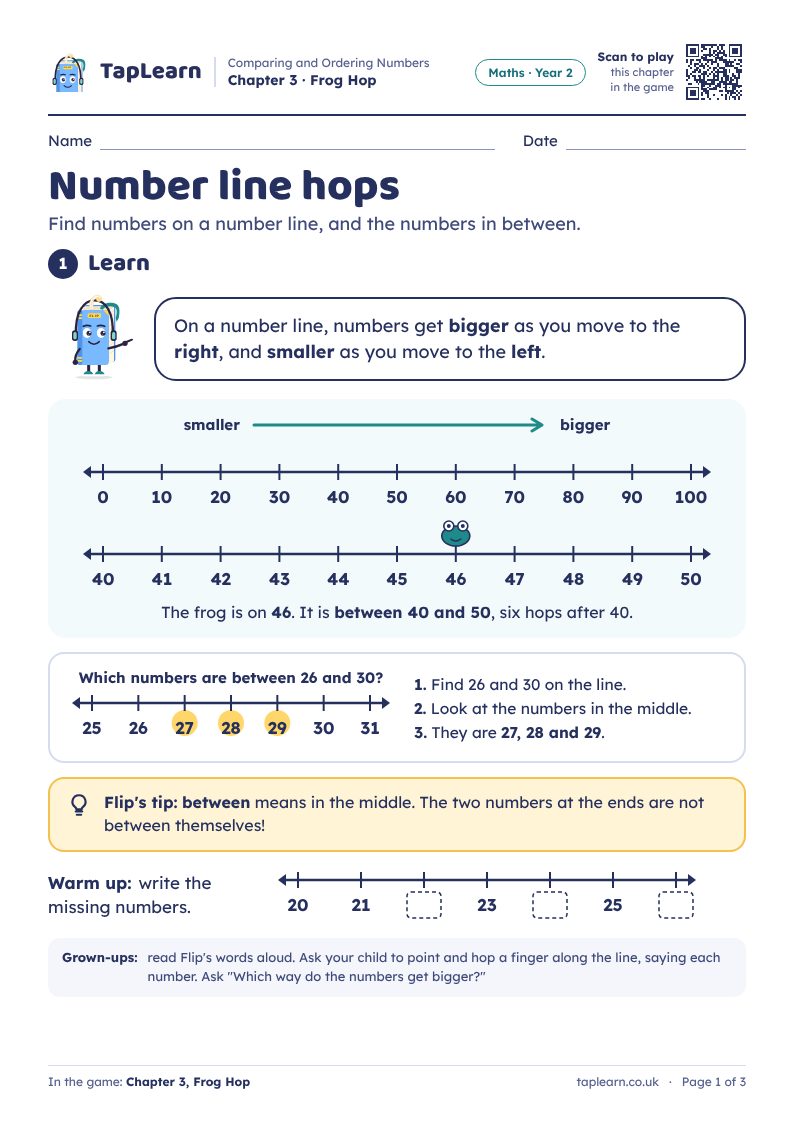
Number Line Hops is a printable numbers on a number line worksheet for Year 2 (ages 6 to 7) that teaches children that numbers get bigger to the right and how to find numbers that come between two others. It covers the Year 2 maths statement to compare and order numbers from 0 up to 100 and use <, > and = signs.
This worksheet is for members
Membership opens every chapter of every game and every worksheet, for all your children.
See the plansAlready a member? Log in to print it.
Start with the free one: Greater than, less than (chapter 1).
Print it on A4, in colour or black and white. Do it after the chapter, or before it to see what your child already knows.
What's on the worksheet
Your child finds numbers on a number line to 100, fills in missing numbers and says which numbers come between two others. Includes a floor number line to make together and an answers sheet.
- Page 1 · Learn
- Number lines in tens and ones show the frog on 46, with a worked example finding the numbers between 26 and 30 and a missing-numbers warm-up.
- Page 2 · Try it together
- Floor number line: lay out 0 to 100 in tens on scraps of paper, hop a toy frog to called-out numbers and say which ten each is nearer to. Then fill in missing numbers.
- Page 3 · Practise
- Draw arrows to place numbers, read where the frog is, find numbers between pairs like 45 and 49, and a challenge about the numbers between 40 and 44.
- Answers sheet
- Every answer, mix-ups like counting the end numbers as between or crossing a ten, and mystery number and stair hop games.
3 A4 pages and an answers sheet · about 25 minutes
In the classroom
- Make a floor number line in the hall and have children stand where called-out numbers belong.
- Use mystery number as a plenary, with the class asking yes or no questions to find it.
Questions from the worksheet
- Write the missing numbers on the number line: 86, 87, ___, 89, ___, 91, 92, ___, 94
- Numbers in between: between 68 and 72.
- Between 80 and 90, nearer 90.
- Sam says, "The numbers between 40 and 44 are 40, 41, 42, 43 and 44." Is he right? Which numbers are really between 40 and 44?
The answers are on the answers sheet, for grown-ups.
National curriculum in England
This worksheet practises this statement from the Year 2 maths programme of study:
- Compare and order numbers from 0 up to 100; use <, > and = signs
Source: National curriculum in England: mathematics programmes of study (DfE)
Using it at home
- Ask your child to hop a finger along the line saying each number, then ask "Which way do the numbers get bigger?"
- On the floor number line, try 45 (exactly halfway), then 38 (nearer 40) and 71 (nearer 70).
- Play mystery number: "I'm thinking of a number between 30 and 40. It's nearer to 40."
Watch out for
- Counting the end numbers as "between".
- Point to each end and say "We start here and stop here. Which numbers are in the middle?"
- Crossing a ten wrongly, such as writing 80 or 810 after 89.
- Say the numbers aloud together: 89, 90, 91.
- Counting each mark as 1 on a line marked in tens.
- On a line in tens, the mark after 50 is 60, not 51.
Questions and answers
Which way do numbers get bigger on a number line?
Numbers get bigger as you move to the right and smaller as you move to the left.
What does 'between' mean on a number line?
Between means in the middle. The numbers between 26 and 30 are 27, 28 and 29; the end numbers don't count.
How do you find where a number goes on a number line to 100?
Find the two tens it sits between, then count on the ones. 46 is between 40 and 50, six hops after 40.
 TapLearn