Commas worksheet for Year 2: Meet the comma
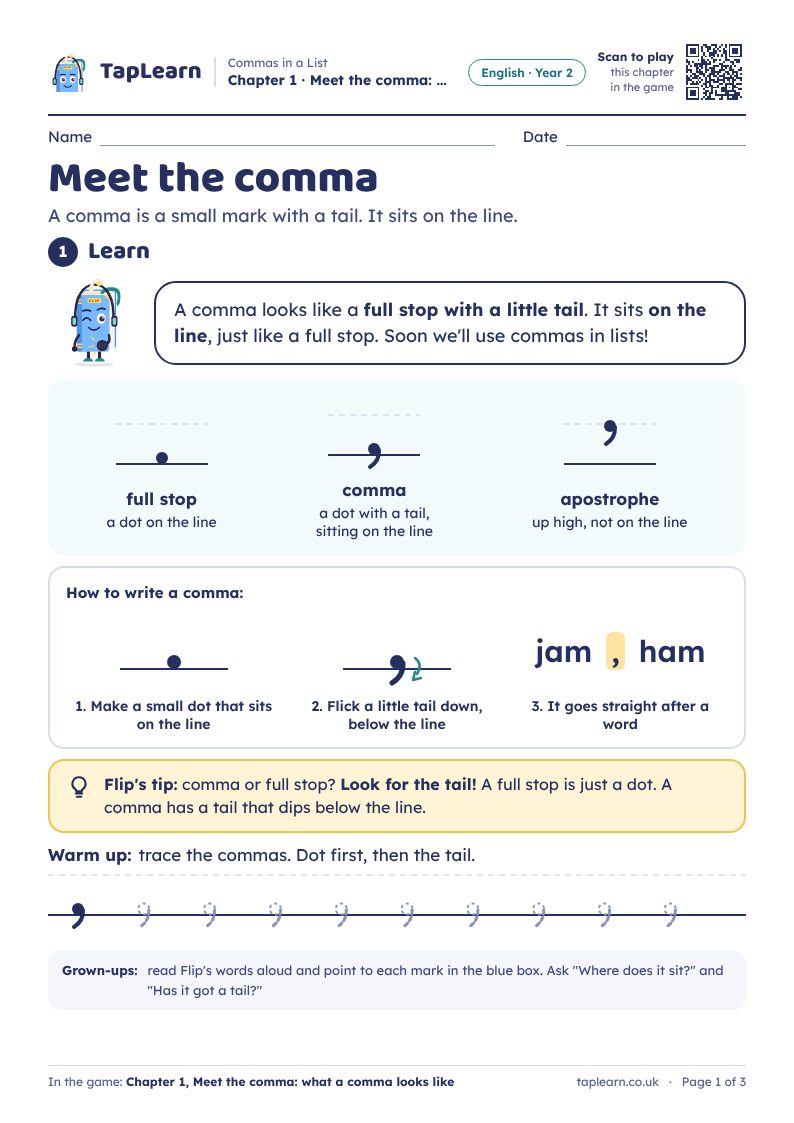
Meet the Comma is a printable commas worksheet for Year 2 (ages 6 to 7) that teaches children what a comma looks like (a dot with a tail, sitting on the line) and how it differs from a full stop and an apostrophe. It covers the Year 2 statement on learning to use familiar and new punctuation correctly, including commas for lists.
Free to print, no account needed.
Print it on A4, in colour or black and white. Do it after the chapter, or before it to see what your child already knows.
What's on the worksheet
Your child spots a comma, tells it apart from a full stop and an apostrophe, and writes it on the line with a little tail. Includes a comma hunt in a book or on a food box and an answers sheet.
- Page 1 · Learn
- A comma, a full stop and an apostrophe side by side, three steps to write a comma, Flip's look-for-the-tail tip, and a trace-the-commas warm-up.
- Page 2 · Try it together
- Comma hunt: pick a page of a book or the back of a food box, hunt for small marks on the line, tally commas and full stops, and copy some words with a comma.
- Page 3 · Practise
- Tick the commas, tick the comma in the right place, ring every comma in three sentences and count them, trace and write commas, and a challenge about Leo's wobble.
- Answers sheet
- Every answer, mix-ups like commas floating up high, and air-commas and comma-or-full-stop ideas.
3 A4 pages and an answers sheet · about 15 minutes
Using it at home
- Point to each mark in the box on page 1 and ask, "Where does it sit?" and "Has it got a tail?"
- In the comma hunt, stories use commas in other ways too. Today your child is just spotting the shape.
- Draw a comma in the air, then on your child's palm with a finger: dot first, then the tail.
Watch out for
- Mixing up commas and full stops.
- Ask, "Has it got a tail?" A full stop has none.
- Writing commas up high, like an apostrophe.
- Point to the line: "A comma sits down here, like a full stop."
- Writing very big commas.
- A comma is small: about the size of a full stop, plus a short tail.
Questions from the worksheet
- Draw a ring round every comma. Then write how many you found: I like apples, pears and plums. We saw ducks, swans, geese and a heron.
- Trace the commas. Then write your own commas on the line below.
- Leo says, "A comma is just a full stop with a wobble." Is he right? What makes a comma different from a full stop?
The answers are on the answers sheet, for grown-ups.
National curriculum in England
This worksheet practises this statement from the Year 2 english programme of study:
- Develop their understanding of the concepts set out in English appendix 2 by: learning how to use both familiar and new punctuation correctly, including full stops, capital letters, exclamation marks, question marks, commas for lists and apostrophes for contracted forms and the possessive (singular)
In the classroom
- Use comma or full stop? as a starter: show marks on the board and pupils call out which.
- Run the comma hunt in pairs with reading books.
Questions and answers
What does a comma look like?
A comma looks like a full stop with a little tail. It sits on the line, and the tail dips just below it.
What is the difference between a comma and a full stop?
A full stop is a dot that ends a sentence. A comma has a tail and goes in the middle of a sentence, for example between items in a list.
How do you write a comma?
Make a small dot on the line, flick a little tail down below the line, and put it straight after a word.
 TapLearn