Commas in a list worksheet for Year 2
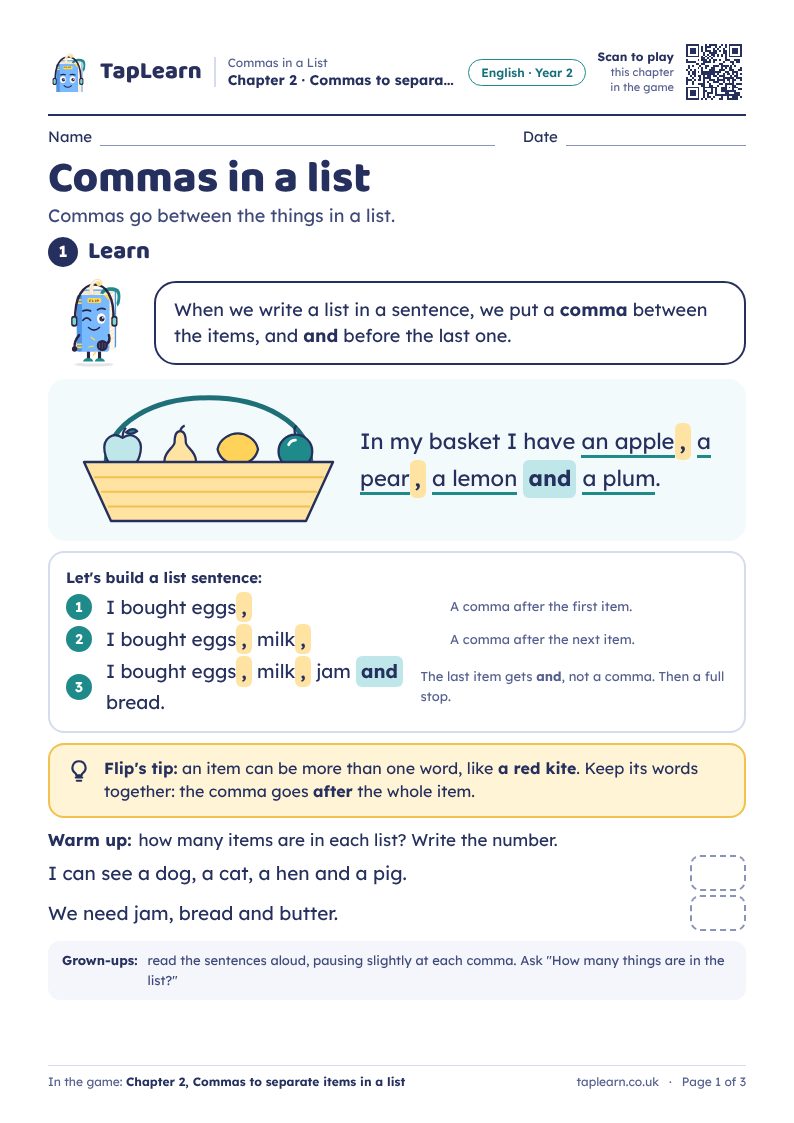
Commas in a List is a printable commas in a list worksheet for Year 2 (ages 6 to 7) that teaches children to put a comma between items, write and before the last one, and keep the words of one item, like a red kite, together. It covers the Year 2 statements on learning to use familiar and new punctuation correctly, including commas for lists and on commas to separate items in a list.
This worksheet is for members
Membership opens every chapter of every game and every worksheet, for all your children.
See the plansAlready a member? Log in to print it.
Start with the free one: Meet the comma (chapter 1).
Print it on A4, in colour or black and white. Do it after the chapter, or before it to see what your child already knows.
What's on the worksheet
Your child uses commas to separate the items in a list, with and before the last one, and keeps each item's words together. Includes a pack-a-bag activity and an answers sheet.
- Page 1 · Learn
- A list sentence about a basket, a list built step by step from eggs to bread, Flip's tip on items of more than one word, and a count-the-items warm-up.
- Page 2 · Try it together
- Pack a bag: put four or five things in a bag one at a time, say the list as one sentence, clap where each comma goes and say "and!" before the last item, then write it.
- Page 3 · Practise
- Write a comma in each box, finish a list sentence about a market stall, tick the sentence with commas in the right places, write a list of foods, and a challenge.
- Answers sheet
- Every answer, mix-ups like a comma in the middle of an item, and shopping-list and I-went-to-market ideas.
3 A4 pages and an answers sheet · about 20 minutes
Using it at home
- Read the sentences aloud, pausing slightly at each comma, and ask, "How many things are in the list?"
- In pack a bag, count the claps together: a list of 4 things has 2 commas and 1 "and".
- Say tonight's shopping list as one sentence and your child claps for each comma.
Watch out for
- Missing commas between items.
- Read it aloud and pause at each gap: "Where do we pause?"
- Putting a comma in the middle of an item, like "a, red kite".
- Ask, "What is the thing?" and keep its words together.
- Putting a comma at the end instead of a full stop.
- The last item is followed by a full stop, never a comma.
Questions from the worksheet
- Write a comma in each box: There is an apple ☐ a banana ☐ an egg and a fish. Sam bought bread ☐ cheese and grapes.
- Which sentence has its commas in the right places? Tick one: I have a, red kite, a ball and a bat. I have a red kite, a ball and a bat. I have a red kite a ball and a bat.
- Write your own list of three things you like to eat.
- Ava wrote: We need milk, eggs and jam, She put a comma at the very end. Is that right? What should go there instead?
The answers are on the answers sheet, for grown-ups.
National curriculum in England
This worksheet practises these statements from the Year 2 english programme of study:
- Develop their understanding of the concepts set out in English appendix 2 by: learning how to use both familiar and new punctuation correctly, including full stops, capital letters, exclamation marks, question marks, commas for lists and apostrophes for contracted forms and the possessive (singular)
- Punctuation: commas to separate items in a list
In the classroom
- Play I went to market round the class, building one long list sentence.
- Use Practise A as a mini-whiteboard comma check.
Questions and answers
How do you use commas in a list?
Put a comma between each item, then write and before the last item instead of a comma: "I have an apple, a pear, a lemon and a plum."
Does an item in a list need a comma inside it?
No. If an item has more than one word, like a red kite, keep its words together and put the comma after the whole item.
How many commas does a list need?
A list of 4 things has 2 commas and 1 and. There is always one comma fewer than the gaps, because and fills the last gap.
 TapLearn