List sentences worksheet for Year 2: Perfect list sentences
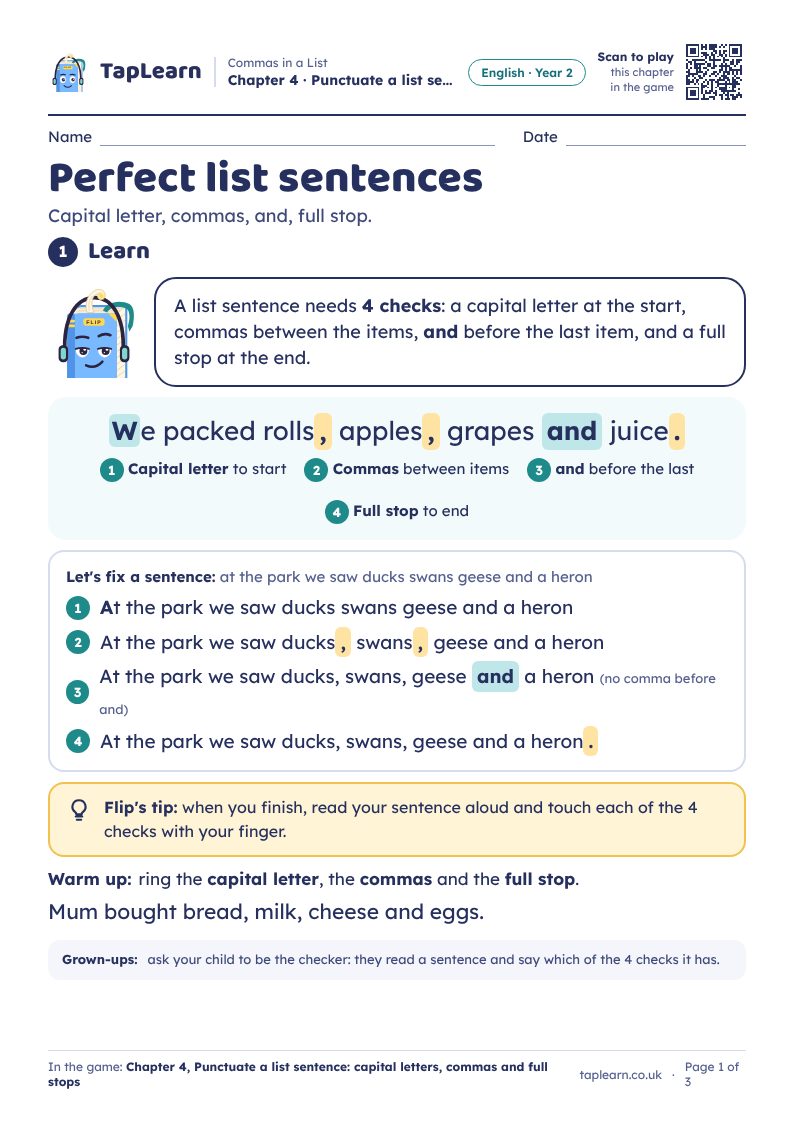
Perfect List Sentences is a printable list sentences worksheet for Year 2 (ages 6 to 7) that teaches children four checks for a list sentence: a capital letter, commas between items, and before the last item, and a full stop. It covers the Year 2 statements on learning to use familiar and new punctuation correctly, including commas for lists and on commas to separate items in a list.
This worksheet is for members
Membership opens every chapter of every game and every worksheet, for all your children.
See the plansAlready a member? Log in to print it.
Start with the free one: Meet the comma (chapter 1).
Print it on A4, in colour or black and white. Do it after the chapter, or before it to see what your child already knows.
What's on the worksheet
Your child punctuates a whole list sentence with four checks: a capital letter, commas between items, and before the last item, and a full stop. Includes a picnic packing list activity and an answers sheet.
- Page 1 · Learn
- A list sentence with its four checks labelled, a worked example fixing a sentence about ducks and swans step by step, Flip's touch-each-check tip, and a warm-up.
- Page 2 · Try it together
- Picnic packing list: choose four things for a pretend picnic, say the list as one sentence, write it, then swap and tick each other's four checks.
- Page 3 · Practise
- Tick what each sentence has forgotten, write two sentences correctly with all four checks, write a list sentence about a market stall, and a challenge about Mia's commas.
- Answers sheet
- Every answer, mix-ups like a comma instead of a full stop, and spoken-punctuation and real-lists ideas.
3 A4 pages and an answers sheet · about 20 minutes
Using it at home
- Ask your child to be the checker: they read a sentence and say which of the 4 checks it has.
- In the picnic activity, write your own sentence with one deliberate slip (like a missing full stop) for your child to find.
- Say a list sentence and do an action for each mark: stand tall for the capital, clap for commas, stamp for the full stop.
Watch out for
- No capital letter at the start.
- Ask, "How does every sentence begin?"
- No full stop at the end, or a comma instead.
- Ask, "Where does the sentence finish? What goes there?"
- Extra commas next to and.
- "And" does the last comma's job.
Questions from the worksheet
- What has each sentence forgotten? Tick capital letter, commas or full stop: we saw lions, bears and seals. Leo ate peas carrots and corn.
- Write each sentence correctly. Use all 4 checks: at the shop we got eggs flour and sugar.
- Write each sentence correctly. Use all 4 checks: the farm has cows pigs hens and ducks.
- Mia wrote: We need eggs, flour, and, milk. She says it's perfect. Can you find two commas she doesn't need?
The answers are on the answers sheet, for grown-ups.
National curriculum in England
This worksheet practises these statements from the Year 2 english programme of study:
- Develop their understanding of the concepts set out in English appendix 2 by: learning how to use both familiar and new punctuation correctly, including full stops, capital letters, exclamation marks, question marks, commas for lists and apostrophes for contracted forms and the possessive (singular)
- Punctuation: commas to separate items in a list
In the classroom
- Use Practise A as a whole-class checking task on the board.
- Have pairs write list sentences and swap to tick the four checks.
Questions and answers
What are the four checks for a list sentence?
A capital letter at the start, commas between the items, and before the last item, and a full stop at the end.
Does a list sentence end with a comma?
No. A list sentence ends with a full stop: "We need eggs, flour and milk."
How can children check their own list sentences?
Read the sentence aloud and touch each of the four checks with a finger: capital, commas, and, full stop.
 TapLearn